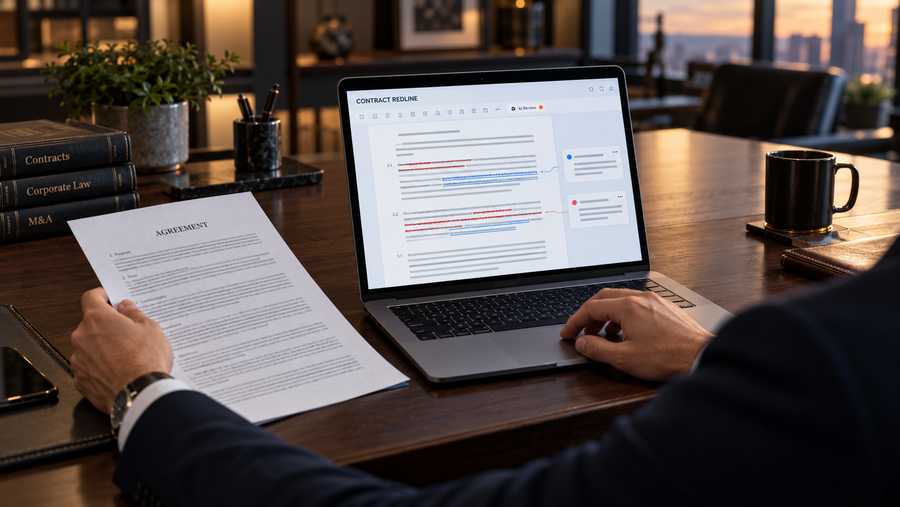
AI can help lawyers process information, review documents, prepare initial drafts, compare contract language, and manage recurring work more efficiently.
The value does not come from replacing professional judgment. It comes from reducing the mechanical work surrounding legal analysis so lawyers can spend more time evaluating risk, advising clients, negotiating material issues, and making decisions.
Used responsibly, AI can improve speed and consistency without lowering legal quality. That requires clear instructions, reliable source material, secure systems, defined review standards, and human verification.
Why Lawyers Are Using AI
Legal work combines high-value judgment with large amounts of document processing, information gathering, and repetitive analysis.
Lawyers may spend time:
• Collecting missing information from clients or business teams
• Reading lengthy contracts and case materials
• Searching for approved clauses and previous advice
• Comparing multiple document versions
• Extracting dates, obligations, and defined terms
• Preparing summaries and first drafts
• Answering recurring legal questions
• Tracking approvals and deadlines
• Reconstructing decisions from emails
These tasks are necessary, but they do not always require a lawyer to begin with a blank page.
AI can provide a structured first pass, allowing the lawyer to begin with organized information, identified issues, or a reviewable draft.
What Legal Tasks Can AI Support?
AI is most effective when the assignment is clearly defined and its output can be verified.
Common applications include:
• Summarizing documents
• Extracting obligations, dates, parties, and renewal terms
• Comparing contracts against approved playbooks
• Identifying missing or unusual clauses
• Preparing first-pass contract reviews
• Suggesting alternative contract language
• Comparing versions and summarizing changes
• Organizing legal research questions
• Creating initial matter chronologies
• Drafting routine client or internal communications
• Converting meeting notes into action items
• Classifying and routing incoming legal requests
AI is less dependable when the correct answer depends on undocumented commercial preferences, incomplete facts, unusual governing law, novel legal questions, or strategic concessions.
The lawyer should determine what the AI may prepare, what it may recommend, and what it must escalate.
Start With a Clearly Defined Assignment
A general instruction such as "review this contract" gives AI little information about the relevant party, transaction, risk tolerance, or expected result.
A stronger assignment identifies:
• The task to perform
• The party being represented
• The relevant business context
• The type of agreement
• The applicable jurisdiction, when relevant
• The standard or playbook to apply
• The required output format
• The issues requiring escalation
• The decisions AI must not make
For example:
"Review this SaaS agreement from the customer's perspective. Compare it with the attached contract playbook. Identify provisions outside approved positions, propose the preferred language where available, and flag issues requiring legal approval. Do not make a final risk-acceptance decision."
Clear instructions reduce irrelevant output and make the result easier to review.
Give AI Reliable Legal Context
AI cannot apply information it has not received.
Depending on the task, useful context may include:
• Approved templates
• Contract playbooks
• Clause libraries
• Previous negotiated agreements
• Internal policies
• Client instructions
• Term sheets
• Business requirements
• Relevant schedules or exhibits
• Trusted legal authorities
Current and approved materials are essential. Connecting AI to outdated templates or obsolete guidance can make errors happen more quickly and consistently.
The source of each document should be identifiable, and teams should establish who is responsible for keeping it current.
Use AI for the First Pass
AI can be valuable at the beginning of a document-heavy workflow.
For contract review, an AI-assisted first pass might:
• Identify the parties and agreement type
• Summarize the commercial structure
• Extract important dates and obligations
• Locate missing provisions
• Compare language with an approved playbook
• Flag unusual or one-sided clauses
• Suggest approved fallback language
• Identify defined-term and cross-reference problems
• Create an initial issue list
This allows the lawyer to move more quickly from locating potential issues to evaluating them.
Alloomi AI can support document-heavy legal workflows by helping professionals organize context, analyze language, identify potential issues, and apply established working methods more consistently.
For more specific workflows, see How to Review a Contract and How to Redline a Contract With AI.
Preserve Human Judgment
AI may identify language that differs from a standard position, but it cannot independently determine whether accepting that language is the correct business decision.
A clause may be acceptable or unacceptable depending on:
• The value of the transaction
• The relationship between the parties
• Bargaining power
• The type of product or service
• The likelihood and severity of loss
• Insurance coverage
• Industry practice
• Governing law
• The client's objectives
• The concessions made elsewhere
The lawyer must decide whether to accept, revise, reject, or escalate a provision.
AI can make the decision easier to evaluate, but it should not silently make the decision on the lawyer's behalf.
Verify AI-Generated Work
AI output should be treated as reviewable work product rather than established authority.
Lawyers should verify:
• Statements of law
• Cases, citations, and quotations
• Factual assertions
• Dates and calculations
• Defined terms and cross-references
• Contract language
• Jurisdictional assumptions
• Conclusions based on incomplete context
• Compliance with client instructions
• Confidentiality and privilege requirements
A polished response may still contain an incorrect legal proposition, invented citation, omitted exception, or clause that conflicts with another section of the document.
The American Bar Association's Formal Opinion 512 addresses lawyers' obligations concerning competence, confidentiality, communication, supervision, candor, and fees when using generative AI.
The use of AI does not transfer professional responsibility away from the lawyer.
Protect Confidential and Privileged Information
Speed does not justify exposing client information through an inappropriate system.
Before using AI for legal work, determine:
• Whether the tool is approved by the firm or organization
• Whether prompts and uploaded documents are retained
• Whether submitted information is used for model training
• Which providers and subprocessors receive the data
• Whether encryption and access controls are appropriate
• Whether retention and deletion settings are available
• Whether the system creates useful audit records
• Whether client consent or disclosure may be required
• Whether the intended use complies with professional obligations
Sensitive information should not be entered into an unapproved consumer AI tool simply because it is accessible.
According to the ABA's 2026 discussion of AI in modern legal practice, lawyers remain responsible for understanding how AI systems handle data, maintaining independent judgment, and ensuring accuracy through human oversight.
Standardize Recurring Decisions
AI becomes more useful when the organization has already defined how recurring issues should be handled.
Relevant resources may include:
• Approved contract templates
• Clause libraries
• Contract review playbooks
• Negotiation fallback positions
• Approval matrices
• Issue checklists
• Standard client communications
• Self-service business guidance
• Escalation rules
A contract playbook might identify the preferred position, acceptable alternatives, prohibited language, and required approver for each material clause.
This gives AI a defined standard to apply and gives the human reviewer a transparent basis for checking the output.
Standardization does not mean every matter receives the same answer. It establishes the normal position and makes meaningful exceptions easier to identify.
Combine AI With Better Legal Intake
AI cannot compensate for missing instructions.
A structured intake process should collect the information required to understand and prioritize the matter:
• The requesting person and business owner
• The desired outcome
• The relevant parties
• The type of agreement or legal issue
• The transaction value
• The requested completion date
• The reason for the deadline
• Supporting documents
• Known risks or unusual terms
• Previous advice or approved precedent
Better intake reduces follow-up emails and prevents lawyers or AI systems from analyzing an incomplete record.
The process should remain proportionate. Routine work should not require the same intake procedure as a high-risk or unusual matter.
Delegate Mechanical Work, Not Accountability
Legal work can be divided between tasks requiring professional judgment and tasks that follow a repeatable process.
AI may assist with:
• Organizing documents
• Extracting information
• Comparing versions
• Formatting initial drafts
• Locating standard language
• Preparing summaries
• Tracking routine issues
• Creating preliminary checklists
Lawyers should retain control over:
• Legal conclusions
• Strategic advice
• Material risk decisions
• Negotiation positions
• Client recommendations
• Final work product
The same principle applies when work is delegated to an associate, paralegal, legal operations professional, or external provider: the assignment requires context, standards, escalation rules, and review.
Build AI Into the Workflow
Isolated use of AI may save time on an individual task, but greater value comes from connecting it to a controlled process.
A contract workflow might include:
• Structured intake
• Document classification
• Assignment according to agreement type and risk
• AI-assisted first-pass review
• Comparison against an approved playbook
• Escalation of non-standard provisions
• Human legal and commercial approval
• Controlled redlining
• Final clean-copy review
• Signature and storage
Each stage should have a defined owner and outcome.
The team should also be able to determine which version was reviewed, which standards were applied, what issues were escalated, and who approved the final position.
Measure Quality Alongside Speed
AI productivity should not be measured only by how quickly it produces an answer.
Useful measures include:
• Turnaround time
• Accuracy of extracted information
• Percentage of material issues identified
• Number of unnecessary flags
• Time required to verify the output
• Consistency with approved playbooks
• Number of review rounds
• Frequency of rework after approval
• Client or business-team satisfaction
• Time reclaimed for strategic work
The Thomson Reuters Future of Professionals Report 2026 found that professionals working under a clear AI strategy reported better outcomes than those using AI without one. It also reported that 34% of professionals used AI tools their organizations had not approved, highlighting the need to develop productivity and governance together.
The relevant question is not simply, "Did AI produce this faster?" It is, "Did AI help produce a reliable result with less unnecessary effort?"
Common Mistakes When Lawyers Use AI
Using AI Without a Defined Purpose
Experimentation can help teams understand a tool, but production workflows require a defined task, expected output, and reviewer.
Providing Incomplete Context
AI may fill information gaps with assumptions. Supply the relevant facts, documents, and standards instead of expecting the system to infer them.
Trusting Fluent Output
Confident wording does not establish accuracy. Verify legal authorities, facts, citations, calculations, and contractual effects.
Uploading Sensitive Information to an Unapproved Tool
Review the tool's data handling, retention, security, and training practices before using it for client information.
Automating an Unclear Process
Technology cannot fix outdated templates, inconsistent positions, incomplete intake, or unclear approval authority.
Accepting Every Suggested Change
More output is not necessarily better output. A contract containing unnecessary edits may take longer to negotiate and make material issues harder to identify.
Removing Humans From High-Risk Decisions
AI may organize and analyze information, but consequential legal and commercial decisions require accountable human judgment.
Frequently Asked Questions
How Do Lawyers Use AI to Work Faster?
Lawyers use AI to summarize documents, extract information, compare versions, identify contract issues, prepare initial drafts, organize research, and support recurring legal workflows.
Can Lawyers Rely on AI-Generated Legal Work?
AI-generated material should be reviewed and verified before it is relied on or shared. Lawyers remain responsible for legal authorities, facts, citations, advice, and final work product.
Which Legal Tasks Should Not Be Fully Automated?
Legal conclusions, strategic advice, material risk acceptance, negotiation decisions, client recommendations, and final approval should remain under qualified human control.
Can AI Review Contracts?
AI can provide a first-pass contract review, compare language with a playbook, identify unusual provisions, and suggest alternatives. A qualified reviewer should verify the findings and make final decisions.
Does Using AI Reduce Legal Quality?
AI does not inherently reduce quality. Quality depends on the task, instructions, source material, tool, security controls, review process, and human oversight.
How Does Alloomi Help Lawyers?
Alloomi AI helps professionals apply established expertise and working methods across document-heavy workflows. It can support context organization, document analysis, issue identification, and consistent execution while lawyers retain control of consequential decisions.