To draft a contract, define the transaction, identify the parties, translate the agreed terms into clear obligations, allocate risk, establish payment and exit rules, and review the complete document before signature.
A strong contract should explain not only what the parties promise, but also how the relationship will work when circumstances change or performance fails.
Contract drafting is not simply the process of making an agreement sound legal. Its purpose is to turn business intentions into terms that the parties can understand, perform, verify, and enforce.
This guide explains how to draft a contract in eight practical steps. It provides general educational information rather than legal advice. Contract requirements vary by transaction and governing law.
What Is Contract Drafting?
Contract drafting is the process of expressing an agreement through written contractual language. It converts commercial decisions into defined rights, responsibilities, procedures, standards, and remedies.
Contract drafting is closely related to contract authoring. The terms are often used interchangeably, although some teams use “authoring” to describe the wider workflow of collecting instructions, selecting templates, collaborating, and approving a draft.
For a fuller explanation, read What Is Contract Authoring and Drafting?
A well-drafted contract should answer practical questions such as:
• Who are the parties?
• What must each party provide?
• When is performance due?
• How and when will payment be made?
• How will performance be measured and accepted?
• Who owns the resulting work or intellectual property?
• How can the agreement be changed?
• What happens if a party fails to perform?
• How can the relationship end?
• Which obligations continue after termination?
Before You Start Drafting
Do not begin with contract language until the transaction is sufficiently clear. Starting too early often produces a polished document built around incomplete assumptions.
Collect the following information first:
• The full legal names and entity types of the parties
• The business objective of the transaction
• The products, services, rights, or deliverables involved
• Pricing, expenses, taxes, and payment timing
• Important dates, milestones, and dependencies
• Required service levels or acceptance standards
• Intellectual property and data requirements
• Material legal, commercial, and operational risks
• Required internal reviewers and approval authority
• The expected contract term and exit arrangements
If important information is missing, record it as an open question. Do not hide an unresolved issue inside vague contractual language.
How to Draft a Contract in 8 Steps
1. Define the Transaction and the Parties
Start by identifying what the agreement is intended to accomplish.
Use each party’s complete legal name rather than a trading name, product name, or informal abbreviation. Confirm the entity type, registered address, and the authority of the intended signatory.
Then summarize the transaction in plain language:
• What is being provided?
• Who will provide it?
• Who will receive it?
• What outcome does each party expect?
• What is the duration and approximate value?
• Are other agreements, schedules, or order forms involved?
This summary helps determine the appropriate contract type and structure. A nondisclosure agreement, employment agreement, software licence, services agreement, and statement of work require different provisions.
2. Select the Correct Starting Document
Use a current, approved template whenever an appropriate one exists. A controlled template provides a consistent structure and may contain provisions that have already been reviewed by legal, finance, privacy, security, and other stakeholders.
Check that the template:
• Matches the transaction type
• Is the current approved version
• Is suitable for the relevant jurisdiction
• Contains the required schedules and attachments
• Does not include terms intended for a different business model
Avoid copying the last contract signed with a similar customer or supplier. That document may contain negotiated concessions, outdated clauses, or deal-specific compromises that should not become the starting position for a new transaction.
A template is a foundation, not a substitute for understanding the deal.
3. Draft the Scope and Performance Obligations
The scope should describe what each party must do in sufficiently specific terms.
Address:
• Included products, services, and deliverables
• Excluded work or responsibilities
• Delivery dates and milestones
• Customer responsibilities and dependencies
• Required personnel, systems, or materials
• Service levels and performance standards
• Acceptance procedures and criteria
• Reporting and communication requirements
• The process for requesting additional work
Avoid relying on expressions such as “appropriate support,” “industry standard,” “as needed,” or “promptly” unless the contract provides enough context to determine what they require.
The current Federal Acquisition Regulation, Subpart 37.6, effective March 13, 2026, provides a useful drafting principle for performance obligations: describe required results and use measurable standards involving quality, timeliness, and quantity where appropriate.
Although the FAR applies to U.S. federal procurement, the underlying lesson is useful in commercial contracts. Performance should be capable of objective assessment.
4. Define Payment and Commercial Terms
The payment provisions should match the actual commercial arrangement and invoicing process.
Specify:
• Fees and pricing structure
• Currency
• Invoice timing and requirements
• Payment deadlines
• Deposits or advance payments
• Reimbursable expenses
• Applicable taxes
• Price increases or adjustments
• Credits, refunds, or service remedies
• Procedures for disputed invoices
• Interest or consequences for late payment
• Any permitted suspension rights
Connect payment to performance where necessary. For example, payment may depend on delivery, completion of a milestone, acceptance, usage, or the passage of a defined period.
Check for contradictions between the main agreement, order form, statement of work, pricing schedule, and purchase order.
5. Allocate Legal and Commercial Risk
Risk provisions should be drafted as a connected system rather than as isolated clauses.
Common risk provisions include:
• Warranties
• Indemnities
• Limitation of liability
• Excluded damages
• Liability-cap exceptions
• Insurance requirements
• Confidentiality
• Data protection and security
• Compliance obligations
• Intellectual property ownership and licensing
• Dispute-resolution procedures
A warranty should state the promised standard and the available remedy. An indemnity should identify the claims it covers, the events that trigger it, and the procedure for defence and settlement. A liability clause should be reviewed alongside warranties, indemnities, insurance, and termination rights.
Do not assume that broad language creates better protection. A provision that is unclear, inconsistent, impractical, or incompatible with governing law may create uncertainty rather than control risk.
6. Address Changes, Duration, and Termination
Contracts should explain how the relationship can evolve and how it can end.
Include a change-control process for modifications to scope, price, timing, deliverables, or responsibilities. State who may approve a change and whether it must be documented through an amendment, change order, or updated statement of work.
For duration and termination, consider:
• The initial contract term
• Automatic renewal
• Renewal notice deadlines
• Termination for breach
• Cure periods
• Termination for convenience
• Insolvency or regulatory events
• The treatment of active work
• Final fees and refunds
• Data return, export, and deletion
• Transition services
• Continuing licences or access
• Provisions that survive termination
A right to terminate is not a complete exit plan. The contract should also explain what happens after termination.
7. Check Definitions, Structure, and Consistency
Review the document as one connected agreement.
Confirm that:
• Each defined term has one consistent meaning
• Defined terms are actually used
• Capitalization is consistent
• Dates and time periods align
• Cross-references point to the correct provisions
• Schedules and exhibits are included
• Payment terms match the pricing structure
• Acceptance terms match the delivery process
• Indemnities align with the liability provisions
• Termination addresses active orders and statements of work
• The order of precedence is clear
Use one term for each concept. If “Customer Data,” “Client Data,” and “User Information” describe the same information, using all three may create an unintended legal distinction.
Read the contract both forward and backward. Reading forward shows how the relationship begins and operates. Reading backward from termination helps test whether the parties can leave the arrangement in a workable way.
8. Prepare the Contract for Review and Approval
A draft is not ready merely because every section contains text.
Before circulating it, confirm that the document has:
• A clear filename and version number
• No unresolved drafting notes
• Clearly marked placeholders
• All required schedules and attachments
• A record of changes from the approved template
• A list of unresolved legal or commercial issues
• The correct reviewers assigned
• A defined approval and signature process
The contract may require review by legal, finance, procurement, tax, privacy, security, insurance, compliance, or operational teams.
Once the draft is complete, use a structured review process to test whether it reflects the deal and allocates risk appropriately. See How to Review a Contract for the next stage.
Essential Clauses to Consider
The necessary clauses depend on the contract type, but many business agreements address the following areas:
• Parties and effective date
• Definitions and interpretation
• Scope and responsibilities
• Deliverables and milestones
• Pricing, invoicing, and payment
• Acceptance criteria
• Change control
• Intellectual property
• Confidentiality
• Privacy and data security
• Warranties
• Indemnities
• Limitation of liability
• Insurance
• Contract term and renewal
• Suspension and termination
• Effects of termination
• Dispute resolution
• Governing law
• Notices
• Assignment
• Force majeure
• Order of precedence
• Signature requirements
This is a drafting checklist, not a universal clause list. A short agreement may not need every provision, while a complex transaction may require additional schedules and regulatory terms.
Contract Drafting Best Practices
Use Plain and Specific Language
Prefer language that clearly communicates the intended result. Legal terms may be necessary when they carry an established meaning, but unnecessary complexity makes the agreement harder to review and perform.
Draft for the People Who Will Use the Contract
A signed agreement may be used by project managers, finance teams, procurement professionals, sales teams, security reviewers, and business owners. Drafting should help these users understand their responsibilities without repeatedly asking legal counsel to interpret routine obligations.
Keep Obligations Measurable
Replace subjective promises with defined standards where practical. Include deadlines, quantities, service levels, acceptance criteria, and reporting requirements when they are necessary to evaluate performance.
Separate Business Decisions From Drafting Decisions
A drafter can express an agreed position, but should not silently invent an important commercial term. Escalate unresolved questions about pricing, risk, scope, or responsibility to the appropriate decision-maker.
Record Deviations From Approved Language
When a draft changes an approved template or clause, record the reason and required approval. This makes review faster and helps prevent negotiated exceptions from becoming accidental policy.
Common Contract Drafting Mistakes
Copying Clauses Without Checking Their Context
A clause taken from another agreement may depend on different definitions, laws, remedies, insurance, or liability provisions. Review how it interacts with the entire contract.
Drafting Before the Deal Is Clear
Unresolved business terms often become vague language, inconsistent schedules, or hidden assumptions. Collect complete instructions before treating the document as review-ready.
Using Vague Performance Standards
Words such as “reasonable,” “appropriate,” and “timely” may be useful in some contexts, but they should not replace measurable commitments when objective standards are available.
Creating Conflicting Documents
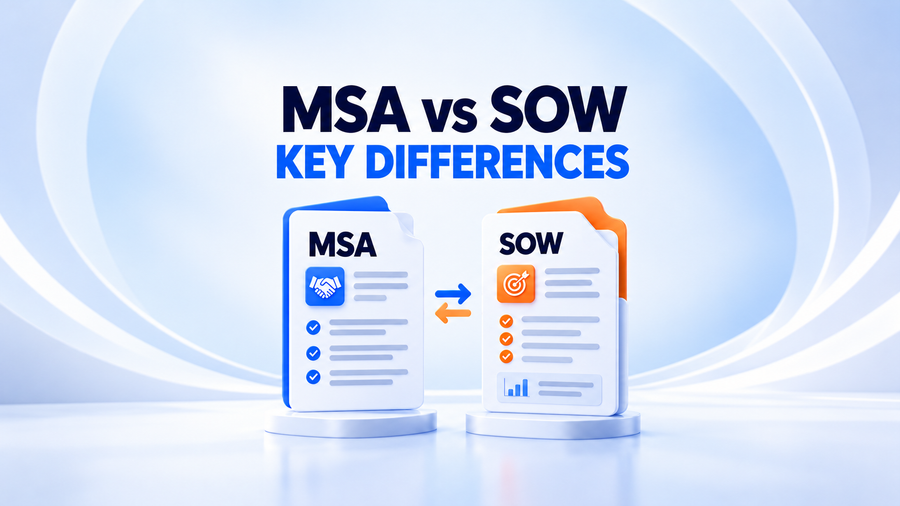
The main agreement, SOW, order form, policies, and purchase order may contain overlapping terms. Include an order-of-precedence clause that explains which document controls a genuine conflict.
Treating Contract Review as Proofreading
Proofreading identifies spelling and formatting errors. Contract review also examines legal effect, commercial alignment, enforceability, risk allocation, and operational feasibility.
Ignoring the End of the Relationship
A contract may explain how to terminate without addressing data return, final payments, transition support, active work, or surviving obligations. Draft the exit process as carefully as the start of the relationship.
How AI Can Help With Contract Drafting
AI can help organize drafting instructions, retrieve approved clauses, compare a draft against a template, identify inconsistent definitions, summarize revisions, and prepare questions for reviewers.
Alloomi AI helps legal and business teams connect contract drafts with approved templates, clause libraries, matter information, and established review processes. This can support faster drafting while keeping the relevant source material available for verification.
AI-generated language should still be reviewed for accuracy, confidentiality, legal requirements, commercial intent, and suitability for the transaction. The American Bar Association’s guidance on generative AI and contract drafting recommends maintaining lawyer oversight, protecting confidential information, and verifying legal output against primary sources.
Before finalizing an important contract, consider having a qualified lawyer review it.
Contract Drafting Checklist
• Confirm the correct parties and agreement type
• Collect complete legal and commercial instructions
• Use the current approved template
• Define the scope, exclusions, and responsibilities
• Add measurable deliverables and acceptance criteria
• Confirm pricing, invoicing, expenses, and taxes
• Address intellectual property and confidentiality
• Address privacy and security requirements
• Review warranties, indemnities, liability, and insurance together
• Define the term, renewal, termination, and exit process
• Check dates, definitions, schedules, and cross-references
• State the order of precedence
• Record deviations from approved language
• Identify unresolved issues and required reviewers
• Review the final clean version before signature
Frequently Asked Questions
Can I Draft My Own Contract?
A person or business may draft its own contract. Alloomi AI can help create a working draft, organize key terms, and identify provisions that may need attention. Because legal requirements and enforceability vary by jurisdiction and circumstances, important or high-risk agreements should be reviewed by a qualified lawyer before signing.
What Makes a Contract Legally Binding?
Requirements vary by jurisdiction. Under general U.S. contract principles, common elements include mutual assent, consideration, capacity, and a lawful purpose. Cornell Law School’s Legal Information Institute provides an overview of these basic elements.
Do Contracts Need to Be in Writing?
Not every contract must be written, but certain transactions are subject to writing or signature requirements. A written agreement also provides clearer evidence of the parties’ obligations and intended terms.
Should I Use a Contract Template?
An approved template can provide a reliable starting structure and improve consistency. It must still be checked against the specific transaction, jurisdiction, current law, and negotiated business terms.
What Is the Difference Between Drafting and Reviewing a Contract?
Drafting creates or revises contractual language. Reviewing evaluates whether that language reflects the deal, follows applicable requirements, allocates risk appropriately, and works with the rest of the agreement.
Can AI Draft a Contract?
AI can generate working language, suggest alternatives, compare clauses, and identify potential gaps. Alloomi AI supports contract drafting and review workflows by helping teams analyze agreements and surface issues more efficiently. Its output should be verified by a qualified human before the contract is finalized.
Final Takeaway
Contract drafting turns a proposed transaction into clear, workable rights and obligations. The strongest drafts begin with complete instructions, use an appropriate template, define measurable performance, connect related risk provisions, and address how the relationship can change or end.
The first draft is only the beginning. Before signature, review the complete agreement for legal effect, commercial alignment, internal consistency, operational feasibility, and compliance with applicable requirements.