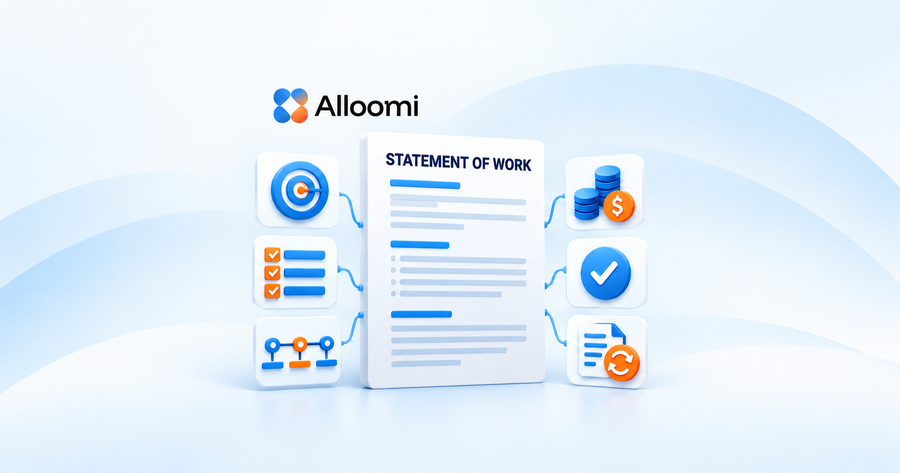
A statement of work review should answer a practical question: can both parties tell exactly what must happen, who must do it, when it is due, how success will be measured, and what changes will cost? A strong review connects scope, responsibilities, deliverables, acceptance, pricing, and change control instead of reading each provision in isolation.
That matters because an SOW often turns the general rules of a commercial relationship into an actual project and spending commitment. A vague sentence may later become a disputed deliverable, a missed dependency, a delayed payment, or a costly change request.
This article provides general information, not legal advice. The governing law, transaction, and contract language may require a different analysis.
Start With the Contract Stack, Not the SOW Alone
Before reviewing the project details, identify every document that may govern the work. An SOW commonly operates under a master services agreement, but it may also incorporate proposals, schedules, security requirements, service levels, rate cards, or technical specifications. Record the exact name, date, and version of each document and obtain any missing attachment.
Next, locate the incorporation and order-of-precedence language. Do not assume that the SOW automatically overrides the MSA because it is newer or more project-specific. The controlling document depends on the language the parties adopted. If the SOW is permitted to modify the MSA, the exception should normally identify the affected provision and state the intended change clearly.
This hierarchy is important enough to resolve expressly. As an official public-procurement example, the federal Order of Precedence clause provides a defined sequence for resolving inconsistencies among contract components. Private commercial agreements do not automatically follow that clause, but the same drafting lesson applies: ambiguity about precedence creates avoidable interpretation risk.
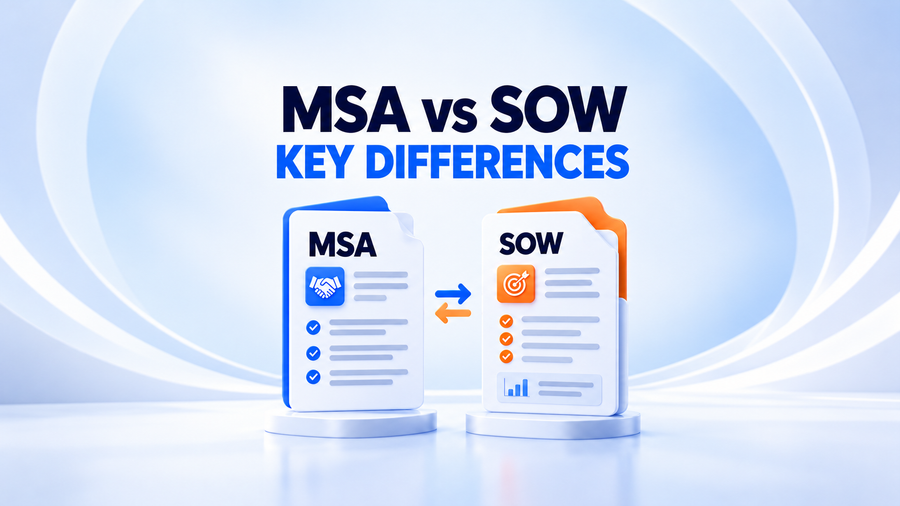
For a closer explanation of the relationship between the two documents, see MSA vs SOW: Key Differences and Which Agreement Controls.
Read the SOW as the Story of the Project
A useful SOW should tell the complete story of the project without relying on unwritten explanations, internal shorthand, or assumptions. An informed reader who was not involved in the negotiation should still be able to understand the project objective, required work, expected deliverables, responsible parties, and conditions for completion.
If the document only makes sense after a project manager explains what the parties "really meant," important terms are probably missing.
Compare the draft with the proposal, approved budget, key correspondence, meeting notes, and internal instructions. Look for promises that never reached the SOW and language that expands the deal beyond what was approved.
The business team closest to the project should perform this comparison. Legal reviewers can assess contractual effect, while technical, finance, security, and operations stakeholders may be better positioned to identify an incorrect assumption or impossible deadline.
Find Scope Gaps Before They Become Change Requests
The scope should define both the work included and the boundaries around it. Broad phrases such as "implementation support," "standard integration," "reasonable assistance," or "all necessary services" may conceal different expectations. Replace or supplement them with identifiable activities, systems, locations, users, volumes, environments, and outputs.
Review exclusions as carefully as inclusions. An exclusion is not harmless background language if the excluded task is necessary to obtain the expected result. For example, a provider may agree to configure a system while excluding data cleansing, migration validation, user training, or production support. The project can still fail even though the provider performed the narrow scope exactly as written.
Assumptions deserve the same attention as the scope because they can shift substantial project risk between the parties. A fixed fee based on five "simple" reports is not truly fixed unless the parties agree on the number of reports and define what "simple" means.
For each important assumption, ask:
• Is it objectively verifiable?
• Who controls whether it remains true?
• What happens if it is wrong?
• Does failure trigger more fees, more time, or both?
• Is there a notice and approval process before the consequence applies?
The goal is not to remove every assumption. It is to make the remaining assumptions specific enough that the parties can manage them.
Connect Responsibilities, Dependencies, and the Schedule
Project obligations often depend on both sides. The provider may need customer data, access, decisions, personnel, or feedback. The SOW should assign an owner and due date to each dependency.
Avoid language stating that any customer delay automatically extends all deadlines or creates unlimited additional fees. The consequence should be proportionate to the actual impact. Consider requiring prompt notice, reasonable mitigation, an explanation of the affected schedule, and approval of added charges through change control.
Test the plan against operational reality. Are milestones logically sequenced? Are review periods realistic? Does the schedule account for financial close, audits, security reviews, data availability, and vendor handoffs?
The official U.S. Federal Acquisition Regulation offers a useful completeness benchmark for certain government SOWs. FAR 8.405-2 calls for a description of the work, location, period of performance, deliverable schedule, performance standards, and special requirements. Those rules do not govern every private transaction, but the categories are helpful when testing whether a commercial SOW is operationally complete.
Make Deliverables, Acceptance, and Payment Work Together
A deliverable should be identifiable and testable. "Provide a dashboard" is weaker than specifying its data sources, functions, format, users, documentation, and acceptance criteria. Where quality is subjective, use examples, reference standards, or a review process that narrows uncertainty.
Acceptance terms should identify the reviewer, criteria, review period, and consequences of rejection. A provider should receive enough detail to understand a defect and an opportunity to cure it. If acceptance is automatic after a deadline, the period and triggering event should be clear.
Payment milestones should track measurable progress. Review deposits, recurring fees, expenses, taxes, invoice timing, and refund rights together. Calendar-only payments may become due before the related work is complete, while payment tied to open-ended "customer satisfaction" may be too uncertain.
Confirm currency, rates, units, quantities, hours, caps, and formulas. Separate setup costs from recurring charges. For time-and-materials work, consider budget alerts, a not-to-exceed amount, or prior approval before exceeding an estimate.
Pressure-Test Change Control and Cost Exposure
Almost every project changes. A workable process identifies who may request a change, what the request must contain, how schedule and price effects are assessed, and who may approve it.
Address work started before a change order is signed. Can project managers authorize commercial changes, or must designated representatives approve them? What happens while a request is being evaluated?
Watch for provisions that allow additional charges without meaningful approval. A statement that inaccurate assumptions, customer delays, or additional effort "may result in fees" does not explain how those fees are calculated or accepted. Require enough detail to prevent a routine project discussion from becoming an unintended commitment.
A strong process creates a written record without forcing the parties to renegotiate the entire contract for every minor adjustment.
Resolve Conflicts, Failure Scenarios, and Exit Rights
Compare the operational terms with the MSA, focusing on payment, intellectual property, confidentiality, security, warranties, service levels, liability, termination, and disputes. An SOW should not casually introduce a rule that conflicts with the parent agreement.
For custom materials, configurations, data, reports, or software, identify ownership and required licenses. Confirm that acceptance, payment, and ownership triggers do not conflict.
Then read the SOW from the perspective of a troubled project. The documents should address missed milestones, repeated rejection, unavailable inputs, budget overruns, escalation, cure, termination, transition support, data return, and work in progress where relevant.
This is also the point to conduct a focused MSA review. A well-written SOW cannot repair a harmful liability allocation or termination structure hidden in the master agreement.
Use AI to Organize the Review, Not Replace Judgment
AI can help compare the SOW with the MSA, locate undefined terms, surface inconsistent dates, identify missing provisions, and turn reviewer comments into an issue list. The value is greatest when the system has access to the correct contract version, deal context, approved playbooks, and prior decisions.
Alloomi AI supports contract review by connecting document changes with matter facts, client positions, and relevant sources. It can help teams surface material issues and prepare suggested revisions while keeping the underlying context available for human review.
AI output should still be verified. A tool may identify textual inconsistencies without understanding an unstated commercial priority, jurisdiction-specific rule, or operational constraint. The final decision should remain with the appropriate business owner and qualified legal professional.
Final Questions Before Signing
Before approving the SOW, confirm that the team can answer these questions without relying on unwritten explanations:
• What exactly is being delivered, and what is excluded?
• Who owns every material task and dependency?
• How will each deliverable be tested and accepted?
• When is payment due, and what event triggers it?
• Which assumptions can change cost or timing?
• Who may approve changes and additional spending?
• Which document controls if the SOW conflicts with the MSA?
• What happens if performance fails or the project ends early?
If the answers are not visible in the contract stack, resolve them before signature rather than relying on the relationship to solve them later.
Frequently Asked Questions
Who Should Review a Statement of Work?
The business owner, project lead, finance team, technical or security specialists, procurement, and legal counsel may all have relevant roles. The right reviewers depend on the project, but the people responsible for performance should verify the operational facts rather than leaving the entire review to legal.
Should an SOW Repeat the MSA?
Usually, an SOW should apply the MSA rather than repeat all of its general legal terms. Repetition can create inconsistency. The SOW should focus on project-specific terms and clearly identify any permitted exception to the MSA.
Does the SOW Control Over the MSA?
Not automatically. The order-of-precedence and amendment provisions determine which document controls a conflict. If the parties want an SOW provision to override the MSA, they should state that result clearly and identify the affected term.
Conclusion
An effective SOW review is not a search for missing boilerplate. It is a test of whether the contract can guide real performance when the project is busy, delayed, changed, or disputed.
Review the entire contract stack, make the scope and assumptions measurable, connect acceptance to payment, and establish a usable process for changes and failure. Clear terms at the beginning give both parties a better chance of delivering the project they actually intended.