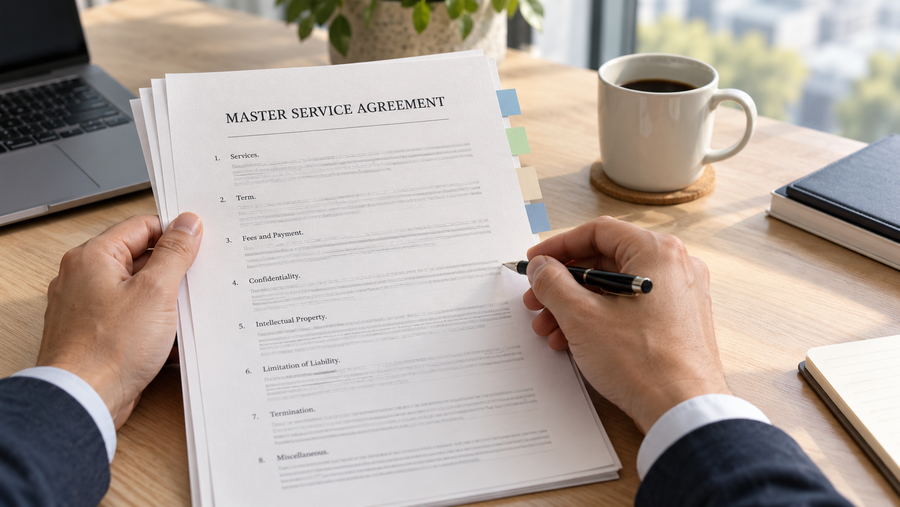
Contract review is important because a signature turns written terms into real obligations, costs, rights, and risks. A careful review tests whether the document matches the deal, makes responsibilities clear, exposes unfavorable terms, and gives the parties a chance to resolve problems before they become expensive disputes.
This article explains why contract review matters and what it protects. If you need a practical process for examining a document clause by clause, read our guide on how to review a contract before signing.
In short:Contract review is a form of preventive risk management. It helps a business understand the commitment it is making, correct terms that do not reflect the deal, allocate risk deliberately, and preserve workable options if the relationship changes.
Why Is Contract Review Important?
A contract is not merely a record of a business conversation. It creates obligations that may be enforceable by law. The Legal Information Institute at Cornell Law School describes a contract as an agreement between parties that creates legally enforceable mutual obligations.
That distinction matters. A price mentioned in a call, an exception discussed over email, or a deadline assumed by one team may offer little protection if the signed document says something different. Once the contract is executed, the written language becomes the operating framework for payment, performance, ownership, liability, renewal, termination, and dispute resolution.
Contract review creates a deliberate pause between negotiation and commitment. It asks a business question with legal consequences: Does this document create the relationship we actually intend to enter?
The Key Risks of Skipping Contract Review
Skipping review does not make contractual risk disappear. It makes the risk less visible until a deadline is missed, an invoice is challenged, a relationship ends, or a dispute forces both sides to interpret the agreement under pressure.
Seven Risks of Skipping Contract Review
Common contract risks and their potential impact on a business.
| Risk | What it can look like in practice | Potential business impact |
|---|---|---|
| Ambiguous obligations | The scope, deliverables, deadlines, or acceptance criteria are unclear | Delays, rework, withheld payment, and disputes over performance |
| Unfavorable risk allocation | Liability, indemnity, or warranty obligations fall disproportionately on one party | Unplanned legal exposure and costs that exceed the contract’s value |
| Hidden financial commitments | Automatic renewal, minimum spend, price increases, or early termination fees are overlooked | Budget surprises and unwanted long-term commitments |
| Weak exit rights | The agreement lacks a practical termination right or requires a narrow notice window | Difficulty leaving an underperforming or outdated relationship |
| Loss of intellectual property or data control | Ownership, license, confidentiality, or data-use terms are broader than expected | Loss of valuable rights, restricted reuse, or confidentiality concerns |
| Regulatory or policy misalignment | The agreement does not reflect applicable requirements or internal approvals | Compliance failures, unenforceable provisions, or operational friction |
| Version and context errors | The final document omits negotiated changes or conflicts with an attachment | The signed contract does not match the deal decision-makers approved |
The issue is not that every imperfect clause will cause litigation. The issue is that unclear or one-sided terms reduce predictability. They make ordinary business decisions harder precisely when clarity matters most.
Seven Benefits of a Thorough Contract Review
1. It confirms that the written contract matches the actual deal
The first benefit of contract review is alignment. The document should reflect the commercial understanding reached by the parties: who will do what, when performance is due, how much will be paid, and which negotiated exceptions apply.
For example, a supplier and customer may agree that implementation support is included in the price. If the final contract treats implementation as an additional service, the commercial agreement and the legal document are misaligned. Review catches that gap before the parties begin performing under different assumptions.
2. It makes obligations measurable
A useful contract replaces assumptions with defined expectations. It identifies deliverables, dependencies, deadlines, acceptance standards, reporting duties, and payment triggers with enough precision for both sides to know whether performance is on track.
Clear obligations do more than help in a dispute. They help project, finance, procurement, sales, and legal teams manage the relationship day to day. A contract that no one can operationalize is difficult to enforce and even harder to perform well.
3. It reveals how risk is allocated
Contracts decide who carries the consequences when something goes wrong. Warranties, indemnities, limitations of liability, insurance obligations, confidentiality provisions, and remedies all allocate risk between the parties.
Review makes that allocation visible. It allows decision-makers to compare the legal exposure with the value of the transaction and decide whether to accept, limit, insure, price, negotiate, or escalate the risk. The goal is not to remove every risk; it is to avoid accepting material risk unintentionally.
4. It reduces avoidable disputes
Many contract disputes begin with competing interpretations rather than deliberate misconduct. One side believes a task was included; the other considers it out of scope. One side expects a fixed price; the other believes it can increase fees. One side expects the relationship to end; the other relies on an automatic renewal clause.
A review cannot guarantee that no dispute will occur. It can, however, remove ambiguity, document agreed positions, and establish a process for handling changes and disagreements. This gives both sides a clearer reference point when memories, personnel, or circumstances change.
5. It protects financial value
Contract value can be lost through more than lawsuits. Leakage also occurs through missed price adjustments, unclaimed service credits, unmanaged renewals, unfulfilled obligations, excess scope, and terms that no longer support the business.
A 2026 report from World Commerce & Contracting found that organizations lose an average of 11% of procurement contract value after signature through gaps in execution, governance, and relationship management. Contract review alone cannot prevent all post-signature value leakage, but it creates a clearer baseline for tracking obligations, deadlines, rights, and commercial outcomes.
6. It improves negotiation and decision-making
Review turns dense language into a set of decisions. A team can identify which terms are acceptable, which need clarification, which should be revised, and which require legal or executive approval.
This makes negotiation more focused. Instead of objecting to a clause because it “feels unfair,” the reviewer can explain the business effect: the clause permits unilateral price increases, transfers ownership of pre-existing work, creates unlimited exposure, or prevents termination for an impractical period. Specific consequences support better decisions and more productive negotiations.
7. It creates a reliable record for the relationship
People change roles. Negotiators leave. Email threads become difficult to reconstruct. A reviewed and properly finalized contract gives future teams a dependable record of what was approved and why.
That record is especially important when a contract is amended, renewed, expanded, or disputed. It also supports consistent handoffs between legal, sales, procurement, finance, operations, and account teams.
Contract Review Before Signing: Key Checkpoints
Contract review is often associated with the period immediately before signature, but important review points exist throughout the contract lifecycle.
Contract Review After Signing: What to Monitor
Important review points exist throughout the contract lifecycle, not only before signature.
| Review point | Why it matters |
|---|---|
| Before signing | Confirm the deal, identify unacceptable exposure, and negotiate changes while leverage remains |
| Before renewal | Check notice deadlines, pricing, performance, and whether the relationship should continue |
| When scope changes | Ensure new services, responsibilities, fees, and timelines are documented consistently |
| When laws or policies change | Determine whether the agreement still fits applicable requirements and internal standards |
| During a dispute or suspected breach | Clarify obligations, notice requirements, remedies, and escalation procedures |
| Before assignment, acquisition, or restructuring | Identify consent, change-of-control, and transfer restrictions |
Annual reviews can be useful for long-running or high-value agreements, particularly when operations, pricing, laws, or strategic priorities have changed. But frequency should be risk-based: a complex cross-border agreement may require closer attention than a low-value, short-term purchase.
When Is Contract Review Most Important?
Every contract deserves informed attention, but the need for professional review increases when:
- The agreement involves substantial money, a long term, or a business-critical relationship.
- Liability is unlimited, unclear, or potentially disproportionate to the contract value.
- The contract includes indemnities, personal guarantees, exclusivity, or restrictive covenants.
- Intellectual property ownership or licensing is central to the transaction.
- Personal, confidential, or regulated data will be accessed or processed.
- The transaction spans multiple jurisdictions.
- The governing law, dispute forum, or regulatory requirements are unfamiliar.
- The document is heavily negotiated, contains multiple attachments, or has changed through many versions.
- The cost of getting the decision wrong is greater than the cost of qualified advice.
Business teams can identify commercial inconsistencies and unresolved questions, but a qualified lawyer should assess significant legal exposure and jurisdiction-specific issues. This article provides general information, not legal advice.
How AI Can Strengthen Contract Review
Contract review rarely depends on one document alone. A reviewer may need to compare the current draft with previous versions, negotiation emails, client instructions, internal playbooks, approved exceptions, and related agreements.
Technology can help organize that context, compare language, surface deviations, and trace issues back to their source. Alloomi supports this work by connecting contract language with the facts, instructions, decisions, and earlier versions that give the document meaning. It can help reviewers identify changes to obligations and risks, explain why they may matter, and prepare revisions for human review.
AI does not remove the need for judgment. A human reviewer should verify the source language, assumptions, business impact, and proposed response before accepting a recommendation. For lawyers, the American Bar Association's Formal Opinion 512 also highlights duties involving competence, confidentiality, communication, supervision, and independent professional judgment when using generative AI tools.
Frequently Asked Questions
What is the main purpose of contract review?
The main purpose of contract review is to determine whether the written agreement accurately reflects the intended deal and allocates obligations, rights, costs, and risks in an acceptable way. The result should be a clear decision about what to accept, revise, clarify, escalate, or reject before commitment.
What happens if you do not review a contract?
If a contract is not reviewed, a party may accept unclear duties, unfavorable payment terms, automatic renewal, broad liability, weak termination rights, or restrictions it did not intend. Problems may remain hidden until performance begins, the relationship changes, or a dispute makes the precise wording important.
Does contract review prevent all disputes?
No. Contract review cannot prevent every breach, disagreement, or change in circumstances. It reduces avoidable disputes by clarifying expectations, documenting negotiated positions, allocating risk, and establishing procedures for changes, termination, and dispute resolution.
Should contracts be reviewed after they are signed?
Yes. Existing contracts should be revisited before renewal, amendment, major scope changes, assignment, or a suspected breach. Periodic review may also be appropriate when laws, pricing, operations, or business priorities change. The appropriate frequency depends on the agreement's value, duration, complexity, and risk.
Can AI review a contract?
AI can help summarize terms, compare versions, find inconsistencies, and surface clauses that deserve attention. It should support—not replace—human judgment. The responsible reviewer should verify the contract language, relevant context, legal implications, and any proposed change before making a decision.
How is this different from learning how to review a contract?
This article explains the business and legal value of contract review: the risks it exposes and the benefits it creates. For an eight-step process, clause checklist, and practical red flags, read How to Review a Contract Before Signing: A Practical Guide.
The Bottom Line: Review Contracts Before You Sign
Contract review matters because the cost of a contract is not limited to its stated price. The document also controls operational duties, renewal, ownership, liability, exit rights, and the options available when circumstances change.
A strong review makes those consequences visible before they become commitments. It gives decision-makers a chance to align the document with the deal, negotiate risk deliberately, and enter the relationship with a shared understanding of what happens next.