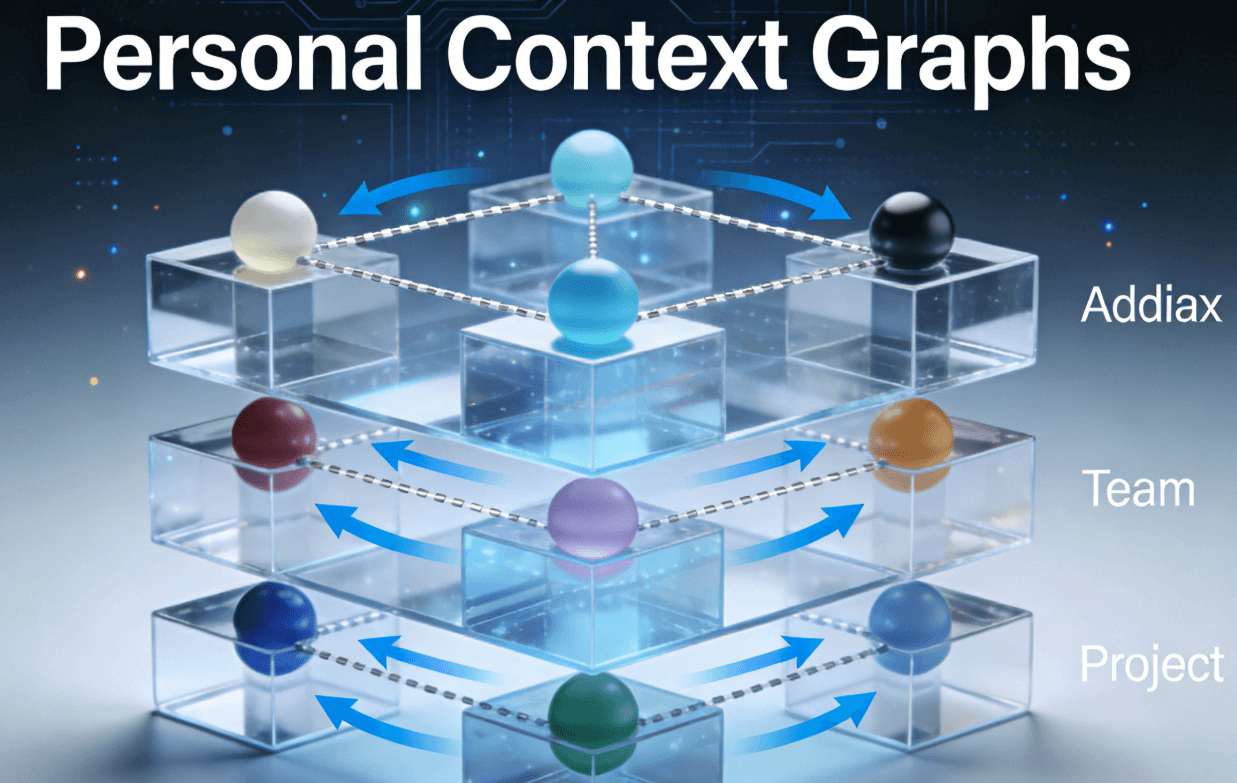
Personal Context Graphs
Published on 1/29/2026
Most high-leverage work doesn’t fail in dramatic ways. It fails quietly.
A partnership that “looked promising” slowly goes cold. A launch that “seemed on track” drifts until the last week turns into a fire drill. A deal that “was progressing” stalls, and nobody can point to the exact moment it started slipping. Weeks later, you’re left with the same frustrating question: what actually happened?
This isn’t a communication problem. Teams communicate constantly. It’s not even an effort problem. The people involved are usually working hard. The real issue is more structural: modern work is built on fragmented signals, and most organizations don’t have a coherent model of reality that stays updated as things change.
High-leverage professionals end up becoming that model.
If you’re in sales, partnerships, fundraising, product leadership, ops, or management, you’ve felt this. Your job isn’t just to execute tasks. It’s to maintain a mental map of the system: who matters, what’s in motion, what’s blocked, what’s fragile, what’s urgent, what’s noise, and what’s quietly decaying. You’re constantly stitching together fragments across Slack, email, meetings, documents, and side conversations, then making decisions based on that reconstructed picture.
That’s exhausting. And it’s also why AI, for all its power, still often feels shallow: it can generate content inside your workflow, but it can’t carry your workflow unless it understands your world.
A personal context graph is how you give software that capability.
Why “More Memory” Isn’t the Breakthrough People Think It Is
A lot of AI products talk about memory like it’s the missing piece. Store more history. Recall old messages. Increase the context window. Retrieve last month’s notes.
That’s useful, but it’s not enough, because storage is not understanding.
A transcript of your week is not the same thing as knowing what’s going on. It’s raw material. In high-leverage work, the question is rarely “what was said?” The question is: what does it mean, given everything else?
Context isn’t just static information. Context is dynamic structure.
It’s the relationships between people, decisions, commitments, timing, and intent. It’s how you know whether “let’s circle back” means “not now,” “waiting on legal,” or “we’re losing internal support.” Humans can tell the difference because we carry a model of the situation. Most tools can’t, because they treat everything as text.
That’s why the real leap isn’t “more memory.” It’s a world model.
Work Isn’t a List of Tasks. It’s a Living Graph.
The most useful way to think about modern work is not as a stack of artifacts, emails, docs, tasks, meetings, but as a graph that evolves over time.
In every meaningful initiative, there are:
- people with different roles and influence
- projects and opportunities that depend on timing
- commitments that are explicit, implied, or quietly forgotten
- signals that indicate momentum, hesitation, or risk
- dependencies that don’t show up until they break
None of these live in isolation. Their meaning comes from how they connect.
The same update can be harmless or dangerous depending on who said it, when they said it, and what changed since the last decision. The same silence can be “busy week” or a deal starting to die. The same meeting can be “alignment” or a polite postponement.
This is what high performers do that looks like instinct: they’re constantly maintaining a dynamic graph in their head. They see the system, not just the messages.
But keeping that graph alive manually, across dozens of loops, across constantly shifting context, is exactly what creates the fragmentation tax.
Personal Context Graphs: A World Model for Your Work
A personal context graph is a persistent, evolving representation of your working world.
Not a file cabinet. Not a better notes app. Not a searchable memory or archive.
A world model.
It connects the things that actually determine outcomes: people, relationships, projects, commitments, decisions, and traces of how those decisions were made. It doesn’t just remember events; it understands what they mean in the larger system.
This is the critical distinction: the graph is not “what happened.” It’s “how your world works.”
On the people side, it captures the reality that decides outcomes: who influences decisions, who’s engaged, who’s drifting, who needs to be brought in early, what each stakeholder cares about, and how relationship temperature changes over time.
On the work side, it represents what’s in motion and what’s at risk: what’s blocked, what depends on what, what’s urgent because the window is closing, and what feels loud but doesn’t matter.
When you combine those, the graph stops being memory and becomes understanding.
And once you have understanding, you can finally get something modern work rarely gives you:
control.
The Real Unlock: Control, Not Automation
A lot of people describe what they want from AI as “help” or “automation.” But if you’re doing high-leverage work, what you’re really craving is control, the ability to see the real state of the world clearly, and move it intentionally.
Modern work steals that control. Reality is scattered across tools, and you’re always operating on partial information. You feel the drag, but you can’t always point to the source. You sense a deal cooling down, but you can’t prove it until it’s too late. You suspect a launch is drifting, but nobody wants to sound alarmist without evidence. You’re constantly reacting because you can’t see the system cleanly enough to drive it.
A world model changes the feel of work.
When you can see the system as it is, what’s in motion, what’s decaying, what’s missing, what’s blocked, who’s disengaging, where the real risk is, you’re no longer working in the dark. You’re no longer managing through anxiety and guesswork.
You’re operating with clarity.
This is the “open your third eye” moment. The feeling that, with surprisingly little effort, you can understand the whole state of play, across threads, across time, across stakeholders, without having to manually piece it together every day.
That’s the kind of control high performers have always built for themselves through experience and sheer mental load. A personal context graph makes it available without requiring you to carry everything in your head.
Why This Compounds Over Time
The most powerful thing about a personal context graph is that it gets better the more you work.
Not in a generic “the model learns” way, but because the graph becomes a higher, resolution representation of your world. It learns what “important” means for you. It learns what patterns signal risk in your domain. It learns which stakeholders matter and how momentum behaves in your specific loops.
Over time, this turns into a compounding advantage:
- fewer things slip through cracks
- fewer late-stage surprises
- fewer stalled loops that die quietly
- faster, calmer decision-making
- more consistent outcomes with less effort
The system isn’t just making you faster. It’s making your work more reliable.
And that’s what leverage actually is.
Why the Future Isn’t a Chatbox
Once you see work this way, a lot of current AI product design feels incomplete.
A chatbox can be a useful tool, but it’s not a world model. It’s episodic. It waits for you to ask. It doesn’t continuously maintain reality, and it doesn’t give you command over what’s happening.
A personal context graph is the opposite. It persists. It evolves. It connects. It reasons. It can surface what matters before you even know you need to ask.
That’s why I think personal context graphs are the missing layer for AI-native work. Not as a feature, but as infrastructure: the substrate that makes work legible, manageable, and finally less heavy.
This is the direction we’re building toward at AlloomiAI: a personal context graph that understands your work as a living system, gives you control with minimal effort, and helps you keep momentum without carrying the entire world in your head.
Because the best productivity system isn’t the one that helps you do more.
It’s the one that lets you see clearly, and move the right things forward with calm, consistent control.