A law firm may believe it has not adopted AI because it has not purchased a firm-wide legal AI platform. Individual lawyers, paralegals, law clerks, vendors, and clients may already be using AI through writing tools, search products, meeting assistants, document systems, and public chatbots.
Without a clear policy, each user is left to decide which tools are safe, what information may be entered, how the output should be verified, and whether AI use should be disclosed.
That is not a technology strategy. It is the unplanned delegation of legal and security decisions to individual users.
A useful law firm AI policy should not attempt to prohibit every new tool or describe every possible risk. It should give people clear instructions for choosing tools, protecting information, reviewing outputs, escalating uncertainty, and responding when something goes wrong.
Why a General Technology Policy Is Not Enough
Most law firms already have policies concerning information security, confidentiality, acceptable technology use, records retention, and vendor management.
Those policies remain important, but they may not answer the practical questions created by generative AI.
Can a lawyer paste a client email into a public chatbot for summarization? Can a paralegal use AI to prepare a chronology? May a meeting assistant record and summarize a witness interview? Can a lawyer use AI-generated research in a court filing? Must the client be informed?
A general instruction to "protect confidential information" does not tell the user whether a specific AI platform retains prompts, uses submitted material for training, or allows administrators to review conversations.
An AI policy should translate existing professional duties into instructions that apply to daily work.
Start With the Work, Not the Technology
A strong policy begins by identifying how legal professionals may use AI.
The same tool may present different risks depending on the task. Improving the grammar of a public marketing draft is different from analyzing privileged investigation notes. Summarizing a published court decision is different from recommending a litigation strategy.
The policy should distinguish low-risk administrative assistance from work involving confidential information, legal judgment, client advice, court filings, evidence, financial decisions, or regulatory submissions.
This task-based approach is more durable than a list of product names. AI products change quickly, but legal risk continues to depend on the information involved and the consequence of an incorrect result.
The firm can still maintain an approved-tool register. The policy should explain why certain tools are approved and what uses remain restricted even within an approved system.
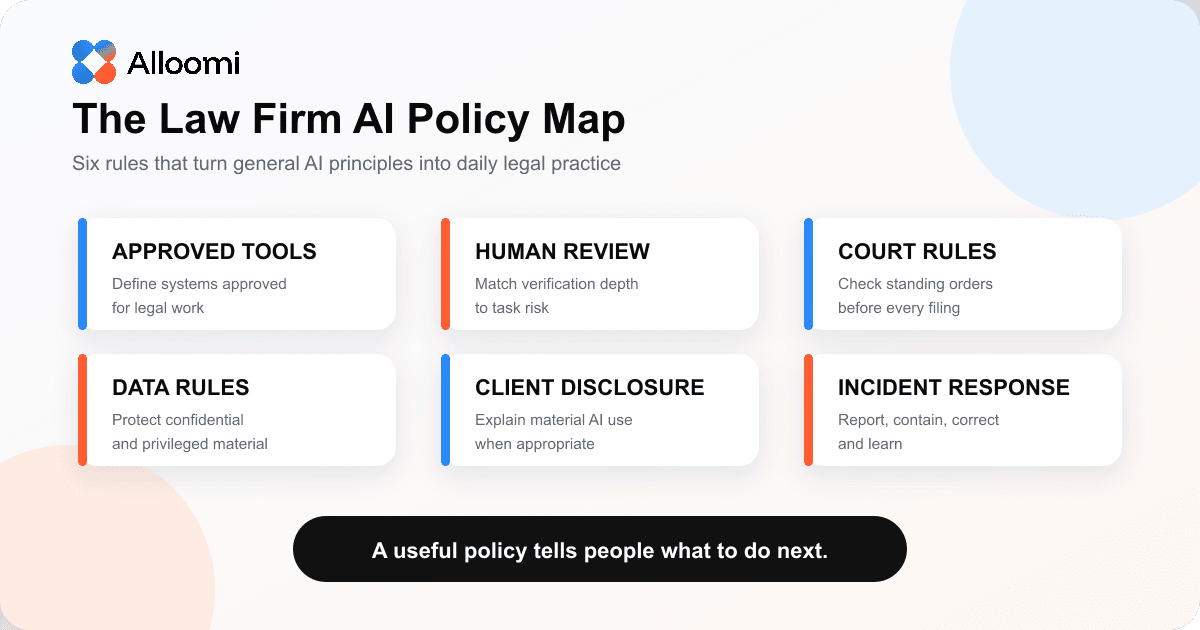
The Law Firm AI Policy Map
A practical policy should cover six operational areas: Approved Tools, Data Rules, Human Review, Client Disclosure, Court Rules, and Incident Response.
Approved Tools
The policy should tell users which AI systems may be used for legal work and who is responsible for approving them.
Approval should consider more than accuracy or convenience. The firm should evaluate security, retention, model training, access controls, data location, deletion, vendor terms, subprocessors, incident notification, and the ability to audit activity.
Approval also should not be permanent. A provider may change its terms, introduce a new model, modify retention settings, or add a feature that affects how information is processed.
The firm should therefore assign an owner to monitor approved systems and review material changes.
An approved tool is not approved for every purpose. The policy should distinguish between systems that may handle public information and systems authorized to process confidential client documents.
Data Rules
Users need specific instructions about what information may be submitted.
A policy should address confidential client information, personal data, trade secrets, protected health information, investigation materials, court-protected discovery, privileged communications, and information subject to contractual restrictions.
The safest rule is not necessarily "Never enter confidential information into AI." That rule may be impractical if the firm uses an enterprise legal AI system specifically designed to analyze client documents.
Instead, the policy should identify which categories of information may be processed in which approved environments.
It should also explain that removing a client's name may not make the information anonymous. Facts, dates, transaction details, locations, and unusual circumstances may still identify the client or matter.
ABA Model Rule 1.6 requires lawyers to make reasonable efforts to prevent unauthorized access to or disclosure of information relating to client representation.
The AI policy should convert that obligation into clear operational controls.
Human Review
Every AI-assisted task should have an appropriate review standard.
The required review should depend on the nature of the work and the consequence of error. A generated meeting agenda does not require the same verification as a legal opinion, contract analysis, or court filing.
The policy should identify work that always requires review by a qualified lawyer. It should also explain what review means.
Reviewing only the final prose may not be enough. A lawyer may need to open cited authorities, inspect source documents, verify quotations, confirm factual assertions, and test whether the reasoning accounts for relevant exceptions.
For high-risk matters, the firm may require the reviewer to document the sources checked and the corrections made.
ABA Formal Opinion 512 explains that lawyers using generative AI must consider duties involving competence, confidentiality, communication, supervision, candor, and fees.
An internal policy should show how those duties apply to the firm's actual workflow.
Client Disclosure
Not every minor use of AI requires a separate conversation with the client. However, some uses may affect how the representation is conducted, how confidential information is handled, what expenses are charged, or what risks the client accepts.
The policy should identify circumstances in which disclosure or consent may be appropriate.
Relevant factors may include the materiality of the AI use, the sensitivity of the information, the expectations of the client, the terms of the engagement, applicable ethics guidance, and whether the client has provided specific technology instructions.
The firm should avoid relying only on broad engagement-letter language stating that technology may be used. Meaningful communication may require explaining what the system does and why it matters to the representation.
The policy also should address client restrictions. If a client prohibits the use of certain AI systems, that restriction should be visible to everyone working on the matter.
Court Rules
Courts and individual judges may adopt different requirements concerning AI-assisted filings.
Some rules require lawyers to verify the accuracy of AI-generated content. Others may require disclosure, certification, preservation of prompts, or identification of AI-assisted portions.
The policy should require the responsible lawyer to check the applicable local rules, standing orders, and judicial practice standards before filing.
A centralized court-rule tracker can help, but it should not replace matter-specific review. Rules may change, and a particular judge may impose requirements that do not appear in a general court guide.
The District of Maryland Standing Order 2026-03, for example, emphasizes that lawyers and unrepresented parties must verify filings, especially when relying on AI.
The firm's policy should make clear that the lawyer who signs or submits the document remains responsible for its accuracy.
Incident Response
A policy is incomplete if it describes only correct use.
People will make mistakes. A user may enter confidential information into an unapproved tool, rely on an inaccurate result, submit a flawed draft, or discover that an AI provider changed its data practices.
The policy should explain how to report an incident without encouraging users to hide it.
The response may involve stopping further use, preserving relevant records, notifying responsible firm personnel, evaluating disclosure obligations, correcting affected work, contacting the client, or updating the workflow.
Not every error will require the same response. However, early reporting gives the firm more options.
The incident should also produce a lesson. The firm may need to revise training, change a tool configuration, improve access controls, or clarify an unclear policy provision.
Training Makes the Policy Operational
A written policy does not create safe AI use unless people understand how to apply it.
Training should use realistic examples from the firm's work. Lawyers should practice deciding whether information can be submitted, how deeply an output must be reviewed, and when a matter should be escalated.
Different roles may require different training. Partners may need to understand supervision and client communication. Associates may need source-verification methods. Paralegals and law clerks may need clear task boundaries. IT and procurement teams may need vendor-assessment standards.
The policy should also explain that AI literacy is ongoing. New tools, court rules, and professional guidance will continue to change the risk environment.
How Alloomi AI Fits Into a Controlled Policy
Alloomi AI can help legal professionals analyze documents, retrieve relevant provisions, compare language, and keep the supporting source material available for review.
A controlled legal AI workflow allows the firm to define which materials may be analyzed, who may access them, and what human review must occur before the output is used.
Teams can also use the Five-Gate AI Legal Work Check as a verification method covering scope, source, substance, security, and final sign-off.
The policy sets the rules. The workflow makes those rules part of everyday legal work.
Final Thoughts
The best AI policy is not the longest policy. It is the policy that helps a lawyer make the correct decision while the work is happening.
It should identify approved tools, establish data boundaries, define review expectations, address disclosure and court requirements, and create a clear incident-response path.
A policy that only warns users about hallucinations will quickly become outdated. A policy built around legal duties, information sensitivity, task risk, and accountability can adapt as technology changes.
Frequently Asked Questions
1. Should a law firm ban public AI tools?
A firm may restrict public AI tools from processing client-confidential or sensitive information. Whether a complete ban is appropriate depends on the firm's work, approved alternatives, security controls, client requirements, and risk tolerance.
2. Who should own the law firm's AI policy?
Ownership may involve firm leadership, legal ethics, information security, privacy, innovation, risk management, and practice-group representatives. One person or committee should have clear responsibility for maintenance and enforcement.
3. How often should an AI policy be updated?
The policy should be reviewed regularly and whenever there is a material change in technology, professional guidance, court rules, vendor terms, client requirements, or the firm's approved use cases.
