An AI system reviews documents and identifies a high-risk clause. A lawyer revises the result and sends advice to the client.
Several months later, a question arises. Which document version did the system analyze? What instruction was used? Which source supported the conclusion? What did the lawyer change? Who approved the final advice?
If the legal team cannot reconstruct that path, it may be difficult to verify the work, correct an error, respond to a client, or explain the process during litigation or an audit.
A Legal AI audit trail is the record that connects the input to the output and the output to the final human decision.
It should not be treated as a technical log that only IT professionals can understand. A useful audit trail should help lawyers determine what happened, why it happened, and who accepted responsibility for the result.
What Is a Legal AI Audit Trail?
An audit trail is a chronological record that allows activities and decisions to be reconstructed.
The NIST definition of an audit trail describes it as a record sufficient to reconstruct and examine the sequence of events surrounding an operation or event from inception to result.
For legal AI, that record may include the documents submitted, user instructions, source materials retrieved, model output, reviewer comments, corrections, approvals, and final work product.
The purpose is not to preserve every technical event forever. It is to retain the information required to understand and defend the legal workflow.
The appropriate record depends on the task. A court filing may require more detailed documentation than an internal brainstorming exercise. Analysis of privileged documents may require different access controls than work based entirely on public sources.
Why Ordinary Document History Is Not Enough
A traditional document management system may show who edited a final memorandum and when the file changed.
It may not show which documents were submitted to AI, what the system was asked, which passages it retrieved, or how the generated analysis changed during review.
Without this information, the final document can become disconnected from the process that produced it.
An AI-generated contract summary may state that a customer has a termination right. The final memorandum may repeat that conclusion. If the summary was based on a superseded agreement, ordinary version history may not reveal the error.
An audit trail makes the connection visible.
It allows the reviewer to identify the input version, inspect the instruction, locate the supporting provision, and determine whether the lawyer corrected or accepted the generated result.
The Legal AI Audit Trail
A practical audit trail follows six points: Input, Prompt, Source, Output, Review, and Decision.
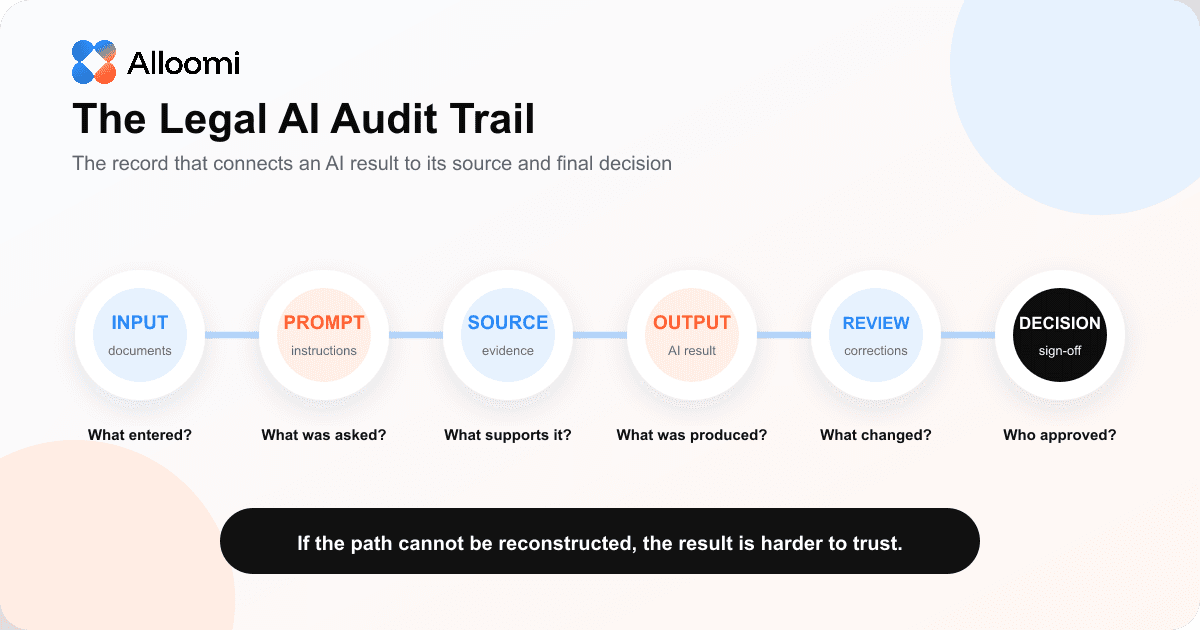
Record the Input
The record should identify what information entered the system.
This may include contracts, pleadings, transcripts, emails, policies, research materials, and structured data.
Document identity matters. The audit trail should make it possible to determine which version was reviewed. A filename alone may not be enough if several copies use similar names.
Relevant metadata may include the document title, version, source, upload date, matter, custodian, or a unique identifier.
The record also should identify significant exclusions. If the system analyzed the main agreement but not its schedules, that limitation may affect the reliability of the result.
Preserve the Material Instruction
The prompt or instruction defines the task the AI attempted to perform.
Small wording changes can produce different results. "Summarize this agreement" is not the same as "Identify every provision allowing unilateral price changes and cite the relevant section."
For material legal work, the team should preserve the approved instruction or enough information to reconstruct it.
This does not necessarily mean retaining every exploratory conversation. The organization should establish a retention rule that reflects the nature of the task, potential relevance, confidentiality, and applicable legal obligations.
Courts may also impose specific requirements. Some 2026 judicial orders have required counsel to maintain records of prompts or inquiries submitted to generative AI tools when those records may become relevant.
Connect Conclusions to Sources
An AI answer should not exist as an isolated block of text.
The audit trail should identify the authority, document, passage, transcript page, clause, or record supporting each material conclusion.
Source links make verification faster. They also help distinguish between retrieved evidence and generated explanation.
If the system states that a contract permits immediate termination, the reviewer should be able to open the relevant provision and examine related definitions, exceptions, and amendments.
If the source does not support the conclusion, the reviewer can correct the error and record the reason.
This connection is especially important when AI combines information from several documents. The team should know whether the final statement came directly from a source or was inferred by the model.
Retain the Relevant Output
The audit trail should preserve the output used in the legal workflow.
If the system generates several drafts, the firm does not necessarily need to treat every version as permanent. However, it should retain enough information to understand which output influenced the final work.
The retention decision should account for litigation holds, discovery obligations, privilege, professional duties, client requirements, and the firm's records policy.
An output should not be preserved indefinitely merely because it was generated by AI. Excessive retention can create its own security and discovery risks.
The goal is controlled traceability rather than unlimited storage.
Document Human Review and Correction
The audit trail should show that a qualified person evaluated the result.
This may include comments, source checks, changed classifications, corrected citations, revised conclusions, or approval records.
Human review should not appear as a checkbox with no connection to the work performed.
For high-risk tasks, the record may identify which sources were checked, which material changes were made, and which issues remained uncertain.
Corrections also provide information about system performance. If reviewers repeatedly fix the same type of error, the organization may need to change the prompt, source collection, model, or permitted use.
The NIST AI Risk Management Framework Playbook emphasizes governance, documentation, oversight, validity, accountability, and continuous risk management.
A legal audit trail turns those principles into a matter-level record.
Identify the Final Decision-Maker
The end of the audit trail should identify who approved the legal work.
Approval does not mean the person read every technical log. It means the responsible professional reviewed the work at the level required by the task and accepted responsibility for the final result.
The record may also distinguish between different decisions. One lawyer may approve the legal analysis, while a client or business leader decides whether to accept the commercial risk.
Separating those decisions prevents the system from making it appear that legal approved a business choice or that a business owner approved a legal conclusion.
Audit Trails Support More Than Compliance
Traceability can improve legal work even when no dispute occurs.
A lawyer reviewing a similar matter can see which sources were used and what earlier reviewers corrected. A team leader can identify recurring error patterns. A knowledge manager can distinguish approved guidance from preliminary AI output.
Audit records also support vendor evaluation. The organization can examine whether a system consistently retrieves the correct sources, how often lawyers override its conclusions, and which tasks produce the most errors.
This information can guide training and investment decisions.
Instead of measuring AI only by how quickly it produces an answer, the legal team can measure whether that answer survives review.
Auditability Must Be Balanced With Confidentiality
An audit trail may contain sensitive prompts, legal strategy, client information, and reviewer comments.
The organization should protect audit records with appropriate permissions, encryption, retention rules, and matter-level access.
Not every system administrator should be able to read privileged legal prompts merely because the records are stored in a technical log.
The firm should also decide whether audit data can be used to train internal or external models. Information retained for accountability should not be repurposed without authorization.
Auditability and confidentiality are not competing goals. A well-designed system should preserve the record while limiting access to the people who need it.
How Alloomi AI Supports Traceable Legal Work
Alloomi AI can help legal teams analyze and compare documents while maintaining connections between generated analysis and the supporting source material.
Source-linked results make it easier for lawyers to verify conclusions, correct errors, and understand why an issue was surfaced.
The Five-Gate AI Legal Work Check provides a complementary review framework covering scope, source, substance, security, and lawyer sign-off.
Together, verification and auditability help legal teams use AI without separating the final answer from the evidence and judgment behind it.
Final Thoughts
Trust in Legal AI should not depend on whether the output sounds convincing.
A legal team should be able to reconstruct the path from source material to instruction, output, human correction, and final decision.
That path is the Legal AI audit trail.
The appropriate record will vary by task, risk, jurisdiction, and retention obligation. The underlying principle remains consistent: if the process cannot be reconstructed, the result is harder to verify, explain, or defend.
Frequently Asked Questions
1. What should a Legal AI audit trail include?
It may include input documents, document versions, prompts, retrieved sources, generated outputs, reviewer corrections, approvals, timestamps, and the identity of the final decision-maker.
2. Should every AI prompt be retained?
Not necessarily. Retention should reflect the task, risk, applicable court rules, discovery obligations, client requirements, privilege, and the organization's records policy.
3. Does an audit trail make an AI result legally defensible?
An audit trail does not prove that the result was correct. It provides evidence of the process, sources, review, and decision-making, which can support verification and accountability.
