Boilerplate clauses are standardized provisions that govern how a contract is interpreted, administered, transferred, amended, enforced, or ended. They often appear near the end of the agreement, but they can materially affect leverage and outcome.
The label "boilerplate" can create a false sense that the language is neutral or interchangeable. In reality, a standard clause may decide where a dispute occurs, whether an affiliate can receive the contract, how notice must be delivered, which prior promises survive, and whether past leniency becomes a waiver.
These provisions should be reviewed in the context of the transaction, the parties, and the governing law rather than accepted automatically.
Why Boilerplate Deserves Transaction-Specific Review
Business teams naturally focus on scope, price, delivery, and liability. Boilerplate provisions can appear secondary because they do not describe the product or service. Their importance often becomes visible only after a corporate transaction, operational failure, notice deadline, or dispute.
The same wording can also affect parties differently. A broad assignment right may be useful to a company planning a reorganization but unacceptable to a customer that selected a particular provider.
A strict notice clause may create discipline but also cause a termination notice to fail if it is sent to the wrong address or by the wrong method.
The reviewer should ask what event would activate the clause and whether the process works for the actual organization.
Assignment
An assignment clause controls whether a party may transfer contractual rights or delegate obligations to another person or entity.
Review whether consent is required, whether consent may be withheld, and whether exceptions apply to affiliates, mergers, reorganizations, or sales of assets. Check whether the clause addresses both assignment and delegation. A transfer of payment rights may raise different concerns from a transfer of performance obligations.
Consider the commercial reason the counterparty was selected. If performance depends on licenses, personnel, security controls, financial strength, or a particular business model, a broad transfer right may undermine that decision.
Also check change-of-control language elsewhere in the agreement. A contract may treat a change of ownership as an assignment even if the legal entity remains the same.
Notices
A notices clause specifies how formal communications must be delivered and when they become effective.
Identify which communications require formal notice. Termination, non-renewal, breach, indemnity claims, price changes, and force majeure notices may be subject to different requirements.
Check the permitted delivery methods, addresses, named recipients, timing rules, and proof of receipt. Confirm that the information is current and operationally manageable. If email is permitted, determine whether notice is effective when sent, received, or acknowledged.
The clause should not be reviewed in isolation. Renewal, cure, and termination provisions may contain separate notice periods. A valid method sent too late can still be ineffective.
Entire Agreement and Reliance Language
An entire agreement or integration clause states that the written contract represents the parties' complete agreement on its subject matter. It may also address reliance on prior statements, proposals, demonstrations, or negotiations.
This provision matters when important commitments exist outside the signed contract. Sales presentations, security responses, implementation promises, emails, and product documentation may not have the intended contractual effect if they are not incorporated.
The Cornell Legal Information Institute discussion of the parol evidence rule explains the general role of prior or contemporaneous external evidence when parties have reduced an agreement to a final writing, while also noting exceptions. The application of that rule varies by jurisdiction and circumstances.
Before accepting an entire agreement clause, confirm that every material commitment appears in the contract or an incorporated document.
Governing Law and Forum
A governing law clause identifies the law used to interpret the agreement. A forum selection clause addresses where disputes must or may be heard. Arbitration provisions may create a separate dispute process.
These clauses affect more than litigation convenience. The selected law can influence interpretation, available remedies, limitation periods, enforceability, and mandatory rules. The selected forum affects cost, procedure, travel, and leverage.
The Cornell Legal Information Institute defines choice of law as the process of determining which jurisdiction's law applies to a dispute. Contract language may guide that analysis, but mandatory law and jurisdiction-specific rules can still matter.
Check whether governing law, courts, venue, and arbitration provisions point to a coherent system. Avoid combinations that create uncertainty, such as one jurisdiction's law with an unrelated exclusive forum unless that result is intentional.
Severability
A severability clause addresses what happens if part of the contract is held invalid or unenforceable.
Some clauses state that the remaining provisions continue in effect. Others permit or direct a court to modify the invalid term.
The Cornell Legal Information Institute definition of severability describes the general principle that valid portions may remain effective when another portion is invalid.
Review whether preserving the rest of the contract makes commercial sense. If the invalid provision is central to the exchange, automatic preservation may produce a deal one party would not have made. Some clauses therefore require negotiation of a valid replacement that most closely reflects the original intent.
Amendments
An amendment clause states how the parties may change the contract. It often requires a written document signed by authorized representatives.
Check whether the agreement also permits changes through order forms, online terms, policy updates, email approval, or unilateral notice. A strict signed-writing requirement may conflict with operational provisions allowing one party to update policies or service descriptions.
Applicable law can affect modification requirements. For transactions within its scope, UCC Section 2-209 addresses modification, rescission, waiver, and provisions requiring signed modifications.
The practical goal is to make authorized changes possible while preventing accidental amendments through routine communications.
Waiver
A waiver clause addresses whether a party's failure or delay in enforcing a right prevents later enforcement.
Standard language often states that one waiver does not waive future rights and that a waiver must be written. Review whether this matches how the parties operate.
Repeated acceptance of late performance or other departures can create factual complexity even when the contract contains protective language.
The clause should work with cure periods, remedies, amendments, and course-of-performance provisions. If the business regularly grants exceptions, create a process for documenting the scope and duration of each exception and reserving rights where appropriate.
Other Boilerplate Clauses to Check
The exact list varies by agreement, but reviewers should also consider:
• Counterparts and electronic signatures.
• No third-party beneficiaries.
• Independent contractor status.
• Survival of obligations.
• Force majeure.
• Interpretation and construction rules.
• Headings and references.
• Cumulative or exclusive remedies.
• Publicity and use of names.
Each clause should be tested against the transaction. A survival provision, for example, should identify obligations that logically continue after termination without extending operational duties indefinitely by accident.
Review Boilerplate as a Connected System
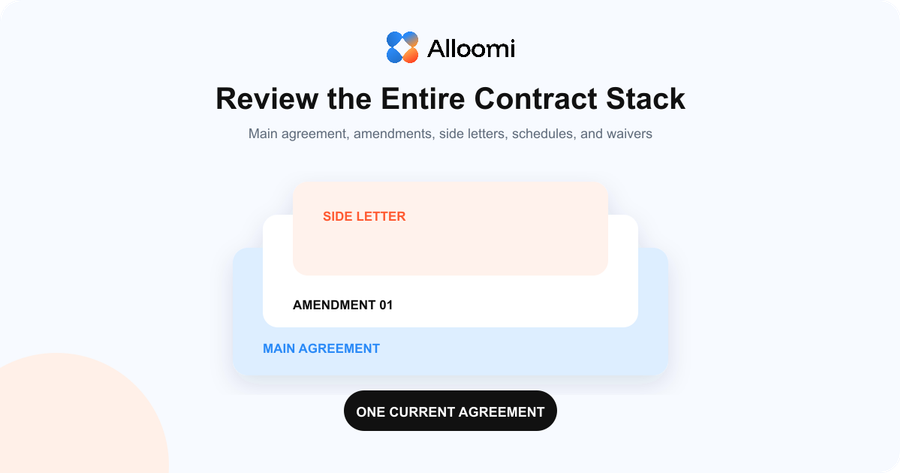
Boilerplate clauses interact. Assignment may affect confidentiality and licensing. Notices control termination and renewal. Entire agreement language affects side letters and proposals. Amendment and waiver provisions determine how the written contract can evolve.
Reviewers should therefore avoid checking each clause as an isolated template item. Map the event, required process, decision owner, deadline, and consequence.
For example, if the business wants to terminate for an uncured breach, the reviewer should connect the breach clause, cure period, notices provision, termination right, effect of termination, transition assistance, and surviving obligations.
For agreements changed by supplemental documents, see How to Review Contract Amendments and Side Letters Together.
How AI Can Assist With Boilerplate Review
AI can identify boilerplate provisions, compare them with approved language, detect missing clauses, and surface inconsistencies across the agreement. It can also help connect notice, amendment, waiver, assignment, and termination provisions that may appear in different sections.
Alloomi AI can support contract review by helping teams analyze language in context and identify issues that deserve attention. It should not be assumed that a clause is safe merely because it resembles standard language.
A qualified human should confirm the clause text, applicable law, transaction context, business process, and recommended position before the agreement is approved.
Common Boilerplate Review Mistakes
One mistake is accepting the counterparty's standard language without asking which party benefits from it.
Another is reviewing clause labels instead of operative wording. Two sections called "Assignment" may produce very different results.
Reviewers also fail when they do not check operational details. A notice clause with an obsolete address or an approval requirement assigned to the wrong role can be legally and commercially disruptive.
Finally, teams may negotiate a strong commercial position and then weaken it through inconsistent boilerplate, such as an order-of-precedence clause that gives another document control.
Conclusion
Boilerplate is not filler. These clauses shape how a contract is interpreted, changed, transferred, enforced, and exited.
A disciplined review connects each provision to a real event and asks whether the required process, decision authority, and consequence fit the transaction. Standard wording still deserves transaction-specific judgment.
Frequently Asked Questions
1. What are boilerplate clauses in a contract?
Boilerplate clauses are standardized provisions dealing with contract administration, interpretation, transfer, amendment, dispute process, and enforcement. Common examples include assignment, notices, governing law, entire agreement, severability, amendment, and waiver.
2. Are boilerplate clauses legally important?
Yes. They may determine where a dispute occurs, how notice must be delivered, whether rights can be transferred, which prior statements count, and how the contract can be changed or enforced.
3. Can the same boilerplate language be used in every contract?
Not safely. The appropriate wording depends on the parties, transaction, operational process, applicable law, and risk allocation. Standard language should be reviewed for the specific agreement.
Disclaimer: This article provides general information and does not constitute legal advice. The effect of contract clauses depends on their wording, applicable law, transaction structure, and specific circumstances.