Insurance requirements are meant to support the contract's risk allocation when a covered loss occurs. They should not be copied from a standard template without checking the services, assets, people, data, vehicles, professional duties, and maximum credible loss involved in the transaction.
A clause can look protective while requiring the wrong policy, an unavailable endorsement, or limits that do not respond to the principal risk. Review the insurance provision alongside indemnification, limitation of liability, warranties, security obligations, and operational responsibilities.
Start With the Risk, Not the Policy Name
Describe the events the contract is trying to finance or transfer. Examples include bodily injury at a worksite, damage to property, negligent professional services, a security incident, employee injury, vehicle accidents, product defects, or management claims.
The National Association of Insurance Commissioners explains that commercial general liability coverage commonly addresses bodily injury, property damage, personal injury, and certain advertising injury, while professional, employment, vehicle, cyber, and other exposures may require separate coverage. That distinction matters because a general requirement to maintain "appropriate insurance" does not prove that the relevant loss is covered.
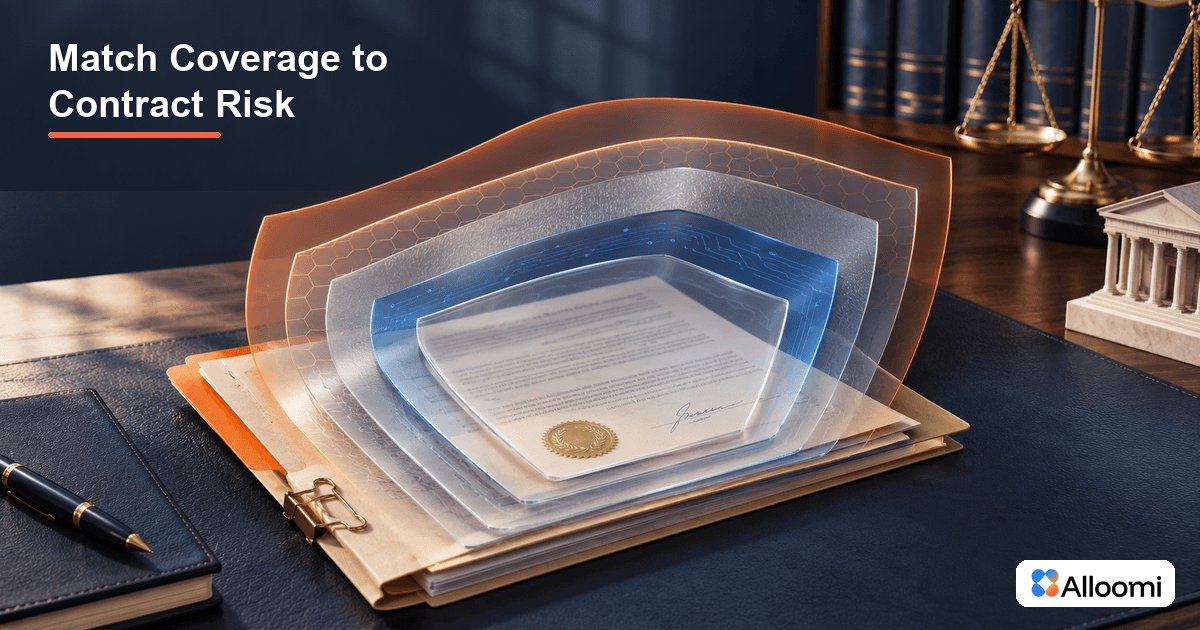
Match Coverage to the Contracted Work
Common requirements may include:
• Commercial general liability for premises, operations, bodily injury, and property damage exposures.
• Professional liability or errors and omissions coverage for advisory, design, technology, or other professional services.
• Cyber or technology errors and omissions coverage where the supplier handles systems, software, personal data, or security obligations.
• Workers' compensation and employers' liability where personnel perform the work.
• Commercial automobile coverage where owned, hired, or non-owned vehicles may be used.
• Product liability, crime, environmental, media, or directors and officers coverage when the risk profile calls for it.
The U.S. Small Business Administration distinguishes general liability, product liability, and professional liability by the type of loss each is designed to address. Use the operational facts of the deal to decide which categories matter.
Test the Limits Against Plausible Loss
Review per-occurrence limits, aggregate limits, sublimits, deductibles, self-insured retentions, and umbrella or excess coverage. A headline limit may be misleading if several customers share the same aggregate or if a relevant category has a lower sublimit.
Ask whether defense costs erode the limit, whether the limit applies per claim or per event, and whether the amount is commercially available for a supplier of that size. The answer should align with the contract's indemnity and liability structure rather than serve as a substitute for it.
Use How to Review an Indemnification Clause in a Contract to compare insured risks with the duty to defend and indemnify.
Review Additional Insured and Primary Coverage Requirements
If one party must be named as an additional insured, specify the policies and operations to which that status applies. Confirm whether ongoing and completed operations are relevant and whether the required endorsement is available.
Terms such as "primary and noncontributory" and waiver of subrogation can materially affect how policies respond. They should be reviewed by qualified insurance professionals and counsel, not inserted solely because they appeared in a prior agreement.
A certificate of insurance is evidence that coverage was represented as existing on a particular date. It should not be treated as the policy itself or as proof that every contractual requirement is satisfied. Where the exposure is material, identify the endorsements or other evidence that must be provided.
Check Claims-Made Coverage Carefully
Professional, cyber, and management liability policies may operate on a claims-made basis. Review the retroactive date, continuity, reporting requirements, extended reporting period, and obligation to maintain coverage after the services end.
A policy maintained only during the active contract may not respond to a claim first made after termination. Tail coverage or continued insurance may be appropriate where the loss could surface later.
Address Exclusions and Contractual Liability
Insurance should not be described as covering every liability assumed under the contract. Policies contain exclusions, definitions, conditions, and endorsements. Contractual liability coverage may be narrower than the indemnity promise, and an exclusion may remove the very event the clause appears designed to cover.
Coordinate the insurance review with How to Review Warranty and Disclaimer Clauses Before Signing and the agreement's liability cap. A party should understand which obligations remain uninsured.
Define Evidence, Notice, and Maintenance Duties
State when evidence is due, who receives it, what documents are sufficient, and how deficiencies are handled. Avoid requiring notice of cancellation on terms the insurer will not provide. Instead, create a contractual duty for the insured party to notify the counterparty promptly after learning of cancellation, nonrenewal, or a material reduction.
Require coverage from appropriately authorized or financially suitable insurers, but ensure any rating threshold is realistic for the relevant market and jurisdiction.
Coordinate Claims Without Giving Away Control
The agreement should explain who reports a claim, who communicates with insurers, who provides records, and how settlements interact with indemnity procedures. Preserve privilege and avoid requiring disclosure of protected legal analysis merely because an insurer requests cooperation.
Where audit rights cover insurance evidence, keep the request proportionate. The review framework in How to Review Audit Rights in Commercial Contracts can help define scope and confidentiality.
Insurance Requirements Review Matrix
| Review area | What to confirm | Common failure |
|---|---|---|
| Coverage | Policy types match the actual services and exposures | Generic CGL requirement for a professional or cyber risk |
| Limits | Occurrence, aggregate, sublimits, retention, and excess layers | Headline limit hides a low sublimit or shared aggregate |
| Status | Additional insured, primary coverage, and subrogation terms | Requirement cannot be supported by the available endorsement |
| Duration | Retroactive date, claims-made reporting, and tail period | Coverage ends before a later claim is reported |
| Evidence | Certificates, endorsements, timing, and deficiency process | Certificate is accepted as proof of policy wording |
| Claims | Notice, cooperation, defense, settlement, and privilege | Contract and policy processes conflict after a loss |
How Alloomi Can Support Insurance-Clause Review
Alloomi AI can help reviewers locate insurance requirements across an MSA, SOW, vendor form, and amendment; compare them with indemnity and liability terms; and surface inconsistent limits, duration requirements, or evidence obligations. Human reviewers should confirm coverage with qualified insurance professionals and legal counsel.
For a complete contract-stack review, see How to Review an MSA.
Frequently Asked Questions
1. Is a certificate of insurance enough?
Not always. It provides evidence of stated coverage but does not replace the policy or required endorsements.
2. Should insurance limits equal the liability cap?
Not automatically. Insurance and contractual liability perform different functions. Their relationship should be deliberate and based on the risk.
3. Who should review the insurance clause?
Legal, risk management, procurement, the business owner, and a qualified broker or insurance adviser may all need to participate.
Conclusion
A useful insurance clause begins with the actual loss scenario. Match coverage to the work, test limits and exclusions, verify additional-insured requirements, address claims-made timing, define evidence, and coordinate the clause with indemnity and liability.