A putative Illinois class action reported in November 2026 alleges that sidewalk delivery robots scanned facial and hand geometry without required notice or consent, lacked a public retention schedule, and shared data with third parties for AI training. The allegations illustrate a broader issue: a camera-equipped robot can become a biometric privacy system even when its primary product is delivery.
Companies using computer vision should not assume that data is outside biometric law because images are collected in public or because the system describes them as safety telemetry.
Why BIPA Matters
The Illinois Biometric Information Privacy Act regulates private entities' collection and handling of biometric identifiers and biometric information. The statute addresses written policy, notice, purpose and term disclosure, written release, sale or profit, disclosure, retention, destruction, and protection. The official text appears in 740 ILCS 14.
Whether a particular technology collects a covered identifier depends on how it processes data, not merely the presence of a camera. Legal review should examine the actual model inputs, templates, embeddings, matching functions, storage, and downstream sharing.
The Questions a Robotics Company Must Answer
What is captured?
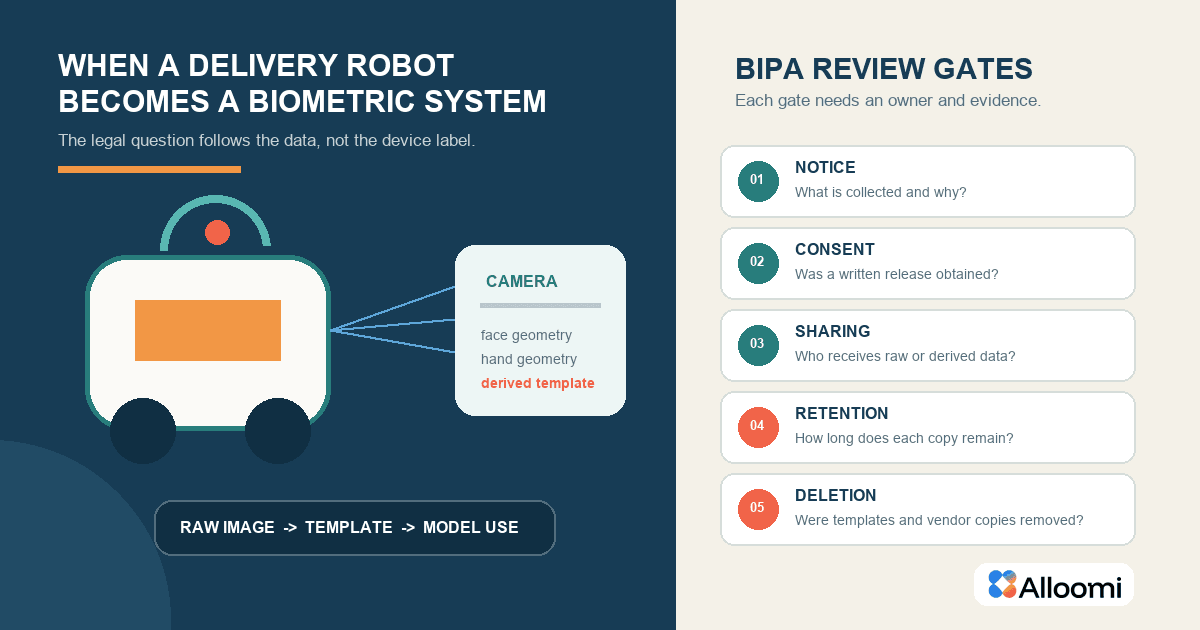
Document video, images, depth data, face or hand geometry, voice, location, device identifiers, and derived features. Explain whether the system identifies, verifies, tracks, or merely detects a person.
When does processing occur?
Distinguish on-device transient processing from transmission, storage, human review, model improvement, and third-party training.
Who receives the data?
Map cloud providers, model vendors, annotation services, security contractors, customers, law enforcement requests, and affiliates.
How is consent obtained?
A sidewalk sign, app term, customer agreement, and bystander notice reach different people. The operational design must match the people whose data is processed.
When is data destroyed?
Define event-level and account-level retention, deletion triggers, backups, training datasets, derived templates, and legal holds.
Public Space Does Not Eliminate Privacy Duties
A person visible on a street may not expect complete anonymity, but that does not answer whether a company may convert an image into a biometric template. Privacy laws often distinguish ordinary observation from automated identification or measurement.
Product counsel should review camera placement, field of view, default retention, and whether people can avoid the scan. Security and safety purposes should be documented rather than used as broad labels for unrelated model development.
Contracts Must Follow the Data
Vendor agreements should specify data categories, processing purpose, retention, deletion, security, incident response, training restrictions, audit evidence, and responsibility for notices and consent. Use the framework in How to Review a Data Processing Agreement Before Signing.
Review whether the vendor can reuse footage or derived features for general model training. For broader AI terms, see What Should an AI Use Clause Include in a Vendor Contract?. Ensure privacy representations match the real system, as discussed in How Consumer Protection Laws Apply to AI Companies.
How Alloomi Can Support the Review
Alloomi can help legal teams connect product data maps, vendor terms, policies, approvals, incidents, and remediation tasks. It does not determine whether a technical feature is a covered biometric identifier.
Frequently Asked Questions
1. Does every camera create BIPA liability?
No. The analysis depends on whether the system collects or derives covered biometric identifiers or information and how that data is handled.
2. Can a privacy policy replace consent?
Not necessarily. Applicable law may require specific notice and a written release before collection.
3. Does deletion of video solve the problem?
Not if templates, embeddings, training copies, backups, or third-party copies remain.
Conclusion
Robotics companies should treat computer vision as a data lifecycle, not a camera feature. Identify biometric processing, design notice and consent for affected people, restrict secondary training, control vendors, and prove deletion across raw and derived data.