On November 13, 2026, the Ontario Court of Appeal reportedly dismissed OpenAI's jurisdictional appeal in a copyright action brought by Canadian news publishers. The ruling allows the dispute to proceed in Ontario without deciding whether the publishers will prevail on infringement.
The procedural result matters because AI systems operate across borders. Content may be published in one country, acquired through infrastructure in another, processed elsewhere, and delivered to users globally. Forum disputes can determine applicable procedure, discovery, cost, remedies, and litigation strategy before a court reaches the merits.
Jurisdiction Is Not the Same as Liability
A court's decision to hear a case does not prove copyright infringement. It addresses whether the forum has a sufficient connection to the parties and dispute and whether another forum is clearly more appropriate under the applicable test.
Legal teams should avoid headlines that convert a jurisdiction ruling into a merits decision. Track the appellate reasons, trial-court record, pleadings, and later orders separately.
The Cross-Border Facts That Usually Matter
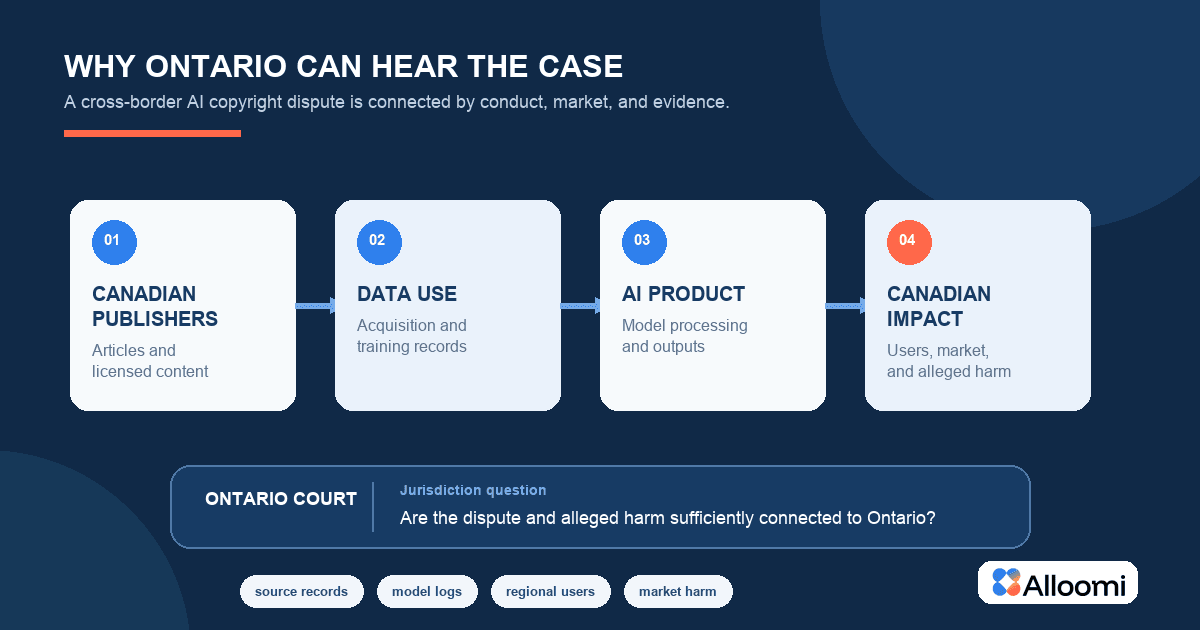
• Where the claimant and defendant carry on business.
• Where the protected content was created, published, or accessed.
• How data was acquired and by whom.
• Where training, storage, retrieval, and output generation occurred.
• Whether the product targeted or served users in the forum.
• Where the alleged market and reputational harm occurred.
• Which witnesses, records, and technical systems are available in each forum.
Build a Litigation-Ready Data Map
A generic architecture diagram is not enough. Preserve source acquisition records, crawler configurations, licenses, hosting regions, model versions, retrieval indexes, output logs, geo-targeting, customer locations, and deletion events. The map should distinguish technical location from legal control.
For model-training provenance, the lessons from the 2026 AI Copyright Lawsuit Tracker and The Legal AI Audit Trail are complementary: preserve both the source and the chain of decisions around it.
Contract Clauses Cannot Eliminate Forum Risk
Choice-of-law and forum clauses can matter in contractual disputes, but they do not necessarily bind nonparties or resolve statutory claims. Review data licenses, publisher agreements, vendor terms, user terms, and indemnities together.
Where third parties supply data, confirm who obtained permission, what territory and use the license covers, and who controls the evidence needed to defend a claim. A warranty without audit evidence may be difficult to enforce when litigation begins.
Use Authoritative Sources Carefully
Because this is an evolving foreign proceeding, rely on the court's reasons and docket when available. Contemporary reporting can identify the development, but teams should not infer the merits from a short case summary. The broader Canadian copyright framework is available through the Copyright Act.
How Alloomi Can Support Cross-Border Review
Alloomi can help authorized teams organize licenses, product records, regional deployments, litigation documents, and reviewer decisions in one source-connected workspace. It does not choose the forum or determine infringement.
Teams handling a large document set can also apply the controls in AI Document Review in Litigation and preserve chronology using a source-linked litigation timeline.
Frequently Asked Questions
1. Did the Ontario court decide that OpenAI infringed copyright?
No. The reported decision concerns jurisdiction, not final liability.
2. Why does forum matter in an AI case?
Forum affects procedure, discovery, governing doctrines, cost, enforceability, and access to evidence.
3. What should companies preserve first?
Preserve acquisition records, licenses, model and index versions, regional infrastructure, output evidence, and records showing where decisions were made.
Conclusion
Cross-border AI disputes are shaped by where content, systems, users, and harm connect. Companies should build jurisdiction-aware data maps and preserve provenance before a complaint forces them to reconstruct a global workflow under deadline.