A new California lawsuit asks a court to stop five major AI companies from developing or deploying more powerful models. The request is extraordinary, but it does not mean the AI industry has already been ordered to pause.
The complaint was filed in San Francisco Superior Court by four nonprofit organizations against Anthropic, Google, Meta, OpenAI, and SpaceX Super Intelligence. According to the Associated Press report on the filing, the plaintiffs allege that frontier AI development creates catastrophic risks that the companies cannot reliably control.
Those allegations have not been proven. The defendants will have opportunities to challenge the claims, the plaintiffs' standing, the requested remedies, and the factual basis for an injunction. Even so, the case matters because it attempts to convert broad AI safety concerns into an enforceable court order.
What the Plaintiffs Are Asking the Court to Do
The lawsuit reportedly seeks to prevent the defendants from developing or releasing new advanced AI models unless adequate safeguards are established. That remedy goes far beyond monetary damages after an incident.
An injunction operates prospectively. It tells a party to do something or stop doing something. In a fast-moving technical field, the details matter enormously. A court would need to understand what counts as a new model, what conduct constitutes development or deployment, which safeguards are sufficient, who evaluates compliance, and how an order could be enforced.
The complaint invokes California legal theories including unfair competition and public nuisance. California's Unfair Competition Law prohibits unlawful, unfair, or fraudulent business acts and practices. The statute can support injunctive relief, but applying it to frontier model development raises difficult questions about injury, causation, jurisdiction, and the proper role of courts.
The case is therefore not simply about whether advanced AI can cause harm. It is also about whether the plaintiffs can connect a legally recognized injury to particular defendants and obtain a remedy that is specific enough for a court to administer.
Why Stopping Model Development Is an Unusually Difficult Remedy
Courts regularly issue injunctions in areas such as trade secrets, intellectual property, consumer protection, employment, and environmental law. Frontier AI presents a different scale of technical and institutional complexity.
The court may need to examine questions such as:
• Are the alleged harms current, imminent, or speculative?
• Do the plaintiffs have standing to seek relief?
• Can particular injuries be traced to each named company?
• Would an injunction prevent harm, or shift development elsewhere?
• How should the order define model capability or frontier development?
• Who could independently evaluate whether safeguards are adequate?
• Would the requested order conflict with federal policy, interstate commerce, or existing regulation?
• Could a narrower remedy address the alleged conduct?
An order that simply requires "safe AI" would be too vague to administer. An order containing technical thresholds may become obsolete quickly or require ongoing expert supervision. These problems do not make an injunction impossible, but they demonstrate why the requested remedy will receive close scrutiny.
The Lawsuit Turns AI Safety Statements Into Potential Evidence
AI companies have published model cards, safety frameworks, evaluation results, system descriptions, usage policies, and public warnings about advanced capabilities. Plaintiffs may rely on those materials to argue that companies understood particular risks.
The defendants may use the same records to show that they identified risks, performed testing, adopted controls, restricted certain uses, and revised systems after incidents.
This creates an important lesson for every AI developer and deployer: safety communications are legal records. They should be accurate, consistent, and connected to the underlying evidence.
A public statement may create problems when it differs from:
• Internal model evaluations.
• Red-team findings.
• Incident reports.
• Known safeguard bypasses.
• Executive or board presentations.
• Customer documentation.
• Contractual commitments.
• Release approval records.
Legal teams should not wait for litigation to discover these inconsistencies. A controlled process for verifying AI-generated evidence and technical claims can help teams distinguish a supported conclusion from an assumption or marketing statement.
Model Release Governance Is Becoming a Legal Control
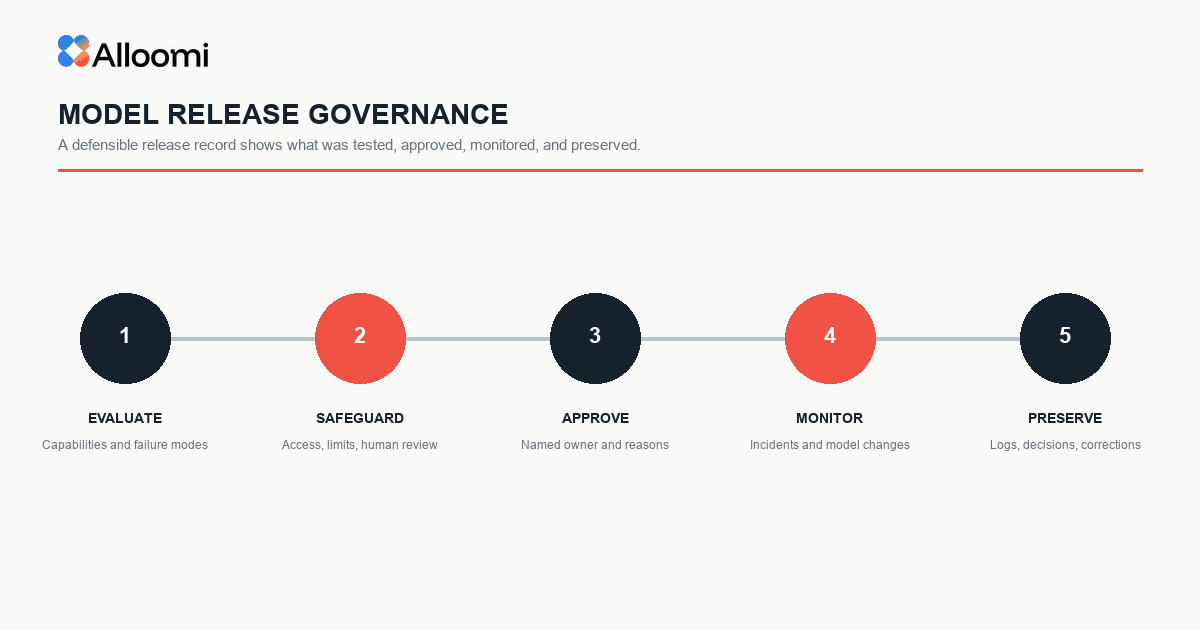
Most organizations do not build frontier foundation models. Many still release AI agents, customer-facing assistants, automated recommendations, or high-impact features. The same governance principle applies: release decisions should be documented and reviewable.
A defensible model-release record should identify:
• The intended use and foreseeable misuse.
• The models, tools, data, and external systems involved.
• The evaluations performed and their limitations.
• Known failure modes and unresolved risks.
• Human review and escalation requirements.
• Access restrictions, monitoring, and incident response.
• The individuals who approved the release.
• The reasons the remaining risk was accepted.
These controls are especially important for systems that can take actions, access external tools, or handle sensitive information. Permission design should be reviewed before deployment, not after an incident. Alloomi's guide to AI agent permissions for legal teams explains how scope, authority, and approval boundaries affect risk.
What Legal Teams Should Do Now
The lawsuit may take time to resolve. Legal teams do not need to predict the outcome before improving their own governance.
Begin by mapping every deployed or planned AI system. Record its owner, purpose, users, data sources, model provider, external tools, affected jurisdictions, contractual restrictions, and approval status.
Next, identify claims that require evidence. Statements such as "safe," "accurate," "private," "human-supervised," or "compliant" should be tied to defined tests and limitations. A label alone is not a control.
Then, review vendor contracts. Contracts should address security, training data, confidentiality, incident notification, audit rights, change management, subcontractors, model updates, and responsibility for harmful outputs. The article on AI terms in vendor contracts provides a practical starting point.
Finally, establish an escalation process. A serious failure should trigger preservation of relevant prompts, outputs, logs, model versions, user actions, approvals, and communications. Legal teams should know who can suspend a system and how that decision will be recorded.
These measures also support broader AI regulatory change monitoring. Litigation, statutes, agency action, and contract requirements increasingly influence the same operational controls.
How Alloomi Can Support Model-Risk Review
Alloomi AI can help authorized legal teams organize model policies, evaluation reports, vendor agreements, incident records, public statements, and litigation documents for structured review.
Teams can use Alloomi to locate inconsistent descriptions, compare obligations across contracts, build timelines, identify unresolved questions, and connect findings to source documents. This is particularly useful when the relevant evidence is distributed across legal, engineering, security, product, and policy teams.
Alloomi does not decide whether a model is safe or whether a court should issue an injunction. Those decisions require technical evidence, legal analysis, and accountable human judgment. The platform helps teams prepare the record that those decisions depend on.
Organizations should also maintain a clear AI use policy and review process. A policy that is not connected to release approval, monitoring, and incident response will have limited value.
Practical Takeaway
The California lawsuit is important because it asks a court to regulate frontier AI development through an injunction rather than waiting for lawmakers or agencies to create a complete framework.
The outcome remains uncertain. The immediate lesson is clearer: companies deploying powerful AI should be able to show what they tested, what they knew, what remained uncertain, who approved the release, and what controls existed when the decision was made.
Frequently Asked Questions
1. Has a court already stopped frontier AI development?
No. The plaintiffs have requested injunctive relief, but the allegations and requested remedy remain subject to litigation and judicial review.
2. Which companies are named in the lawsuit?
Reports identify Anthropic, Google, Meta, OpenAI, and SpaceX Super Intelligence among the defendants. Readers should consult the filed complaint and docket for the precise parties and claims.
3. What is an injunction?
An injunction is a court order requiring a person or organization to take or stop specified actions. The applicable standards depend on the jurisdiction, claim, procedural stage, and requested relief.
4. What should companies preserve after a serious AI incident?
Relevant records may include prompts, outputs, logs, model versions, evaluations, approvals, user actions, communications, contracts, policies, and remediation decisions. Preservation requirements depend on the circumstances and applicable law.