Corporate disclosures are increasingly consumed by machines before many humans read them. Investors, regulators, data vendors, analysts, and AI systems can extract and compare information across thousands of filings. That makes document structure and data quality part of legal risk management.
On November 9, 2026, the Securities and Exchange Commission held a roundtable on machine-understandable data in the age of super intelligence. The discussion distinguished information that is technically machine-readable from information that machines can interpret accurately and consistently.
For legal teams, the point is not that every filing must be written for an AI model. The point is that inaccurate tags, inconsistent definitions, unsupported numbers, and disconnected source records can be detected and amplified more quickly when machines perform the first review.
Machine-Readable Is Not the Same as Machine-Understandable
A PDF can be readable by a person while remaining difficult for software to analyze. Structured formats make particular facts easier to identify, compare, and process. SEC reporting already relies on structured data systems such as Inline XBRL for many disclosures.
Machine-readable information follows a format that software can parse. Machine-understandable information goes further: the system can interpret what the information represents, how it relates to other facts, and whether comparable fields mean the same thing.
The distinction matters because structure cannot correct a false or poorly defined fact. A perfectly tagged number can still be wrong. A clearly labeled risk can still omit a material qualification. A machine may also compare two fields that appear equivalent but were prepared using different assumptions.
SEC Commissioner Caroline Crenshaw's remarks emphasized that making information machine-readable may not make it machine-understandable. Legal, finance, accounting, data, and technology teams therefore need common definitions and evidence, not merely better formatting.
Legal Teams Are Responsible for Meaning, Not Just Format
Disclosure work often moves through several systems. A business unit supplies information. Finance calculates a metric. Legal drafts language. A filing team applies tags. Reviewers approve the final document. Each handoff can introduce inconsistency.
When machines compare disclosures across time, errors that once looked minor may become more visible:
• A metric changes definition without a clear explanation.
• A number in the narrative differs from a tagged amount.
• A risk factor describes a problem as hypothetical after an incident has occurred.
• A subsidiary, product, or contract is named differently across filings.
• A non-GAAP measure cannot be traced to its reconciliation.
• A material agreement conflicts with the public summary of the arrangement.
• A correction appears in one document but not in related disclosures.
This is why a legal team needs more than a final filing. It needs a record of where each material statement came from, who reviewed it, what assumptions were used, and what changed between versions.
That record resembles a Legal AI audit trail: input, instruction, source, output, review, correction, and approval. The same structure supports both human accountability and machine-assisted analysis.
Source Lineage Is the Foundation of Reliable Disclosure
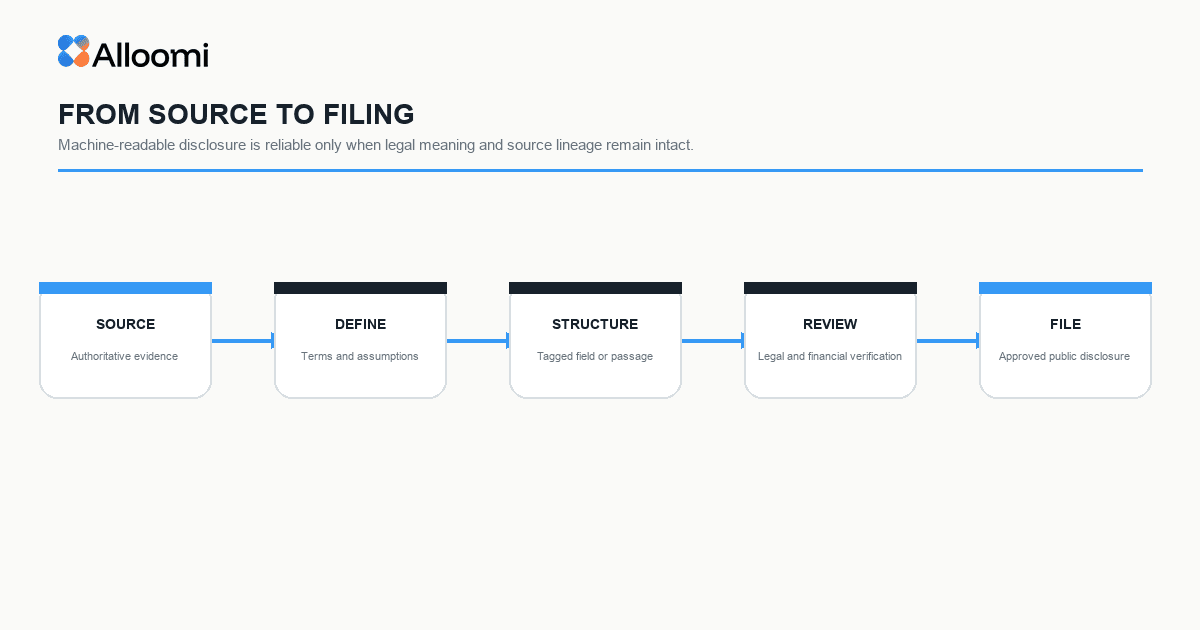
Source lineage connects a published statement to its supporting evidence. For a financial metric, the source may be an accounting system and reconciliation. For a cybersecurity statement, it may be incident reports and security assessments. For an AI risk statement, it may be model evaluations, vendor documentation, product records, and legal analysis.
A strong disclosure workflow should answer:
• What is the authoritative source?
• Who owns the information?
• When was it last verified?
• Which assumptions or definitions apply?
• Where else is the same fact used?
• What changed from the prior reporting period?
• Who approved the final language?
Without those answers, a machine can identify a discrepancy faster, but the legal team may still need days to reconstruct why it occurred.
This problem is familiar in contract management. A clause may appear in several agreements, amendments, side letters, summaries, and operational systems. An AI-ready contract repository needs document relationships and source context, not just extracted fields.
AI-Assisted Review Changes the Scale of Comparison
Traditional disclosure review is constrained by human time. Reviewers compare the current draft with prior filings, board materials, financial reports, and selected source documents. AI-assisted review can expand that comparison across a much larger record.
Possible uses include:
• Comparing definitions and metrics across reporting periods.
• Locating inconsistent descriptions of the same event.
• Identifying changes in risk-factor language.
• Matching public statements to contracts or board records.
• Detecting missing references or broken document relationships.
• Building a timeline of events and corrections.
• Flagging statements that lack an identified source.
The system should not make the final materiality or disclosure decision. It should help reviewers find issues, retrieve relevant evidence, and explain why a statement was flagged.
This is where retrieval-augmented generation can help. A properly designed system retrieves relevant source material before generating an answer, keeping analysis connected to evidence. The article What Is RAG in Legal AI? explains the basic approach and its limitations.
The Risk of Confident but Unsupported Analysis
Machine-understandable data can improve review, but AI introduces its own risks. A model may misread a table, confuse reporting periods, invent a relationship, or provide a confident explanation unsupported by the filing.
Legal teams should require every material AI-assisted finding to include:
• The exact source document.
• The relevant passage, field, or data point.
• The reporting period and version.
• The comparison or reasoning performed.
• Any uncertainty or missing information.
• The human reviewer and final disposition.
The team should also preserve rejected suggestions when they are material to the review process. A reviewer may reasonably conclude that a flag is false, but the basis for that conclusion should be recorded.
These practices support the broader process for reviewing and verifying AI-generated legal work. Verification is not a final glance. It is an evidence-linked workflow.
How Legal Teams Can Prepare Their Disclosure Process
Start with the records, not the AI tool.
Create an inventory of recurring disclosures, metrics, risk factors, material agreements, policies, and responsible owners. Identify the systems and documents that support each item.
Next, standardize definitions. Teams should agree on the meaning of key terms, reporting periods, entities, product names, metrics, and risk categories. When a definition changes, record why and identify every affected disclosure.
Then, establish version relationships. The team should be able to connect a current filing to prior filings, amendments, board materials, source data, and review comments. Contract teams apply the same discipline when they compare contract versions.
Finally, test retrieval and review. Ask whether an authorized reviewer can locate the evidence for a material statement quickly. If the answer depends on one employee remembering an email or folder, the process is not ready for machine-scale scrutiny.
How Alloomi Can Support Traceable Legal Data
Alloomi AI can help authorized legal teams organize filings, contracts, policies, board records, regulatory materials, and supporting documents for evidence-linked review.
Teams can use Alloomi to compare document versions, locate related provisions, identify inconsistent statements, build timelines, and connect conclusions to source material. This helps reduce the manual work required to reconstruct context across separate systems and document collections.
For corporate disclosure workflows, Alloomi can support:
• Source-linked review of draft statements.
• Comparison with prior filings and internal records.
• Tracking of review questions, owners, and resolutions.
• Preservation of relevant evidence and approvals.
• Reuse of verified legal knowledge across reporting cycles.
The goal is not to let an AI system decide what a company must disclose. The goal is to give legal professionals a better-organized record for making and verifying that decision. A broader legal knowledge management workflow can help teams reuse approved analysis without losing its source context.
Practical Takeaway
The SEC's focus on machine-understandable data signals a future in which corporate disclosures are compared at greater speed and scale. Machines may spot inconsistencies quickly, but only organizations can ensure that the underlying information is accurate, defined, traceable, and approved.
Legal teams should prepare by strengthening source lineage, definitions, version control, and review records now. Better structure helps AI, but it also makes human legal work easier to verify and defend.
Frequently Asked Questions
1. What is machine-readable SEC data?
Machine-readable data is information structured in a format that software can parse and process. SEC structured disclosure requirements include formats such as Inline XBRL for specified filings and data.
2. What makes data machine-understandable?
Machine-understandable data includes enough consistent meaning, context, relationships, and definitions for a system to interpret it reliably. Formatting alone does not guarantee understanding or accuracy.
3. Will AI replace lawyers in corporate disclosure review?
AI can accelerate comparison, retrieval, and issue spotting. Lawyers, accountants, executives, and other qualified personnel remain responsible for verifying facts, assessing materiality, resolving uncertainty, and approving disclosures.
4. How can a legal team make its records AI-ready?
Use authoritative source documents, consistent definitions, clear ownership, version relationships, metadata, access controls, evidence-linked conclusions, and documented human review.