An assignment clause determines whether contractual rights or performance obligations may move to another party. A change of control clause addresses what happens when the contracting entity remains in place but its ownership changes. Treating these provisions as interchangeable can create a serious gap during a merger, restructuring, financing, or asset sale.
A strong review asks five separate questions: what may be transferred, which events trigger consent, who remains liable, what exceptions apply, and what remedy follows if a transfer occurs without permission.
Start by Separating Assignment, Delegation, and Novation
An assignment generally transfers contractual rights. Delegation concerns performance of duties. A novation substitutes a new party and releases the original obligor with the required consent. The distinctions matter because a clause that prohibits assignment of the agreement may not answer whether a party can delegate performance or remain secondarily liable.
UCC Section 2-210 illustrates these distinctions for contracts involving goods. It addresses delegation, assignment, material changes in burden or risk, and the effect of assigning the contract as a whole. The applicable law and contract language still control the particular transaction.
Identify Every Event the Clause Covers
Do not review only a direct assignment document. Test the clause against the events the business may actually face:
• Sale of all or substantially all assets.
• Merger or consolidation.
• Stock sale or other change in voting control.
• Internal reorganization among affiliates.
• Transfer to a financing source as collateral.
• Subcontracting or delegation of performance.
• Conversion, domestication, or other entity restructuring.
A merger may transfer rights and liabilities by operation of law under the governing corporate statute. For example, Section 259 of the Delaware General Corporation Law addresses the status, rights, liabilities, and property of surviving entities after a merger. That does not eliminate the need to interpret the contract's own language.
Review the Consent Standard
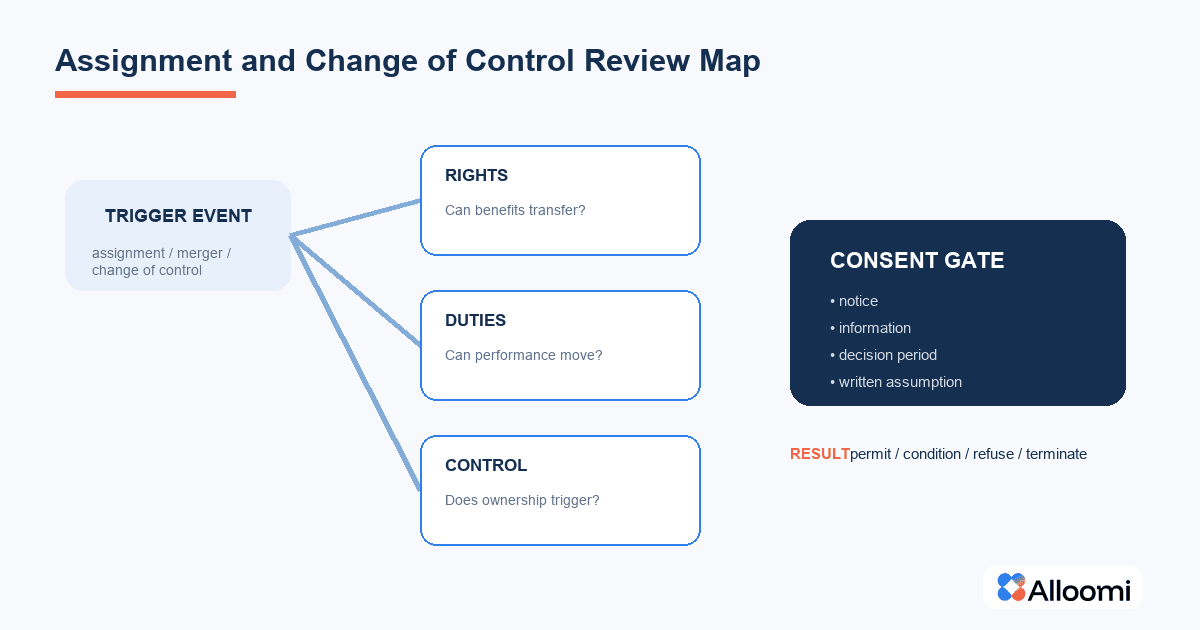
A clause may prohibit transfer absolutely, require prior written consent, or state that consent may not be unreasonably withheld, conditioned, or delayed. Those formulations allocate bargaining power differently.
If consent cannot be unreasonably withheld, consider whether the agreement defines relevant factors such as financial capacity, technical capability, competitive status, sanctions exposure, security controls, reputation, and continuity of service. Without criteria, the parties may later disagree about what counts as reasonable.
Also confirm who must request consent, what information must be provided, how long the other party has to respond, and whether silence has any effect. Connect the consent process to the agreement's notice provision.
Check Affiliate and Financing Exceptions
Many businesses need flexibility to reorganize within a corporate group or grant security interests to lenders. Exceptions should be narrow enough to preserve the original risk allocation.
An affiliate exception should address whether the transferee must remain an affiliate, assume the obligations in writing, meet financial and operational standards, and return the contract if it stops being an affiliate. A financing exception should distinguish a security interest from an enforcement transfer after default.
Use the broader risk method in How to Review Boilerplate Clauses That Can Change the Deal. Assignment language often appears near the end of a contract but can materially affect counterparty risk.
Decide Whether the Original Party Remains Liable
An assignment or delegation should not silently release the original party. If release is intended, specify the conditions and whether a novation is required. Cornell's explanation of novation emphasizes that substitution and release depend on agreement by the relevant original parties.
For critical services, consider requiring the original party to remain liable unless the counterparty expressly releases it. For an asset sale, the buyer may assume performance while the seller remains responsible for pre-closing breaches.
Align the Clause With Termination and Remedies
State what happens after a prohibited transfer. Options include termination, suspension, damages, injunctive relief, or a right to require reversal. Avoid a remedy that is commercially unusable, such as immediate termination of a mission-critical service without transition support.
Review the exit consequences together with renewal and termination terms, data return, transition assistance, prepaid fees, licenses, and confidentiality. If the event occurs during an acquisition, timing may matter as much as the final remedy.
Use Transaction-Specific Contract Mapping
When a company prepares for a merger or sale, create a list of contracts that require consent, notice, or neither. Record the clause text, responsible owner, deadline, delivery method, response, and closing dependency. The comparison process in How to Compare Contract Versions can help identify negotiated deviations from the standard clause.
For amendments or waivers obtained before closing, follow the controls in How to Review Contract Amendments and Side Letters. A side letter may change the transfer rule without modifying the main agreement text.
Build the Consent Schedule Before Signing or Closing
For a major transaction, contract teams should not wait until the closing checklist is nearly complete. Build a consent schedule as soon as the structure is known. Identify the agreement, counterparty, revenue or operational importance, relevant clause, triggering event, notice or consent requirement, response deadline, business owner, and closing condition.
Prioritize agreements where refusal could interrupt critical services, terminate an important license, accelerate payment, or create a default under another contract. Confirm whether disclosure of the proposed transaction is permitted before sending the request. The consent process may itself reveal confidential deal information.
Common Red Flags
• The clause prohibits assignment but never defines change of control.
• An affiliate transfer is permitted even if the transferee later leaves the corporate group.
• Consent may be withheld in absolute discretion with no response deadline.
• The clause releases the original party without an express novation.
• A prohibited transfer triggers immediate termination with no transition period.
• The assignment rule conflicts with a license, data-processing schedule, or order form.
How Alloomi Can Support Assignment Review
Alloomi can help legal teams locate assignment and change of control language across agreements, compare negotiated variants, connect consent obligations to transaction records, and preserve the source for human review. It does not determine whether a particular transaction triggers the clause.
Frequently Asked Questions
1. Is a change of control automatically an assignment?
No. The answer depends on the clause, transaction structure, governing law, and relevant case law. Some contracts expressly define change of control as an assignment; others treat it separately.
2. Does consent release the original party?
Not necessarily. A release should be explicit, and a novation may be required to substitute the new obligor fully.
3. Should internal affiliate transfers always be permitted?
No. The exception should reflect business needs and may require continuing liability, written assumption, financial capacity, and continued affiliate status.
Conclusion
Assignment review is a transaction-continuity exercise. Separate rights from duties, define change of control events, test consent mechanics, control exceptions, preserve liability, and connect the clause to termination, notice, and transition obligations.