A conflict check is not a name search. It is a professional judgment process that begins with accurate intake data, expands the relevant relationships, compares them with firm records, and ends with a documented lawyer decision. AI can improve the middle of that process by finding aliases, subsidiaries, former names, people, and matters that a simple exact-match search may miss.
AI-assisted conflict checking should therefore be treated as a discovery and prioritization tool, not an automatic clearance system. A strong workflow uses technology to widen the search while preserving lawyer control over relevance, consentability, confidentiality, and the final decision to accept or decline a matter.
What Is AI-Assisted Conflict Checking?
AI-assisted conflict checking uses entity matching, relationship extraction, semantic search, and matter context to identify records that may be connected to a prospective client or matter. It can recognize that a company changed names, connect a parent to a subsidiary, identify a director mentioned in an earlier matter, or flag a similar entity whose spelling differs across documents.
The result is a set of possible relationships for review. It is not a legal conclusion that a conflict exists. The lawyer must still determine who the client is, whether interests are directly adverse, whether representation may be materially limited, whether the issue is consentable, and what applicable law or professional rules require.
Why Exact Name Matching Misses Important Relationships
Legal relationships rarely fit into one clean client-name field. A new matter may involve affiliates, beneficial owners, lenders, insurers, witnesses, executives, opposing counsel, counterparties, or experts. Historical records may use abbreviations, old names, local-language names, trade names, or typographical variations.
A conventional search can return nothing even though a meaningful relationship exists. It can also produce hundreds of irrelevant matches when a person or company has a common name. AI can help normalize names, group probable duplicates, and rank results by their connection to the proposed engagement.
Useful expansion targets include:
• Current and former legal names
• Parent companies, subsidiaries, and controlled affiliates
• Directors, officers, beneficial owners, and key employees
• Opposing parties, counterparties, and major witnesses
• Insurers, lenders, experts, and outside advisers
• Former clients and prospective clients
The Professional Rules Still Control
ABA Model Rule 1.7 addresses concurrent conflicts involving direct adversity or a significant risk that representation will be materially limited. Its comments state that a lawyer should adopt reasonable procedures, appropriate to the firm's size and practice, to identify the persons and issues involved.
That obligation cannot be delegated to an AI system. Technology may help locate a prior relationship, but it cannot independently determine whether two matters are substantially related, whether confidential information could be material, whether a conflict is consentable, or whether informed consent is adequate under the applicable jurisdiction.
A Practical AI-Assisted Conflict Check Workflow
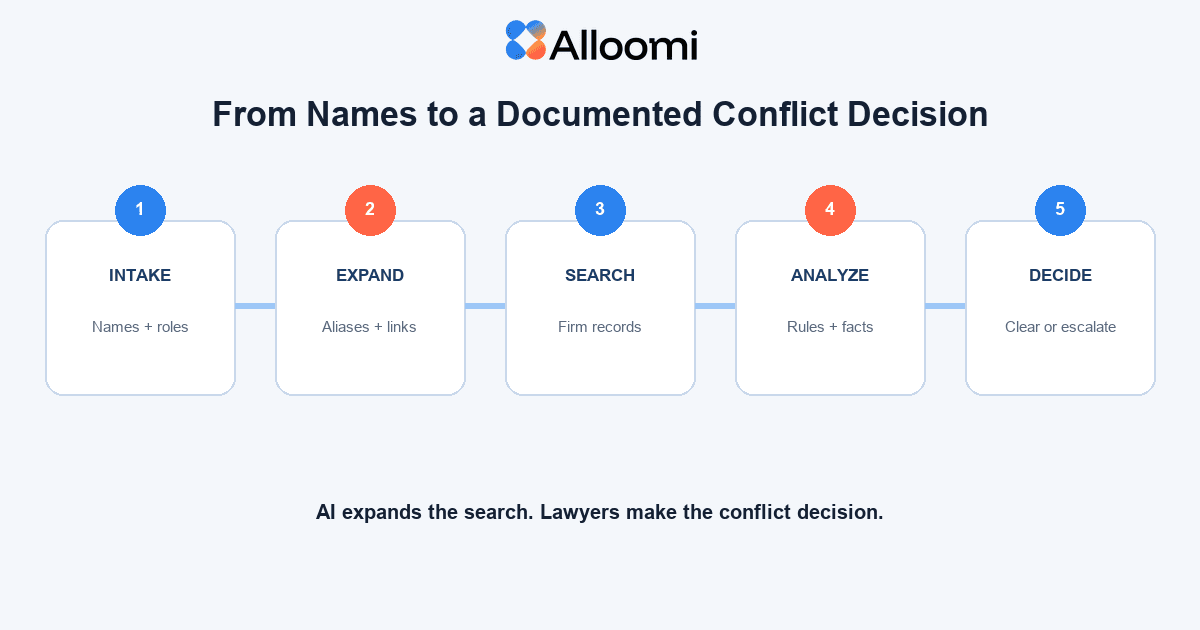
Collect complete intake information
Start with the proposed client, adverse parties, affiliates, relevant individuals, matter description, jurisdiction, and expected role. If intake captures only one company name, the search is constrained before it begins. See What Is Legal Case Intake? for a broader intake framework.
Normalize and expand the entities
Use AI to suggest aliases, spelling variations, former names, and likely corporate relationships. Each expansion should show its basis. A public company filing, client-provided structure chart, prior matter record, or verified database result is more useful than an unexplained association.
Search across connected records
Search client and matter systems, document repositories, billing records, contact lists, prior waivers, and attorney knowledge. Access should remain permission-aware. Sensitive information from one matter should not be exposed merely because a person performs an intake search.
Review possible matches
Separate confirmed matches, likely matches, weak matches, and false positives. The reviewer should see which name or relationship triggered the result, the source record, the responsible lawyer, matter status, dates, and enough context to escalate the issue without opening unrelated confidential content.
Make and document the legal decision
A lawyer decides whether the matter is clear, requires further investigation, needs a waiver, must be restricted, or should be declined. Record the reasoning, decision maker, date, conditions, and any follow-up obligation. This creates an audit trail when relationships change later.
What the Conflict Review Record Should Contain
| Record | Purpose | Review question |
|---|---|---|
| Intake entities | Preserve the exact names and roles supplied at intake | Were affiliates and key individuals included? |
| Expanded relationships | Show aliases, ownership links, and probable connections | What verified source supports each expansion? |
| Matched matters | Connect possible conflicts to firm records | Is it the same entity, and is the matter relevant? |
| Lawyer analysis | Apply current-client, former-client, and other duties | Is the issue actual, potential, consentable, or irrelevant? |
| Final disposition | Document clearance, conditions, waiver, or decline | Who decided, when, and on what basis? |
Where AI Can Create New Risk
AI may merge distinct entities, infer a corporate relationship that no longer exists, or rank a weak match too highly. It may also miss conflicts when source records are incomplete. More serious risks arise when the system exposes confidential matter descriptions to unauthorized users or sends client names to an unapproved external service.
Controls should address data scope, permissions, retention, vendor use, logging, confidence labels, and human escalation. Firms evaluating any legal AI system should also review How to Evaluate a Legal AI Tool Before Firmwide Rollout.
How Alloomi Can Support Conflict Review Context
Alloomi helps authorized legal teams keep people, projects, files, decisions, and history connected. In a conflict review workflow, that kind of context can help teams assemble the relevant matter background, surface prior decisions, and preserve the sources supporting a reviewer's conclusion.
Alloomi does not replace the lawyer's conflict analysis or determine whether representation is permitted. The value lies in reducing fragmented searches and helping the responsible professional review the relationship with the necessary context in view.
Frequently Asked Questions
1. Can AI clear a legal conflict automatically?
No. AI can identify possible relationships and prioritize records, but a lawyer must apply the relevant professional rules and make the final decision.
2. What information should be included in a conflict check?
Include the proposed client, adverse parties, affiliates, key individuals, matter description, jurisdiction, firm role, and any known related entities.
3. Can conflict-check results contain confidential information?
Yes. Search results may reveal sensitive client or matter information, so access should be limited and designed to show only the context needed for review.
Conclusion
AI can make conflict checks broader and more efficient, especially when names and relationships are inconsistent across firm records. The safest design is not automatic clearance. It is a controlled process that combines complete intake, traceable relationship discovery, permission-aware search, lawyer analysis, and documented sign-off.