AI can translate a legal document quickly, but speed does not establish accuracy, legal equivalence, or client understanding. A translation can read smoothly while changing an obligation, weakening a qualification, reversing a deadline, or selecting the wrong legal concept for the jurisdiction.
Lawyers should treat AI translation as a working draft. The review process must preserve the source text, identify the governing language, protect confidential information, verify defined terms and operative provisions, and use a qualified human reviewer when the document may affect rights, evidence, filing obligations, or informed client decisions.
Why Legal Translation Is Different From General Translation
Legal language often performs an action. It creates a duty, grants discretion, allocates risk, limits a remedy, records consent, or satisfies a procedural requirement. A translation that communicates the general idea may still fail if it changes the legal function of the text.
Problems commonly arise with:
• Defined terms that must remain consistent across the document
• Modal verbs such as shall, may, must, and will
• Negation, exceptions, provisos, and conditions
• Jurisdiction-specific concepts without exact equivalents
• Dates, currencies, percentages, names, and legal citations
• Signature blocks, exhibits, schedules, stamps, and handwritten notes
• Text embedded in images, tables, headers, or scanned pages
What AI Translation Can Do Well
AI can help a legal team obtain a preliminary understanding of a large document set, identify potentially relevant records, create a first-pass translation for internal triage, and maintain a terminology list across repeated documents. It can also flag passages where the source structure is ambiguous or where multiple translations may be possible.
Those uses are different from certifying a translation, advising a client based on translated language, filing a translated document, or asking a witness to adopt translated words. The higher the consequence, the deeper the human review should be.
Professional Duties Remain With the Lawyer
ABA guidance discussing Formal Opinion 500 explains that lawyers must identify and address language-access barriers, assess the qualifications of interpreters or assistance providers, and supervise their use. The duty is not satisfied merely because a translation tool produces understandable prose.
The ABA's Standard 5.7 on Implementing Language Justice also states that when machine translation is used for written legal information, a skilled human translator should review and edit the material to preserve clear meaning and plain language.
A Practical Review Process for AI-Translated Legal Documents
Identify the purpose and consequence
Record whether the translation is for triage, internal review, client communication, negotiation, discovery, filing, execution, testimony, or another purpose. A low-risk internal orientation copy may not require the same process as a contract to be signed or evidence to be submitted.
Preserve the source and document structure
Keep the original file, page numbering, version, metadata, tables, annotations, and images. Place source and translated text side by side when possible. A reviewer should be able to move directly from any translated clause to the source passage.
Build a controlled terminology list
List defined terms, party names, institutions, statutes, technical expressions, and recurring business terms. Decide which terms should remain untranslated, use an established equivalent, or include the original term in parentheses.
Review operative language first
Prioritize provisions that create obligations, conditions, deadlines, termination rights, payment duties, liability, indemnity, governing law, dispute resolution, confidentiality, intellectual property rights, and remedies. Compare the legal effect, not only the sentence-level wording.
Verify numbers and references separately
Check dates, amounts, currencies, percentages, section numbers, exhibit references, citations, addresses, account numbers, and names. These details can be altered even when the surrounding paragraph appears correct.
Use qualified human review
For consequential documents, use a reviewer who understands both languages and the relevant legal context. The reviewer should resolve ambiguities, confirm terminology, and document material choices rather than simply proofreading the target text.
Confirm client understanding
A correct translation does not guarantee effective communication. Ask confirming questions, explain unfamiliar concepts, and make sure the client understands choices, risks, and next steps. Do not treat a signed translated form as proof of understanding by itself.
A Legal Translation Review Matrix
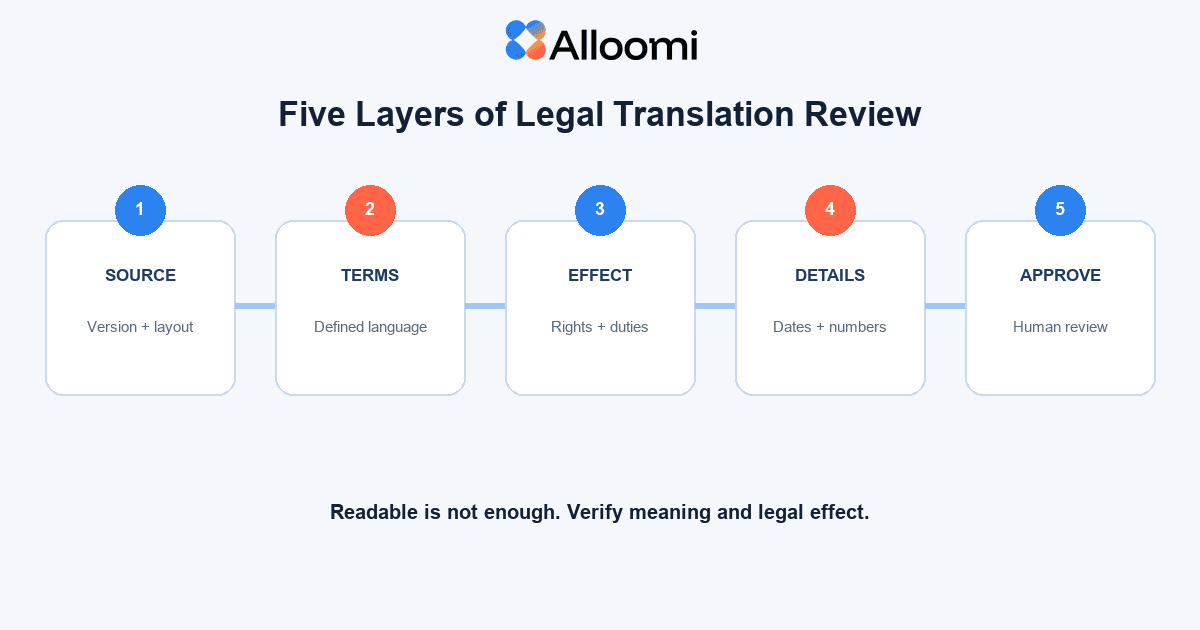
| Review layer | What to verify | Warning sign |
|---|---|---|
| Source integrity | Version, completeness, page order, attachments, and legibility | The translation cannot be mapped back to the source |
| Terminology | Defined terms, names, institutions, and recurring concepts | The same source term has multiple unexplained translations |
| Legal effect | Obligations, discretion, conditions, exceptions, and remedies | Fluent wording changes who must do what or when |
| Data accuracy | Dates, amounts, citations, section references, and identifiers | Numbers were reformatted, rounded, or moved |
| Human approval | Reviewer qualifications, decisions, unresolved ambiguity, and date | No accountable reviewer can explain material choices |
Confidentiality and Vendor Questions
Before uploading client material, determine what the provider receives, where data is processed, whether prompts or documents are retained, whether content is used for training, which subprocessors are involved, and how access is controlled. Do not assume that a consumer translation interface is appropriate for privileged or confidential legal material.
The same controls discussed in How to Evaluate a Legal AI Tool Before Firmwide Rollout apply here. Teams should also remove unnecessary sensitive data where possible and follow a verified redaction process. See How to Redact Legal Documents With AI Without Leaking Client Data.
How Alloomi Can Support the Review Context
Alloomi helps authorized legal teams keep source documents, matter facts, client instructions, prior decisions, and review history connected. That context can support a translation review by showing which version controls, which terminology the team previously approved, and which passages require a decision.
Alloomi is not a substitute for a qualified legal translator or the lawyer's review of legal effect. Its role is supporting organized, source-connected work so that the responsible professional can verify the output and carry approved decisions forward.
When AI Translation Should Not Be the Final Product
Do not rely on an unreviewed AI translation for execution, filing, sworn testimony, formal notice, waiver, settlement, informed consent, or advice about material rights. Court rules, agencies, counterparties, and clients may require certified translations, declarations, or specific translator qualifications.
If the source is illegible, culturally dependent, handwritten, highly technical, or legally ambiguous, escalate early. The goal is not to make the AI output sound polished. It is to preserve meaning, legal effect, and the client's ability to make an informed decision.
Frequently Asked Questions
1. Can lawyers use AI to translate contracts?
AI can prepare a working translation, but material provisions should be reviewed by someone qualified in the relevant languages and legal context before reliance or execution.
2. Is a fluent translation necessarily accurate?
No. Fluency can conceal errors involving duties, exceptions, defined terms, dates, and jurisdiction-specific concepts.
3. Should the original language remain available?
Yes. Preserve the source document and connect each translated passage to it. The agreement should also identify which language controls if multiple versions are used.
Conclusion
AI can reduce the time required to prepare and triage translations, but consequential legal work requires more than readable output. Preserve the source, control terminology, compare legal effect, verify details, protect confidentiality, and obtain qualified human review. That process turns AI translation into a useful draft rather than an invisible source of legal risk.