A useful litigation chronology is more than a list of dates. It connects an event to the people involved, the evidence supporting it, competing accounts, legal significance, and the next question counsel must investigate. AI can accelerate extraction from large collections, but speed is valuable only if every entry remains traceable to a verified source.
The central rule is simple: no event should enter the working chronology without a source locator and a review status. This prevents a fluent AI summary from becoming an unsupported fact that later appears in a witness outline, brief, or client update.
What Is a Litigation Chronology?
A litigation chronology is a structured record of events relevant to a dispute. Depending on the matter, it may cover contract formation, performance, communications, payments, product events, employment decisions, regulatory contacts, preservation activity, discovery, or procedural deadlines.
Each entry should answer five questions: what happened, when it happened, who was involved, what source supports it, and why it matters. A chronology may also record uncertainty, conflicting evidence, privilege, custodians, and links to related issues.
Why AI Helps With Chronology Building
Case records describe the same event in different ways. An email may use an informal project name, a contract may use a defined term, a witness may remember an approximate date, and an invoice may provide the most precise timestamp. AI can help connect those descriptions and propose a normalized event.
It is especially useful for:
• Extracting dates, people, organizations, actions, and document references
• Normalizing date formats and entity names
• Grouping records that appear to describe the same event
• Detecting gaps, contradictions, and unexpected sequences
• Generating issue-specific views from a master chronology
• Updating the chronology when new evidence arrives
Why Source Traceability Matters
An AI-generated event may be incomplete, inferred, duplicated, or wrong. The system may combine two different communications, treat a forwarded email date as the original date, or turn a witness's uncertainty into a definite statement.
Source traceability allows a reviewer to return to the exact page, message, transcript line, spreadsheet row, recording timestamp, or image that supports the entry. It also preserves the distinction between evidence and analysis. This matters when a chronology informs discovery responses, depositions, motions, settlement strategy, or trial preparation.
Federal Rule of Evidence 1006 addresses summaries of voluminous materials offered as evidence and requires underlying records to be available for examination. A private working chronology is not automatically a Rule 1006 summary, but the rule illustrates why accurate connection to underlying material matters.
A Source-First Workflow for AI-Assisted Chronologies
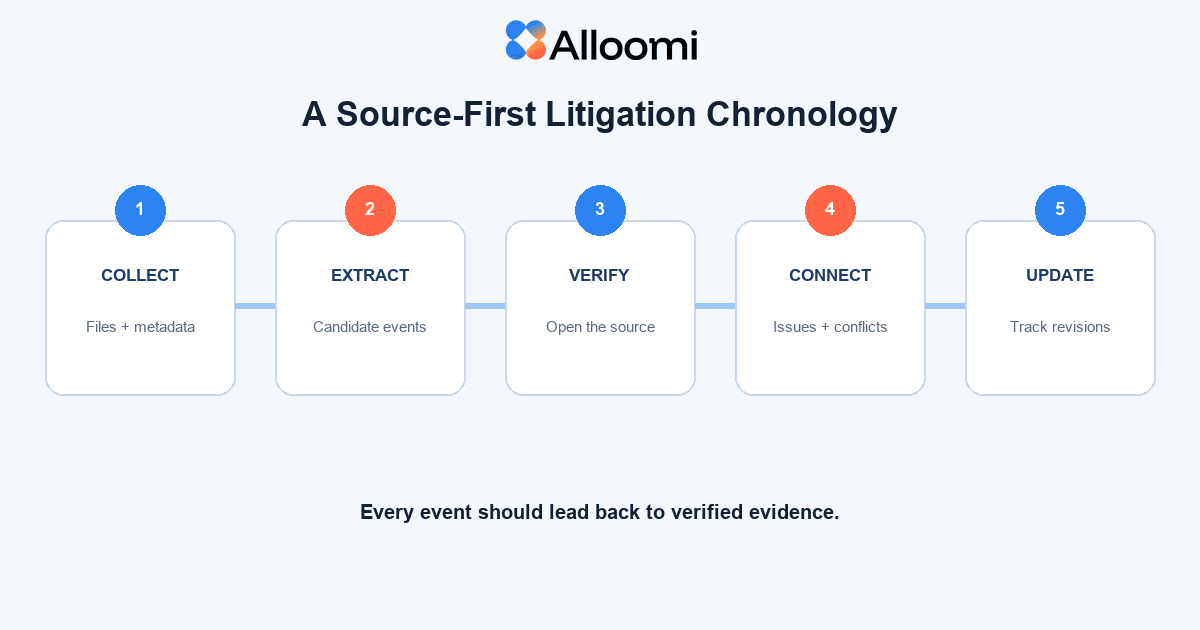
Define the chronology question
Do not begin with "summarize the case." Define the scope: contract performance, notice, causation, damages, knowledge, decision-making, or another issue. Record the date range, custodians, document types, and jurisdictions included.
Prepare the source collection
Preserve document identifiers, metadata, versions, family relationships, attachments, and page or line references. Deduplicate carefully without destroying information that shows who received a communication or when it entered a repository.
Extract candidate events
AI can propose events using a controlled schema. Require a date, event description, actor, source ID, source location, confidence level, and direct supporting passage. If the date is approximate, record it as approximate rather than forcing false precision.
Verify against the evidence
A reviewer should open the source, confirm the event, check context, and determine whether the date reflects creation, transmission, receipt, execution, or later reference. The entry remains "unverified" until this review is complete.
Connect issues and contradictions
Once verified, link the event to claims, defenses, witnesses, discovery requests, damages theories, and open questions. If sources conflict, preserve both accounts instead of asking AI to choose one silently. See The Solo Lawyer's Secret to Finding Case Contradictions.
Maintain the chronology as evidence changes
Track what changed, why it changed, who approved the change, and which downstream work product relied on the earlier version. A chronology that cannot be updated safely becomes stale as soon as discovery continues.
Fields Every Chronology Entry Should Include
| Field | Purpose | Verification question |
|---|---|---|
| Date and time | Place the event in sequence without false precision | Is this created, sent, received, signed, or referenced? |
| Event | State what the evidence supports in neutral language | Does the description add an inference not found in the source? |
| People and entities | Connect actors across records and name variations | Are these confirmed identities or probable matches? |
| Source locator | Return directly to the underlying evidence | Can another reviewer find the exact supporting passage? |
| Issue link | Explain why the event matters to the case | Which claim, defense, witness, or open question is affected? |
| Review status | Separate extraction from lawyer-approved fact work | Who verified the entry, and when? |
Common Chronology Errors
One common error is copying an AI summary into the chronology without a direct source link. Another is collapsing disputed evidence into a single narrative. Teams also confuse document dates with event dates, use inconsistent time zones, omit attachments, or overwrite an earlier interpretation without preserving revision history.
A second risk is privilege. Internal chronology notes may reflect legal strategy, impressions, or attorney work product. Access, exports, and sharing should be controlled. Teams conducting broad review should understand the principles in What Is Privilege Review?.
How Alloomi Can Support Chronology Work
Alloomi keeps documents, matter facts, decisions, versions, and sources connected across legal work. That context can help an authorized team assemble events, identify changes, and keep the supporting record visible while a lawyer reviews the result.
Alloomi does not determine what a court should accept as fact. Lawyers remain responsible for evidence selection, privilege, admissibility, legal significance, and final work product. The practical benefit is a working chronology that is easier to update and less likely to lose the source behind a conclusion.
Frequently Asked Questions
1. Can AI create a litigation chronology automatically?
AI can extract candidate events, but each material entry should be verified against the original evidence before counsel relies on it.
2. What is the difference between a chronology and a fact graph?
A chronology organizes events primarily by time. A fact graph emphasizes relationships among people, evidence, issues, and events. The two can work together.
3. Should every chronology entry include a quotation?
Not always, but every entry should contain a precise source locator. Important or disputed entries benefit from a short supporting excerpt.
Conclusion
AI can reduce the mechanical work of finding and organizing events, but a defensible chronology depends on disciplined sourcing. Define the question, preserve metadata, extract candidates, verify each event, record uncertainty, and keep changes linked to the underlying evidence. That is how a timeline becomes a reliable litigation tool instead of another unverified summary.