California's privacy regulator published proposed rulemaking in November 2026 addressing data broker updates and audits connected with the Delete Request and Opt-out Platform, known as DROP. The proposal matters beyond traditional data brokers because AI products often depend on enrichment data, identity graphs, purchased datasets, and downstream vendors.
Legal teams should treat deletion as an evidence problem. It is not enough to show that a request entered a portal. The organization should be able to prove how the request was matched, which systems and vendors were reached, what was deleted or retained, and why.
What DROP Is Designed to Do
DROP provides a centralized mechanism through which California consumers can request deletion from registered data brokers. The California Privacy Protection Agency maintains official information about the program and rulemaking. The November proposal is available in the agency's Data Broker Updates and DROP Audits notice.
The final obligations may change through rulemaking. Organizations should track the adopted text and implementation dates rather than relying only on summaries.
Why AI Data Supply Chains Complicate Deletion
A single source record may appear in a customer profile, enrichment table, feature store, retrieval index, model-training corpus, evaluation set, log, backup, and vendor environment. Some copies may remain linkable to a person even after obvious identifiers are removed.
Deletion workflows need a defined treatment for raw records, derived attributes, embeddings, model outputs, legal holds, security logs, aggregate data, and backups. If an organization retains data, it should record the legal and operational basis.
Evidence a DROP Audit May Need、
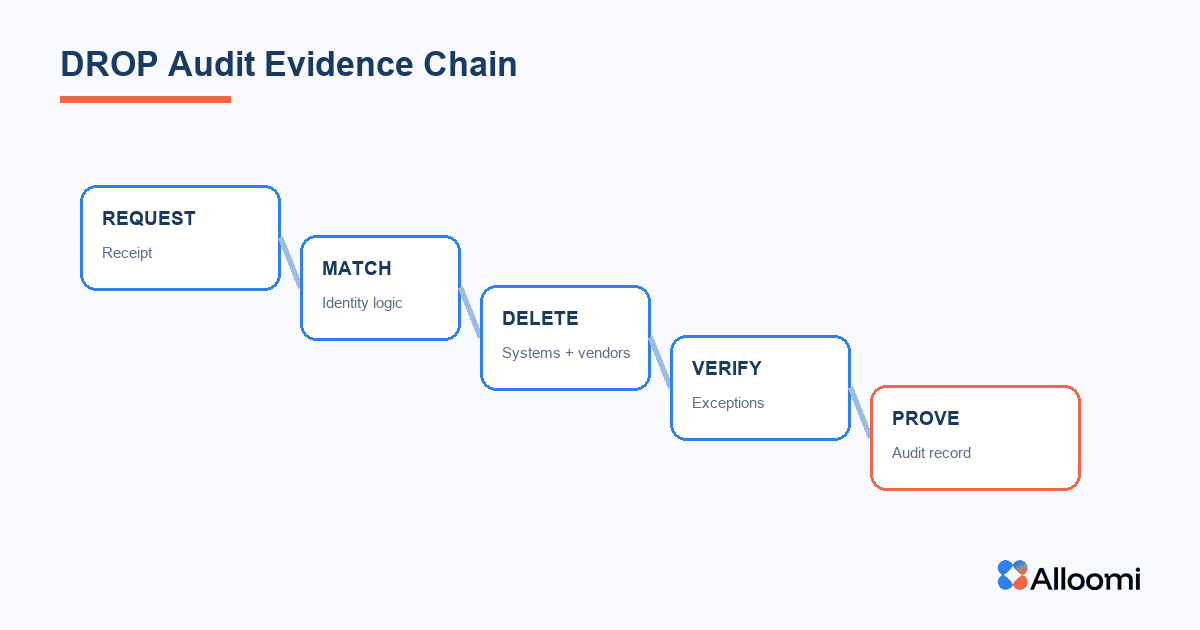
• Registration and status records.
• Request receipt, authentication, and matching logic.
• System and dataset inventory.
• Downstream recipient and vendor notices.
• Completion timestamps and exception reasons.
• Testing results, failures, corrections, and responsible owners.
• Policies, training, access controls, and version history.
Review Vendor Contracts Before the Audit
Contracts should identify data categories, deletion procedures, response times, verification methods, downstream recipients, audit cooperation, evidence delivery, backup treatment, and termination assistance. Use How to Review a Data Processing Agreement Before Signing to test these terms.
If the vendor uses data for model training or improvement, make that permission explicit. The AI clauses described in What Should an AI Use Clause Include in a Vendor Contract? can help separate service delivery from secondary use.
Test the Workflow End to End
Submit controlled test requests using realistic identity variations. Confirm matching across aliases, addresses, emails, devices, and linked profiles. Check that downstream deletion completes and that dashboards reflect the underlying systems rather than a request status flag.
Sample failed and exception cases. Review whether manual teams can explain the exception and whether the organization meets its response deadlines. Record remediation rather than overwriting the original failure.
How Alloomi Can Support Audit Preparation
Alloomi can help legal teams connect policies, vendor agreements, data maps, requests, exceptions, approvals, and remediation evidence. It does not determine whether an organization is a data broker or whether an exception applies.
For a broader audit framework, see What Is a Contract Compliance Audit?. For AI-specific records and accountability, see The Legal AI Audit Trail.
Frequently Asked Questions
1. Is every AI company a California data broker?
No. Status depends on the statutory definition and the company's actual business and data practices.
2. Does deleting a customer profile complete the request?
Not necessarily. Related datasets, derived records, recipients, and retained copies may need separate treatment.
3. Should companies wait for the final rule?
No. They can inventory data, map vendors, test deletion, and improve evidence now while tracking changes in the final requirements.
Conclusion
DROP audit readiness depends on traceability across the full data supply chain. Map raw and derived data, strengthen vendor terms, test matching and deletion, document exceptions, and retain evidence showing that the request reached the systems that matter.