A healthcare compliance problem can become a securities case when investors allege that undisclosed sales, reimbursement, or kickback risks made a public company's revenue statements, growth narrative, compliance claims, or internal-control disclosures misleading.
That transmission path is now central to a proposed securities class action filed against medical-device company CVRx and several executives in the U.S. District Court for the District of Minnesota. The November 9, 2026 complaint alleges that the company failed to disclose unlawful and unsustainable practices involving Barostim. CVRx has not been found liable, and the allegations remain to be tested in court.
The case is useful beyond one company. It shows why healthcare legal teams cannot treat commercial compliance, government-program reimbursement, financial reporting, and investor disclosure as separate workstreams.
What Happened in the CVRx Case?
The plaintiff, Oklahoma Police Pension and Retirement System, filed *Oklahoma Police Pension and Retirement System v. CVRx, Inc. et al.*, Case No. 0:26-cv-04746, on November 9, 2026. The federal docket identifies the matter as a securities action and records the filing of the complaint.
The allegations followed CVRx's disclosure that it had received a civil investigative demand from the U.S. Department of Justice. In its June 2026 Form 10-Q, CVRx said the demand sought information and documents concerning whether the company caused false claims to be submitted to government health insurance programs through improper device marketing, kickbacks, or false information.
The new securities complaint alleges that investors were not adequately informed that sales growth and reported revenue were exposed to those risks. Those are allegations, not findings. The distinction should remain explicit throughout any article, investigation, or public communication about the case.
The Compliance-to-Securities Litigation Chain
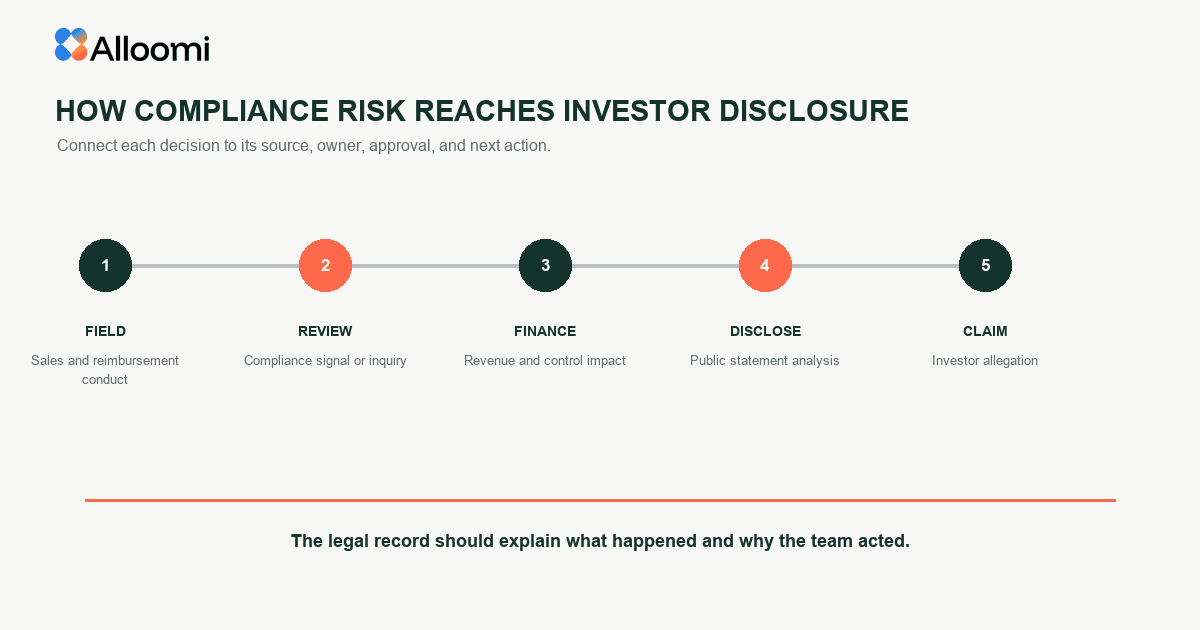
The legal chain usually begins with operational conduct rather than an investor statement. A sales representative, reimbursement team, physician relationship, patient-access program, distributor arrangement, or billing workflow may create a potential healthcare-law issue.
That issue can then affect several public-company representations:
• Reported or projected revenue.
• Descriptions of the company's growth drivers.
• Statements about compliance with healthcare laws.
• Explanations of reimbursement and patient access.
• Risk-factor language describing government investigations.
• Management's assessment of internal controls.
• Statements about the sustainability of commercial performance.
The securities question is not simply whether a healthcare law was violated. Plaintiffs must connect the alleged underlying conduct to a materially false or misleading statement or omission, along with the other elements required by the securities laws.
Why the False Claims Act Matters
The federal False Claims Act can impose liability when a person knowingly submits, or causes the submission of, a false claim for payment to the government. The U.S. Department of Justice's FCA overview explains that the statute can also reach false records material to a claim and improper avoidance of an obligation to pay the government.
For a medical-device company, the risk may involve how a product is marketed, coded, reimbursed, or represented to a government healthcare program. A device can be clinically useful while a separate question remains about whether the related reimbursement submission was accurate and legally supported.
That distinction matters during document review. Legal teams should not reduce the inquiry to whether a patient received treatment. They may need to examine medical necessity, promotional language, reimbursement assistance, coding instructions, physician communications, claims data, and who approved the relevant process.
Why the Anti-Kickback Statute Matters
The federal Anti-Kickback Statute prohibits knowingly and willfully offering, paying, soliciting, or receiving remuneration to induce or reward referrals or business involving federal healthcare programs. The HHS Office of Inspector General explains that remuneration can include more than cash and that both payers and recipients may be exposed.
Commercial arrangements involving consulting fees, training, speaker programs, travel, free services, equipment, research support, discounts, or patient-access assistance require careful review. The existence of a payment does not automatically establish a kickback. The purpose, structure, fair-market value, documentation, and applicable safe harbor all matter.
When a securities complaint follows an AKS investigation, investor plaintiffs may argue that allegedly improper payments made revenue less sustainable than public statements suggested. That argument still must be proven.
Public Statements Must Match the Operational Record
Healthcare companies often describe growth using metrics assembled from sales, reimbursement, physician adoption, procedure volume, coverage decisions, and patient access. Those statements should be reviewed against the underlying commercial record.
A legal team should be able to trace a material statement to:
• The data supporting it.
• Known limitations or exceptions.
• Active complaints and investigations.
• Relevant compliance testing.
• The individuals who reviewed and approved it.
• The date on which it was last validated.
This is where a source-linked workflow matters. Legal AI audit trails can help teams preserve the connection among a claim, the source evidence, the reviewer, and the final decision.
What Internal Investigations Should Examine
An internal investigation should reconstruct the workflow that produced the disputed revenue or claim, not merely collect a large mailbox export.
The scope may include sales training, compensation plans, physician arrangements, reimbursement-support materials, hotline reports, audit findings, government correspondence, claims data, approval records, customer communications, and executive reporting.
The team should identify what each source can and cannot prove. A sales message may show how a representative described a program, but not whether every representative followed the same practice. A payment record may show value transferred, but not the purpose or intent. A compliance policy may show the formal rule, but not how the process operated.
For broader investigation planning, see AI for Legal Due Diligence and How to Review and Verify AI-Generated Legal Work.
How Legal Teams Can Detect the Risk Earlier
The strongest response occurs before a government demand or stock-price event. Legal, compliance, finance, and investor-relations teams should define escalation triggers for commercial conduct that may affect public statements.
Useful triggers include:
• A recurring reimbursement concern connected with a material product.
• Evidence that field practices differ from approved policy.
• Physician compensation that lacks current documentation.
• A sales incentive tied to conduct under investigation.
• A regulator or payer requesting records.
• An internal complaint alleging false information or improper inducements.
• A disclosure statement that no longer matches known facts.
AI regulatory change monitoring offers a related model: identify a change, determine relevance, assign an owner, and record the resulting action rather than leaving the issue in an inbox.
How Alloomi Can Support Healthcare Compliance Review
Alloomi AI can help authorized legal teams organize investigation materials, compare policies with communications, build event timelines, identify repeated issues, and connect findings to source documents.
For example, a team could compare approved sales materials with field communications, locate when reimbursement guidance changed, and trace what management knew before a public statement. Alloomi does not decide whether conduct violated the FCA, AKS, or securities laws. Qualified counsel must verify the evidence and make those legal judgments.
Teams managing multiple investigations may also benefit from the matter-centered structure described in What Is Legal Case Management Software?.
Practical Takeaway
The CVRx case illustrates a recurring public-company risk: an operational compliance issue can affect revenue, reporting, disclosure, internal controls, and ultimately investor litigation.
Healthcare companies should connect their sales-compliance reviews with financial and disclosure controls. A legal team that can reconstruct what happened, when it happened, what management knew, and which statements relied on the affected process is better positioned to respond accurately.
Frequently Asked Questions
1. Does an FCA investigation automatically prove securities fraud?
No. A government investigation is not a finding of liability. Securities plaintiffs must independently establish the required elements of their claims.
2. Can legal sales activity still create disclosure risk?
Yes. Even conduct ultimately found lawful may create a disclosure question if an investigation, operational disruption, or known uncertainty materially affects prior statements or financial expectations.
3. What records matter most in a healthcare sales investigation?
Sales materials, compensation plans, physician arrangements, reimbursement guidance, claims data, approval records, audit findings, complaints, and management communications are often important.
4. Can AI determine whether a payment was a kickback?
No. AI can help locate and organize relevant evidence, but intent, statutory requirements, safe harbors, and legal conclusions require qualified human review.