A CEO preparing to brief Congress needs more than talking points. The legal team must align verified facts, preserved documents, prior public statements, privilege decisions, security restrictions, and clear follow-up procedures before the executive answers questions.
That issue is current for Nvidia. Three House committee chairs requested that CEO Jensen Huang appear for a joint closed-door briefing on November 18, 2026, concerning Nvidia's security protocols and reported interactions involving an alleged foreign intelligence asset. The request appears in an official congressional letter. Reporting indicates lawmakers have also discussed the possibility of compulsory process if Huang does not participate.
The allegations surrounding the matter remain disputed and under investigation. This article addresses preparation for congressional scrutiny, not whether the reported conduct occurred.
A Congressional Briefing Is Not Ordinary Litigation Testimony
Congressional investigations operate under committee rules and constitutional authorities that differ from civil discovery or a courtroom trial. A committee controls the proceeding, the questioning format, counsel's participation, and the scope of information requested.
The Congressional Research Service Oversight Manual explains that committees may restrict counsel's conduct and that witnesses do not receive every procedural protection associated with judicial proceedings.
A closed-door briefing may reduce public exposure in the moment, but it does not eliminate risk. Statements can lead to supplemental requests, subpoenas, referrals, public hearings, legislative action, regulatory scrutiny, shareholder claims, or leaks.
Start With the Requesting Committees and Their Objectives
Preparation should begin by identifying which committees are involved, what jurisdiction each one has, and what problem the members are trying to investigate.
In a matter involving AI chips and alleged foreign influence, the questions may span:
• Corporate security protocols.
• Foreign contacts and counterintelligence reporting.
• Export-control compliance.
• Customer and end-user diligence.
• Board oversight and escalation.
• Public statements concerning the relationship or transaction.
• Communications with executive-branch agencies.
• Remedial steps taken after the issue became known.
The legal team should not assume that every committee wants the same evidence. It should map likely questions to the committee's stated concerns and legislative agenda.
Build a Verified Chronology Before Drafting Answers
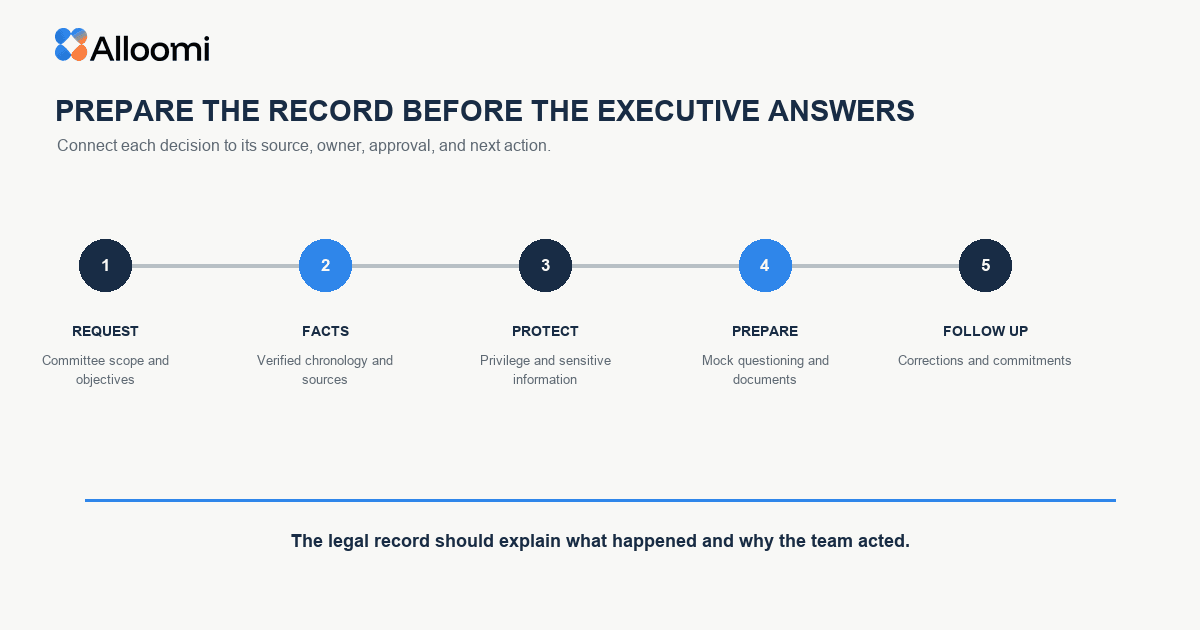
Executive preparation often fails when the team begins with messaging instead of facts. The CEO should not learn the chronology during the briefing.
A defensible chronology may require board materials, security reports, travel records, customer communications, export-license records, government contacts, public statements, device and access logs, and communications involving relevant employees.
Each event should identify:
• The verified date.
• The people involved.
• The source supporting it.
• What was known at that time.
• What remained uncertain.
• Which action followed.
• Whether the event was previously disclosed.
The workflow described in The Legal Deadline Problem is relevant here: dates should have a source, owner, verification status, and next action rather than appearing as unsupported calendar entries.
Reconcile Prior Statements With the Evidence
Congressional staff will often compare current testimony with prior interviews, filings, press statements, earnings calls, company policies, and agency communications.
Before the briefing, counsel should identify every material statement the CEO may be asked to explain. The team should determine whether each statement was accurate when made, whether later evidence changed the analysis, and whether a correction or qualification is needed.
This is closely connected to the disclosure issues discussed in When Must a Public Company Disclose CEO Personal Conduct?.
The CEO should distinguish clearly among:
• What the CEO personally knows.
• What the company concluded after investigation.
• What another person reported.
• What remains disputed or unverified.
• What the CEO cannot answer without reviewing records.
An honest request to confirm the record is usually safer than an overly confident answer that later proves incomplete.
Preserve Documents Before the Request Expands
The legal team should evaluate preservation as soon as congressional scrutiny is reasonably anticipated. Waiting for a subpoena can create avoidable questions about lost messages, auto-delete settings, personal devices, or informal communication channels.
The preservation plan may cover email, messaging platforms, collaboration tools, board portals, security reports, travel records, customer files, access logs, personal devices used for company business, and communications with government officials.
The plan should also identify data located outside the United States, information held by third parties, and records subject to privacy, secrecy, export, or national-security restrictions.
For a broader preservation framework, see What Is a Legal Hold? and What Is an ESI Protocol?.
Decide Privilege and Confidentiality Positions in Advance
Congress may request material that the company regards as privileged, commercially sensitive, export controlled, personally private, or classified. The team should not improvise its position while the CEO is answering.
Counsel should identify:
• Which communications may be protected by attorney-client privilege or work product.
• Who holds the privilege and who may waive it.
• Whether disclosure to Congress could affect privilege elsewhere.
• Which trade secrets require confidential handling.
• Whether export-control rules restrict technical disclosure.
• Whether personal information must be minimized or protected.
• Which accommodations should be requested before the briefing.
Congress is not necessarily bound by common-law privileges in the same manner as a court. The company may need to negotiate procedures rather than assume that an objection will end the request. Related privilege risks are discussed in Can Using AI Waive Attorney-Client Privilege?.
Prepare for Questions About Board Oversight
When the issue involves a CEO, lawmakers may ask what the board knew, when it learned the information, whether directors acted independently, and which controls were imposed.
The legal team should understand the board's investigation mandate, reporting lines, recusal decisions, access restrictions, committee authority, outside-counsel engagement, and remediation steps.
Should a CEO Step Aside During an Independent Board Investigation? examines the interim-control question in more detail.
The CEO should not characterize the board's conclusions beyond the approved record. Management and the independent board process must remain distinct.
Conduct Mock Questioning Without Teaching Evasion
Preparation should help the CEO answer accurately and concisely, not avoid legitimate questions. Mock sessions should reproduce the likely pace, topic shifts, document references, and adversarial framing.
The CEO should practice:
• Correcting an inaccurate premise respectfully.
• Separating personal knowledge from company knowledge.
• Identifying when a question combines several assumptions.
• Avoiding speculation about other people's motives.
• Explaining technical concepts in plain language.
• Deferring only when a record genuinely requires confirmation.
• Making precise follow-up commitments.
The team should record every follow-up promised during the briefing. How Legal Teams Track Instructions Across Emails, Calls, and Documents provides a useful model for turning verbal commitments into assigned, traceable actions.
Plan the Post-Briefing Response Before the CEO Enters the Room
The briefing may generate document requests, corrections, policy commitments, security changes, or questions that require a written response. A response team should be ready before the session ends.
The team should establish:
• A single record of questions and commitments.
• Owners and deadlines for each follow-up.
• A correction process for incomplete testimony.
• Approval rules for communications with Congress.
• Coordination with the board and government agencies.
• A plan for public statements and investor questions.
• Preservation of briefing notes and source materials.
Matter-transfer principles from Why Legal Handoffs Fail apply because the work often passes rapidly among congressional counsel, litigation counsel, security teams, export specialists, and communications staff.
How Alloomi Can Support Congressional Investigation Preparation
Alloomi AI can help authorized legal teams organize committee correspondence, board records, public statements, security reports, timelines, and follow-up commitments while connecting findings to source documents.
It can also help compare earlier statements with later evidence and surface inconsistencies for human review. Alloomi does not decide how a witness should answer, whether privilege applies, or whether information may legally be disclosed. Those decisions require qualified counsel.
Practical Takeaway
A congressional briefing can become the center of several legal risks at once. The best preparation connects facts, sources, privileges, security controls, prior statements, and follow-up ownership before the CEO appears.
The goal is not a perfectly rehearsed performance. It is an accurate, supportable record that can withstand later comparison with documents, regulators, courts, investors, and the company's own investigation.
Frequently Asked Questions
1. Can a CEO bring a lawyer to a congressional briefing?
Often yes, but the committee controls counsel's role and conduct. The applicable committee rules and briefing arrangements should be confirmed in advance.
2. Is a closed-door congressional briefing confidential?
It is not the same as a public hearing, but the company should not assume that every statement or document will remain permanently confidential. Handling procedures should be negotiated.
3. Can Congress subpoena a private-company executive?
Congressional committees may possess subpoena authority under their governing rules. The validity, scope, objections, and enforcement options depend on the circumstances.
4. Should the CEO answer from memory?
Only where the executive can do so accurately. If a question requires checking the record, the CEO should avoid speculation and make a precise follow-up commitment.