A new Georgia lawsuit alleges that OpenAI entities, local officials, and private parties used secrecy, misleading public statements, closed-door decisions, and coordinated transactions to advance Project Camellia, a proposed AI data-center development in Effingham County. The complaint includes fraud, civil conspiracy, and Georgia civil RICO allegations.
These are allegations, not court findings. The defendants will have an opportunity to contest them, and the litigation may narrow or fail. Even so, the dispute is a useful warning for AI infrastructure projects: legal risk can emerge from the process used to secure land, zoning, incentives, utilities, and approvals, not only from the data center's technology.
What Is Project Camellia?
Project Camellia is a proposed large-scale data-center campus associated with OpenAI in Effingham County, Georgia. Public reporting has described a project involving extensive land, power, infrastructure, and local-government coordination.
The latest complaint was filed on November 6, 2026, in Effingham County State Court. Local reporting on the filing says three residents sued OpenAI-related entities, county officials, the development authority, and private parties over the project's land, zoning, and dealmaking process.
Earlier litigation challenged zoning procedures and alleged violations of Georgia's open-meetings and open-records laws. Georgia Public Broadcasting reported that residents claimed the county rezoned the planned site without the required public process.
Why a Data Center Dispute Can Become a RICO Claim
RICO is associated in public discussion with organized crime, but civil RICO statutes can be invoked in business and government-related disputes when plaintiffs allege an enterprise, a pattern of specified unlawful activity, injury, and the other elements required by the statute.
Calling conduct a coordinated project does not establish racketeering. Plaintiffs must plead and prove the statutory elements. Courts frequently scrutinize whether ordinary commercial or political disputes have been impermissibly repackaged as RICO claims.
For AI infrastructure developers, the important point is narrower: repeated communications, transactions, concealment allegations, and coordinated approvals can be assembled into a broader theory when residents believe the public process was manipulated.
Secrecy Can Create More Risk Than the NDA Solves
Large infrastructure projects often require confidentiality before a site is selected. Developers may need to protect land strategy, utility negotiations, financing, security plans, and competitive information.
The risk appears when an NDA is treated as permission to bypass public-law duties. A private company may negotiate confidentially, while a public authority remains subject to open-meeting, open-records, procurement, zoning, or ethics requirements.
Legal teams should distinguish among:
• Information that is legitimately confidential.
• Information that a public body must disclose.
• Decisions that require public notice or hearings.
• Records that must be retained even if temporarily exempt.
• Statements that can be made accurately without revealing protected details.
• Confidentiality obligations that conflict with statutory duties.
The contract review principles in How to Review an NDA apply, but public-private infrastructure deals require an additional layer: the NDA must be tested against the government party's disclosure and meeting obligations.
Zoning Process Is a Litigation Control
Zoning is not merely a permit milestone. It is part of the project's legal defensibility.
Developers and local authorities should document the existing classification, proposed use, required hearings, notice procedures, staff recommendations, environmental materials, conflicts, public comments, and the basis for the final decision.
A rushed or ambiguous amendment can create several disputes at once:
• Whether the change applied generally or was designed for one project.
• Whether required hearings occurred.
• Whether the public received adequate notice.
• Whether commissioners had undisclosed conflicts.
• Whether the stated reasons matched the real transaction.
• Whether the decision relied on complete environmental and infrastructure information.
This is a due-diligence problem as much as a land-use problem. AI for Legal Due Diligence explains how teams can review large document sets while keeping findings tied to evidence.
Public Statements Must Match Private Deal Terms
Community opposition intensifies when public descriptions appear inconsistent with internal agreements. A project may be described as preliminary while land, utility, tax, or construction commitments are already advanced.
Legal teams should compare press releases, meeting statements, economic-development materials, incentive descriptions, land agreements, utility contracts, and internal approvals before publication.
The review should answer:
• Which commitments are binding?
• Which approvals remain outstanding?
• What costs or incentives are public?
• Which environmental and utility impacts are known?
• Which claims depend on future studies?
• Who approved the statement and what evidence supported it?
The same source-to-claim discipline used in The Legal AI Audit Trail can support infrastructure communications.
Map Every Public and Private Decision
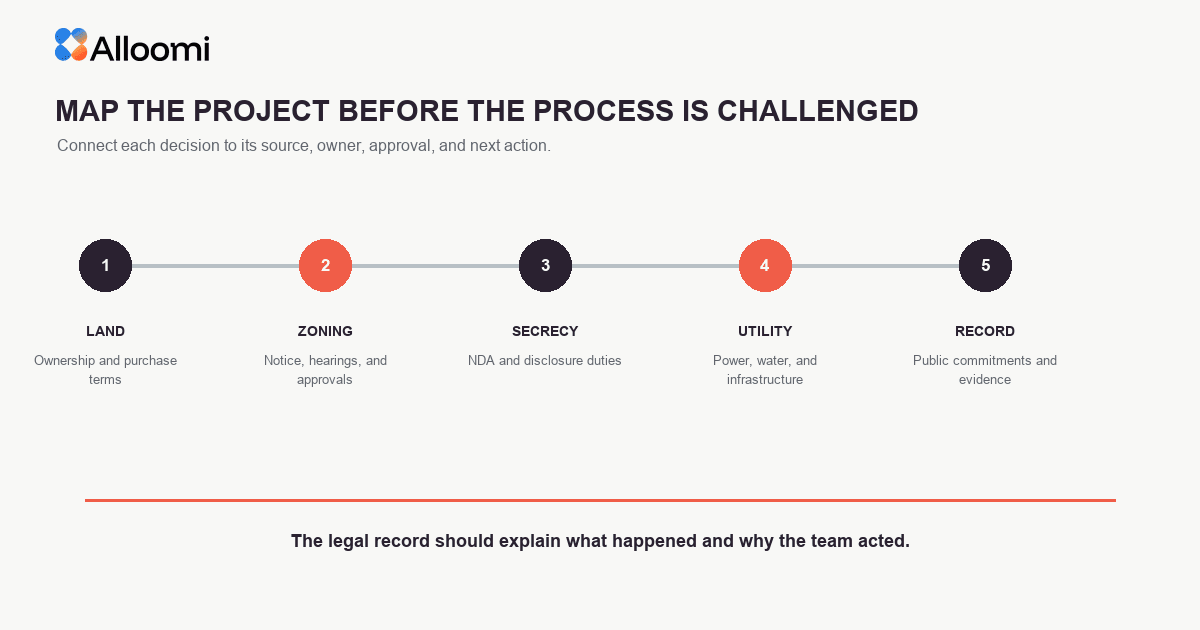
AI data centers involve overlapping participants: developers, affiliates, landowners, utilities, development authorities, county officials, consultants, lenders, contractors, and regulators.
The legal team should create a decision map showing:
• Which entity made each commitment.
• Which board or official approved it.
• Which meeting or written consent recorded the action.
• Which condition remained unresolved.
• Which document governed the relationship.
• Which disclosure obligation applied.
• Which party owned the next action.
Without that map, a project can appear coordinated operationally but fragmented legally. Contract Lifecycle Management provides a related framework for connecting contracts with approvals, obligations, renewals, and performance.
Community Risk Is Legal Risk
Community engagement is sometimes treated as a communications exercise that begins after the transaction is largely complete. For large data centers, that approach can be costly.
Residents may focus on water, electricity, noise, wetlands, roads, housing, tax incentives, emergency services, and the transparency of government decision-making. These concerns can lead to records requests, zoning appeals, environmental challenges, political pressure, financing delays, or broader civil claims.
The project team should maintain a verified issue register that records the concern, source, responsible owner, supporting studies, public response, and unresolved commitments. Regulatory-change workflow principles from From Regulatory Update to Legal Action are useful here because each new permit condition or public commitment should become a tracked action.
What AI Infrastructure Contracts Should Address
The contract structure should anticipate the possibility that approvals are delayed, challenged, or conditioned.
Relevant provisions may include:
• Zoning and permit conditions precedent.
• Allocation of public-process responsibilities.
• Cooperation with open-records requests.
• Confidentiality exceptions required by law.
• Accuracy of government and community communications.
• Environmental and utility study obligations.
• Termination or adjustment if approvals fail.
• Litigation cooperation and document preservation.
• Change control for infrastructure scope and cost.
• Responsibility for public incentives and clawbacks.
Change-management guidance in How to Review Change Orders and Prevent Scope Creep is especially relevant once community conditions or permit requirements alter the planned build.
How Alloomi Can Support AI Infrastructure Review
Alloomi AI can help authorized legal teams organize land agreements, NDAs, meeting records, zoning materials, utility documents, public statements, permits, and project communications while connecting findings to source documents.
A team could use it to build a chronology of approvals, compare public descriptions with operative agreements, and identify which obligations remain unassigned. Alloomi does not determine whether conduct satisfies Georgia RICO, fraud, zoning, or open-government requirements. Those assessments require qualified counsel and verified evidence.
Practical Takeaway
The Project Camellia litigation shows that AI infrastructure risk is not limited to cybersecurity, energy consumption, or model governance. Land transactions, public meetings, zoning, incentives, confidentiality, and community commitments can determine whether a project remains buildable.
Developers should create a reconstructable record from the first site discussion onward. When public and private decisions cannot be reconciled, project secrecy may become the theory around which litigation is built.
Frequently Asked Questions
1. Has a court found OpenAI liable for racketeering in Project Camellia?
No. The civil RICO, fraud, and conspiracy claims are allegations in a recently filed complaint. No final liability finding has been made.
2. Can an NDA override a public-records or open-meetings law?
Generally, a contract cannot eliminate statutory duties imposed on a public body. The applicable Georgia law, exemptions, and specific records must be reviewed.
3. Why do zoning procedures matter to private developers?
Defective notice, hearings, approvals, or records can delay or invalidate project decisions even when the developer is not the government actor responsible for every step.
4. What should legal teams preserve in a data-center dispute?
Land, zoning, utility, incentive, environmental, meeting, communication, public-statement, and approval records may all be relevant, along with versions and metadata.