Lawyers have already faced sanctions for filing AI-generated citations that do not exist. A new proposal in New York asks the next question: what happens when fabricated authority enters an order, opinion, or other adjudicative writing issued by a judge?
New York Senate Bill S10741 would make knowing or reckless use of fabricated legal authority in adjudicative writing a form of judicial misconduct. The proposal is not yet law. Its significance lies in how it frames AI verification as a professional responsibility rather than a software preference.
What New York Senate Bill S10741 Proposes
The official bill text, introduced on November 16, 2026, is titled the Judicial Artificial Intelligence Accountability and Integrity Act. It would amend New York's Judiciary Law to address fabricated authority used knowingly or recklessly in adjudicative writings.
The bill targets the authority in the final judicial work, not merely the use of AI. A judge could use research or drafting technology without violating the proposed rule if every cited authority is real, accurately characterized, and appropriately applied.
That distinction matters. A blanket ban on AI would be difficult to define and enforce. A duty to verify the final legal authority is familiar, technology-neutral, and tied to the integrity of the judicial function.
What Counts as Fabricated Legal Authority?
Fabrication can involve more than a completely invented case. It may include a real case with a false quotation, a nonexistent docket, an altered holding, a citation to the wrong court, or a proposition the opinion does not support.
AI systems can produce each of these errors in fluent language. The danger is heightened when a generated citation resembles the style and structure of genuine authority. Visual plausibility is not verification.
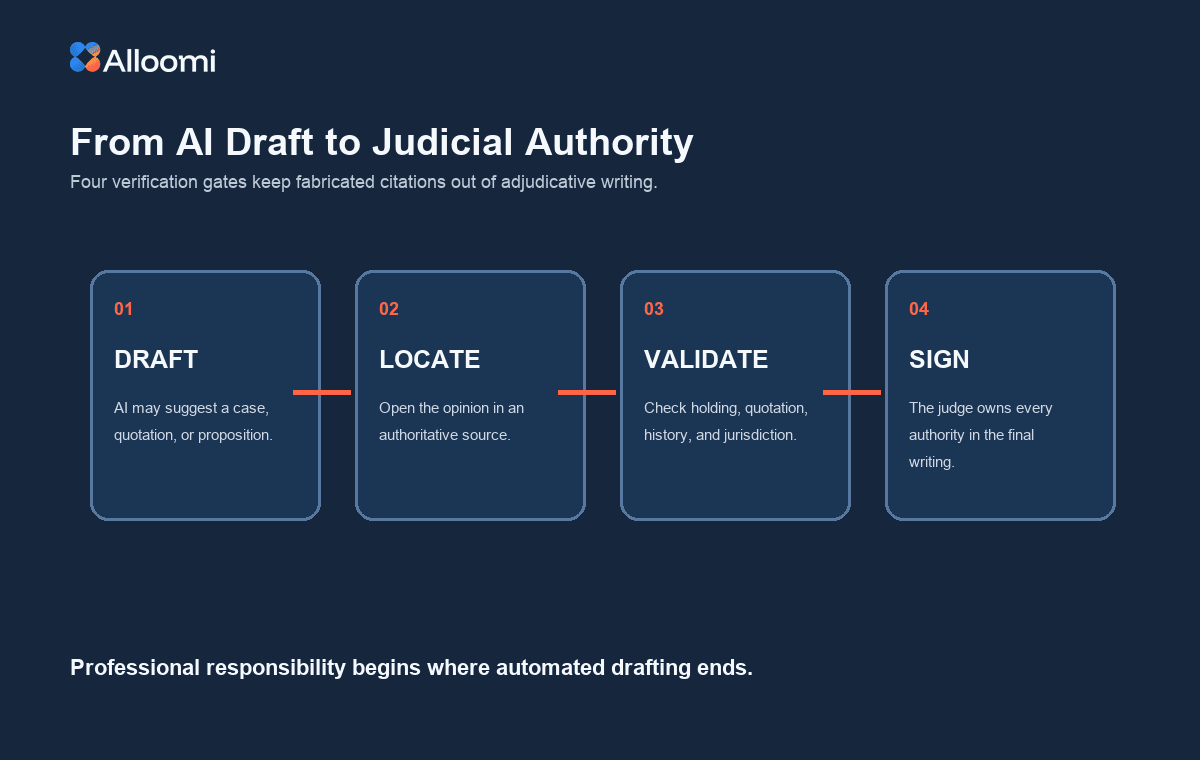
The final writing should pass through location, validation, and human sign-off before an authority is used.
Knowing and Reckless Use Are Different
Knowledge generally involves awareness that an authority is false. Recklessness can reach conduct that disregards an obvious or substantial risk. The exact application would depend on the enacted text, judicial discipline standards, and the facts.
A single typographical error is not the same as repeatedly using cases that no reviewer opened. Warning signs may include citations that cannot be located, quotations found nowhere in the opinion, inconsistent case names, or a draft produced by a system known to invent sources.
The proposed standard therefore encourages a workflow question: what verification happened between generated text and signature?
A Verification Protocol for AI-Assisted Judicial Writing
• Open every cited opinion, statute, rule, and secondary source in an authoritative repository.
• Confirm the court, date, docket, publication status, and later history.
• Compare each quotation against the source and preserve the relevant page.
• Test whether the authority supports the precise proposition stated.
• Check jurisdiction, procedural posture, and whether controlling authority differs.
• Record who completed the verification and when.
This is compatible with the ABA Model Code of Judicial Conduct, which emphasizes competence, diligence, and faithful application of the law, while recognizing that states adopt their own enforceable rules.
Why Courts Need More Than an AI Policy
A general policy may say that staff should verify AI output. It rarely shows whether verification actually occurred. Courts need an operational record that connects the draft proposition to the source reviewed and the person who approved it.
That record should not expose confidential deliberative material unnecessarily. Its purpose is narrower: to prove that the authority exists and was checked. The design resembles the verification of AI-generated legal work already required of lawyers.
What This Means for Lawyers Appearing Before the Court
Lawyers should continue verifying their own submissions even if a court uses AI. If an order cites an unfamiliar authority, counsel should locate the source before relying on it. A correction should be raised through the appropriate procedural mechanism, with care and professionalism.
The proposal also reinforces why sanctions databases and cautionary articles are not enough. Firms need repeatable submission controls like those discussed in AI hallucination sanctions in 2026.
How Alloomi Supports Source-Connected Review
Alloomi AI can help authorized teams organize drafts, sources, quotations, and verification records so human reviewers can trace a legal proposition back to the underlying material. It does not authenticate a citation by itself and does not replace judicial or lawyer responsibility.
The strongest principle in the New York proposal is simple: technology may assist the writing, but the institution owns the authority it publishes.
Frequently Asked Questions
1. Has New York banned judges from using AI?
No. S10741 is a proposed bill, and it focuses on knowing or reckless use of fabricated authority rather than a general ban on AI tools.
2. Can a real case still be an AI hallucination problem?
Yes. The case may be real while the quotation, holding, procedural history, or relevance is misstated.
3. Do judicial ethics rules apply the same way in every state?
No. States have their own constitutions, statutes, judicial conduct codes, and disciplinary procedures.