A legal AI product can remain online while the legal information beneath it becomes incomplete. That is the hidden business continuity risk raised by a newly reported dispute involving Clio and ROSS Intelligence. The disagreement concerns whether a historical case-law update feed must be restarted.
The merits remain contested, but the operational lesson does not depend on who wins. Legal teams evaluating AI research tools should understand where authority comes from, how often it is updated, what happens when a feed ends, and whether the user can detect stale coverage.
Why a Case-Law Feed Matters
Legal research is not a static document collection. Courts issue opinions, correct decisions, change publication status, and alter how earlier authority should be understood. A tool that cannot ingest current material may still return fluent answers, but the answer can omit the case that changes the analysis.
According to the reported federal complaint, Clio sought a declaration concerning its obligation to resume a case-law feed once provided to ROSS. The dispute illustrates how data access, contract duration, product ownership, and technical continuity can converge.
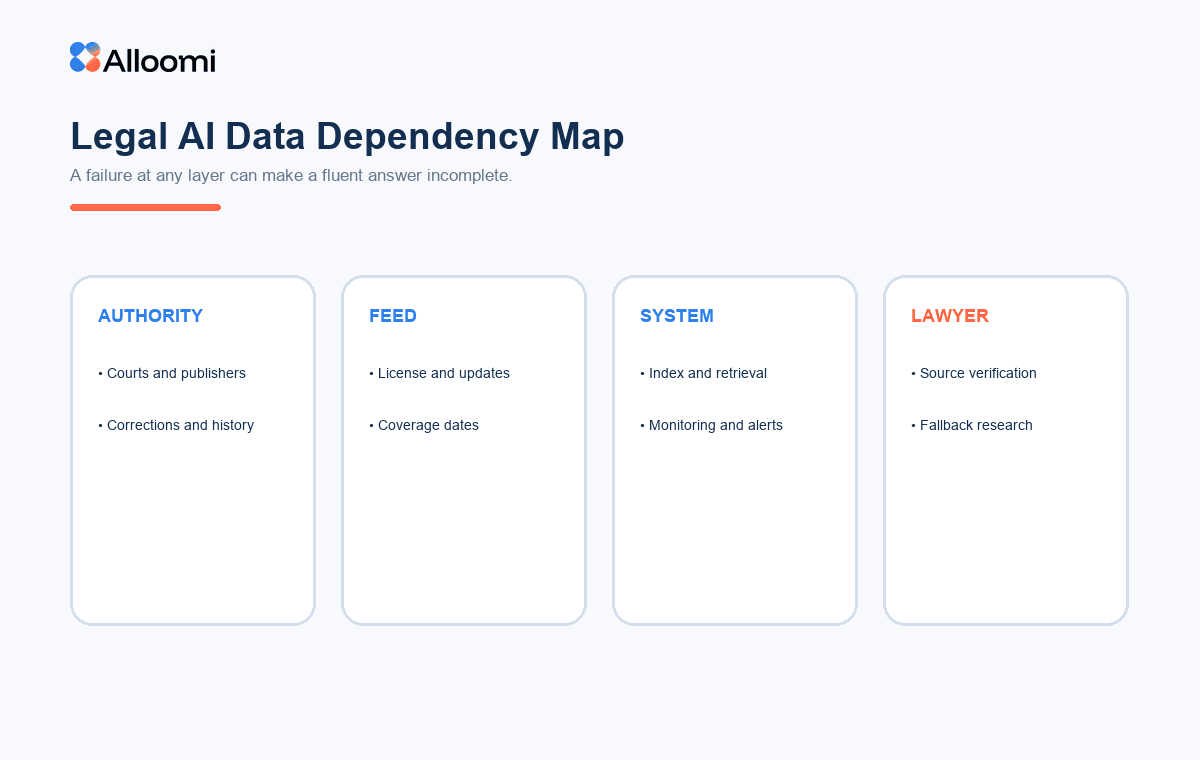
Reliable output depends on every layer between the official authority and the lawyer's final verification.
Reliable output depends on every layer between the official authority and the lawyer's final verification.
The Product Can Work While Coverage Fails
Downtime is obvious. Data degradation is harder to see. Search, summarization, and drafting features may continue to function even when the underlying index is no longer complete.
Warning signs include:
• No clear “current through” date for a jurisdiction.
• Missing corrections, later history, or unpublished decisions.
• Citations that resolve but omit negative treatment.
• Different coverage across jurisdictions without notice.
• An answer that cannot be reproduced from accessible sources.
These risks explain why AI legal research must end with source verification rather than confidence in the interface.
What Procurement Teams Often Miss
Legal AI contracts tend to focus on confidentiality, security, uptime, and output ownership. Those terms matter, but they do not answer whether the provider can continue obtaining the authorities needed to run the service.
Procurement teams should ask who owns each data source, whether access depends on a third-party license, how terminations are handled, and how users will be notified of a coverage gap. The vendor should also explain export options and whether matter records remain usable if a core content relationship ends.
A structured legal AI evaluation should therefore include content provenance and continuity, not just model performance.
What a Continuity Plan Should Contain
• A source register listing jurisdictions, publishers, and update frequency.
• A visible coverage date and known-gap notice.
• Monitoring for failed ingestion or licensing changes.
• A fallback research source for urgent matters.
• Export rights for prompts, citations, notes, and matter history.
• A verification procedure using official or independently licensed authority.
• An incident process for correcting work affected by stale coverage.
These controls belong beside the contractual protections discussed in AI vendor contract terms.
How Legal Teams Should Measure Reliability
Accuracy testing should use time-sensitive questions, not only evergreen doctrine. A team can select recent opinions, corrected cases, and authorities with later history, then compare whether the system retrieves and describes them correctly.
The test record should preserve the question, date, jurisdiction, source retrieved, system answer, reviewer conclusion, and correction. That evidence becomes part of a legal AI audit trail.
How Alloomi Supports Source-Connected Work
Alloomi AI can help authorized teams organize legal materials and keep AI-assisted analysis connected to the documents provided for human review. It does not guarantee that every external legal database remains current. Lawyers should still verify controlling authority through reliable sources.
The practical takeaway is not to avoid legal AI. It is to treat legal data as a dependency that can fail. A tool is only as current as its sources, update pipeline, and disclosure of gaps.
Frequently Asked Questions
1. Can a legal AI tool work with outdated case law?
Yes. The interface and model may continue operating even when the underlying collection is stale or incomplete.
2. What is a “current through” date?
It identifies the latest date through which a source collection is represented. It helps users assess whether recent authority may be missing.
3. Should firms require case-law export rights?
They should at least secure export rights for their own research records, citations, notes, and matter history, subject to third-party content licenses.