When Doctors and AI Disagree: Who Bears Malpractice Risk?
When a physician and an AI system reach different conclusions, the legal problem is not solved by saying that a human remained “in the loop.” A future claimant, expert, insurer, or jury may ask what the system recommended, why the clinician disagreed, what additional checks were performed, and whether the final decision was reasonable at the time.
Research highlighted in November 2026 suggests that this disagreement itself can shape perceptions of fault. The finding does not make AI the legal standard of care. It does show that hospitals need better records of how people evaluate and override machine recommendations.
What the New Research Found
A 2026 Nature Health study presented mock jurors with a hypothetical radiology malpractice case. The patient suffered irreversible harm after a radiologist missed a brain bleed that an AI system had identified. Researchers found that workflow design affected how participants perceived liability.
A separate randomized study published in the Journal of Nuclear Medicine examined how U.S. adults, German adults, and German physicians evaluated decisions to accept or reject medical AI recommendations. Participants generally viewed physicians who rejected AI advice less favorably, especially when the AI recommendation aligned with standard care.
These are experimental studies, not court holdings. They do not prove how a real jury would decide a particular case. Their practical value is different: they expose the evidentiary questions that arise once an AI recommendation enters the clinical record.
Does AI Become the Standard of Care?
Not automatically. Medical negligence usually turns on the applicable professional standard, the facts available to the clinician, causation, and injury. A model's output may be relevant evidence without controlling the legal conclusion.
Context matters. The system may have been approved only for a narrow population. The patient may have contraindications that the model cannot see. The model may have an uncertain error rate for the specific condition. An alert may also be one of hundreds competing for attention.
The key distinction is between independent clinical judgment and undocumented disregard. A reasoned override supported by patient-specific evidence is different from clicking past an alert without review.
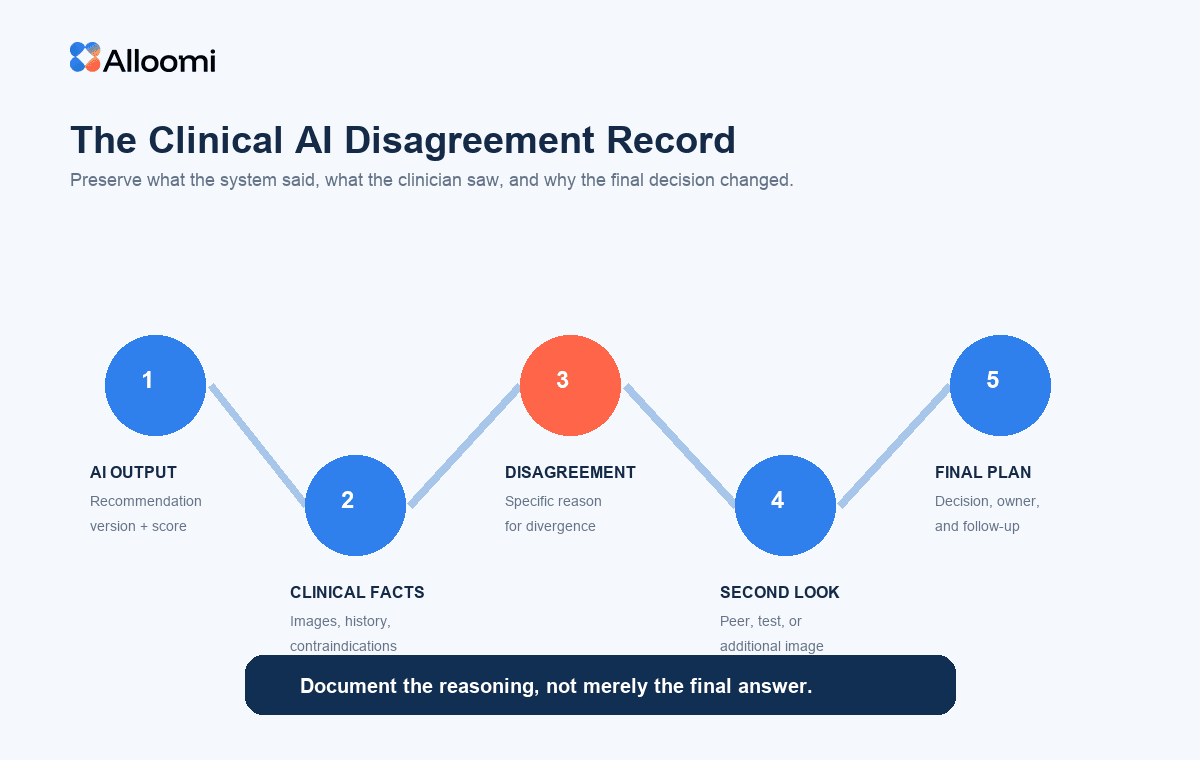
A defensible workflow preserves the recommendation, clinical facts, reason for disagreement, second look, and final plan.
What Hospitals Should Record When Humans Override AI
• The exact model, version, time, and recommendation shown to the clinician.
• The patient data the system used and any material information it could not access.
• The clinician's specific reason for agreeing, modifying, or rejecting the recommendation.
• Any second reader, test, image, consultation, or policy used to resolve the conflict.
• Known limitations, confidence information, or error rates presented in the interface.
• The final decision, responsible clinician, follow-up plan, and later correction.
This record should be clinically useful, not a defensive essay inserted after an adverse outcome. It also needs to preserve the version actually used. A later software update cannot reliably explain what the clinician saw months earlier.
Why “Human Oversight” Is Too Vague
Many policies say that clinicians must exercise independent judgment. That statement is necessary but incomplete. It does not define when a second review is required, who may override a high-risk alert, or how the disagreement should be documented.
Legal teams should connect the policy to the actual interface and workflow. If the software records an override but not the reason, the organization may know that disagreement occurred without being able to reconstruct why. A structured AI audit trail helps connect outputs, sources, reviewers, and final decisions.
Contract Questions for Medical AI Vendors
Hospitals should not assume that the vendor will preserve every input and output needed in litigation. The agreement should address version histories, logs, retention, incident notice, validation material, access to error-rate information, and cooperation with legal holds.
Responsibility also needs to be allocated carefully. A broad disclaimer that the product is “for informational purposes only” may conflict with sales claims or the way the product is integrated into clinical care. Review the allocation together with AI vendor contract terms and the organization's actual deployment.
How Legal Teams Should Prepare for a Claim
Start with preservation. Identify the medical record, images, AI output, model version, interface display, validation documents, internal policies, support tickets, and communications with the vendor. Then build a chronology that separates facts known at the time from conclusions formed after the outcome.
Do not treat the AI result as inherently correct. Verify what the system was designed to do and whether the disputed recommendation fell within its intended use. The same verification discipline used for AI-generated evidence applies here.
Where Alloomi Fits
Alloomi AI can help authorized legal teams organize policies, contracts, incident records, medical AI documentation, and source materials for human review. It can support chronology building and issue comparison, but it does not determine the medical standard of care or decide whether a clinician was negligent.
The lesson is not that doctors must obey AI. It is that disagreement creates a recordable decision point. Hospitals that can reconstruct that point are better positioned to explain responsible clinical judgment.
Frequently Asked Questions
1. Is a doctor negligent for rejecting an AI recommendation?
No automatic rule says so. Liability depends on the applicable standard of care, facts, causation, and the reasonableness of the decision.
2. Should AI recommendations be stored in the medical record?
Organizations should determine what must be retained based on clinical, legal, regulatory, and litigation-hold requirements. The policy should be consistent and technically enforceable.
3. Can an AI vendor be liable for a wrong recommendation?
Potential responsibility depends on product design, claims, contracts, applicable law, and the facts of the injury. Multiple parties may be examined.