A November 2026 High Court judgment has given courts, litigants, and legal teams a practical way to think about the cost of specialist AI research tools. In Foster & Hitchens v Wargrave, the court allowed £1,488 spent on a legal AI subscription as a litigation expense. The decision did not create a general rule that every AI subscription is recoverable. It applied familiar costs principles to a new category of software.
The result matters because it separates three questions that are often blurred together: whether software is a legal service, whether it is a litigation expense, and whether the amount was reasonably and proportionately incurred.
What the High Court Actually Decided
The appellants were litigants in person who bought a specialist AI legal research subscription for the proceedings. According to the court's official press summary, the service helped them identify authorities, conduct research, and prepare submissions.
The court held that access to the software was not, without more, a payment for legal services. No qualified lawyer supplied advice or accepted responsibility for the submissions. The tool was closer to a legal database, practitioner text, or litigation-support platform.
That classification did not make the expense irrecoverable. The court asked whether it was specific to the proceedings, whether it materially assisted the case, and whether the amount was reasonable and proportionate. On the facts, the subscription passed that test.
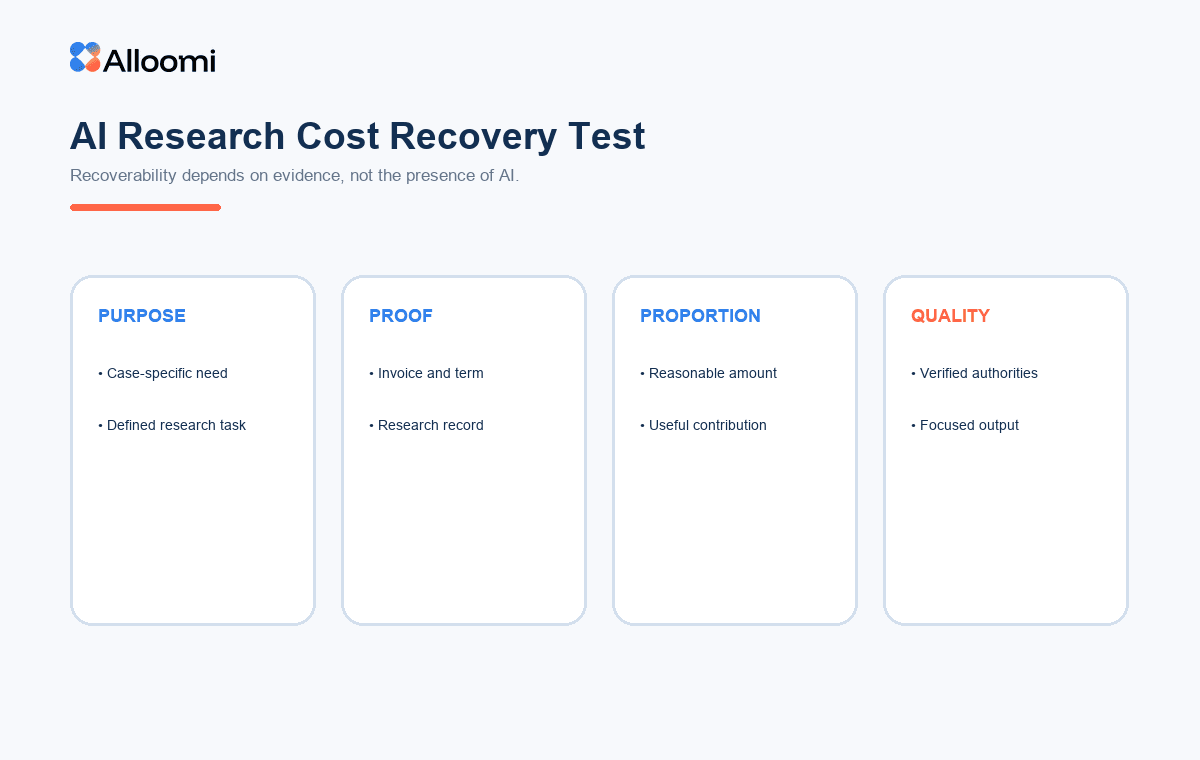
A practical record should connect purpose, case-specific use, proportionality, and output quality.
Why This Is Not a Blank Check for AI Spending
The approved judgment stressed responsible use. Excessive, repetitive, or unhelpful material may lead to costs being reduced or disallowed. A subscription does not become reasonable simply because it contains AI.
For legal teams, the better question is not “Did we use AI?” It is “What work did the tool support, what sources were checked, and what useful result did the expense produce?” That approach aligns with an AI legal audit trail and the verification practices described in AI for legal research.
What Evidence Should Be Preserved?
• The subscription term, invoice, and payment record.
• The matter-specific purpose for purchasing the tool.
• Research logs showing the authorities or issues examined.
• Human verification of cases, quotations, and procedural rules.
• A short explanation of time saved or work made possible.
• The final submissions or work product that benefited from the research.
These records do more than support a costs claim. They also help a firm distinguish productive use from output that merely looks polished. The same discipline reduces the risk discussed in AI hallucination sanctions.
What This Means for Law Firms
Law firms usually treat standing software subscriptions as overhead, while a client-specific service may be handled differently. The judgment does not decide every billing or recoverability issue. It does, however, reinforce that courts may examine function rather than labels. A specialist AI tool used for one proceeding can be evaluated like other litigation-support technology.
Before passing through a cost, firms should check the engagement letter, applicable costs rules, client billing guidelines, and whether the expense is already reflected in hourly rates. Transparency matters. The client should not be charged twice for the same capability.
How Alloomi Fits Into Responsible Legal Research
Alloomi AI can help authorized teams organize source documents, compare legal materials, and preserve links between an AI-assisted result and the evidence reviewed by a human. It does not transfer professional responsibility away from the lawyer.
The practical lesson is simple: recoverability depends less on the novelty of the technology than on necessity, proportionality, traceability, and useful work. A documented workflow is easier to defend than a generic claim that AI made the case more efficient.
Frequently Asked Questions
1. Is every legal AI subscription recoverable?
No. The decision was fact-specific. Courts may consider purpose, necessity, proportionality, and the quality of the resulting work.
2. Is an AI legal research platform a legal service?
Not necessarily. In this decision, the software was treated as a tool used by the litigants, not advice supplied by a lawyer.
3. Can poor AI output affect costs?
Yes. Prolix, inaccurate, or unhelpful output may undermine a claim that the expense was reasonably incurred.
This article provides general information and is not legal advice.