Nvidia reinstated Jensen Huang as president and chief executive officer on November 23, 2026. The board also created a National Security and Export Control Committee and announced a search for a new chief compliance officer. Those governance changes matter more to legal teams than the one-day stock reaction.
A committee and a CCO do not independently prove that export-control risk is managed. The real test is whether authority, reporting lines, contract requirements, transactional screening, and evidence preservation work together.
What Nvidia Announced
In an SEC-filed company announcement, Nvidia said Huang was reinstated immediately as CEO and a board member. It also described a new board committee focused on national security and export control and a search for a chief compliance officer.
Associated Press reporting placed the decision in the context of continuing congressional scrutiny and the company's independent investigation. Legal teams should therefore describe the reinstatement, investigation, and oversight measures separately. One event does not resolve the others.
Why Companies Add a CCO After a Crisis
A chief compliance officer can consolidate ownership of risks that otherwise sit across legal, sales, procurement, engineering, logistics, security, and finance. The position is most effective when the CCO can reach the board, challenge revenue decisions, require remediation, and obtain complete operational data.
Adding the title without defining authority creates a reporting layer rather than a control. The board should document the CCO's mandate, budget, access rights, escalation path, protection from retaliation, and relationship with the general counsel, internal audit, and business leadership.
What the New Board Committee Should Oversee
• Product classification and changes affecting export status.
• Customer, distributor, reseller, cloud, and end-user screening.
• License conditions and transaction-specific restrictions.
• Diversion indicators, unusual routing, and high-risk intermediaries.
• Compliance representations made to regulators, investors, and counterparties.
• Investigations, corrective actions, disciplinary decisions, and repeat failures.
• Whether commercial incentives undermine escalation or shipment holds.
Effective oversight needs reliable information. A board committee that receives only aggregate training counts cannot see which transaction was stopped, which warning was overridden, or whether the same distributor generated repeated alerts.
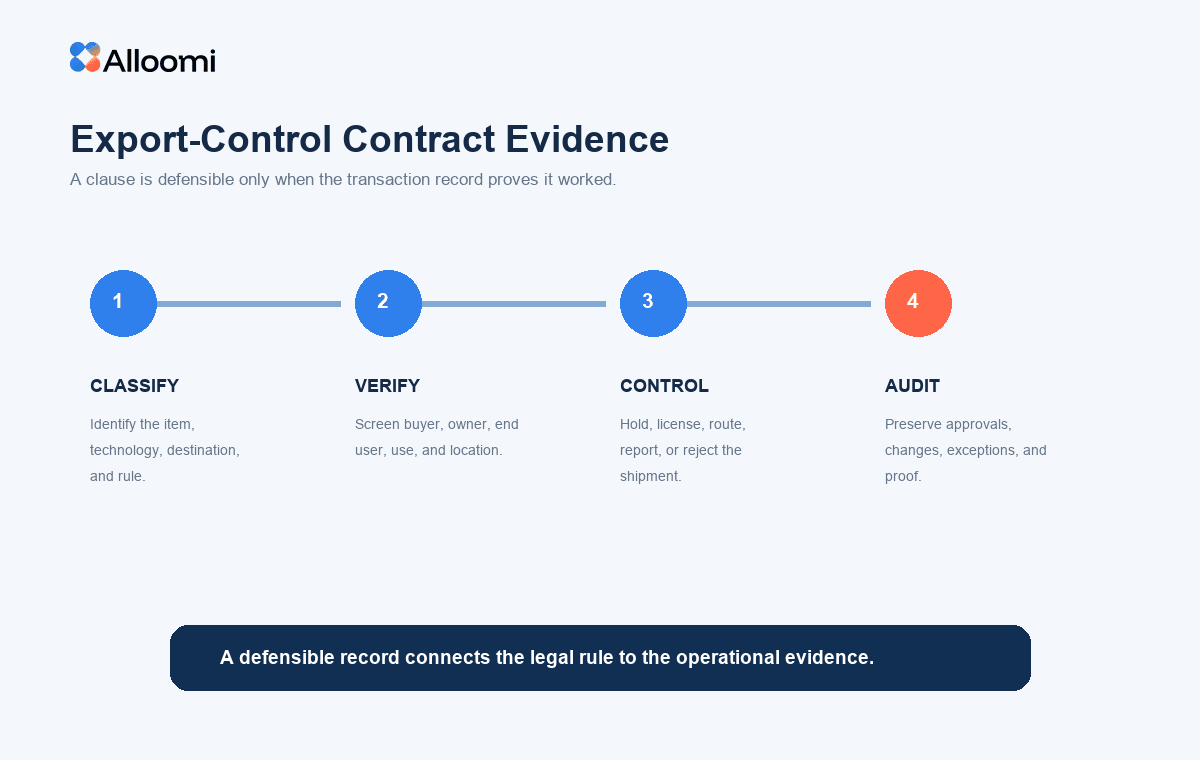
Contract language matters only when classification, screening, shipment controls, and audit evidence remain connected.
Where the Chip Security Act Fits
The Chip Security Act proposal would require location-verification mechanisms for certain advanced chips and create related reporting and enforcement obligations. It remains proposed legislation, so companies should not describe it as an enacted universal requirement.
Even before enactment, the proposal highlights the direction of travel: lawmakers want stronger evidence about where sensitive chips go after sale. Hardware manufacturers, distributors, data-center operators, and cloud providers should evaluate whether their contracts and systems can produce that evidence.
Contract Clauses That Need Operational Support
End-user and end-use representations should identify the purchasing entity, beneficial owners, deployment location, intended use, and restricted parties or activities. Flow-down clauses should reach resellers and affiliates where the commercial chain requires them.
The agreement should also address notice of ownership or location changes, audit and information rights, shipment holds, license cooperation, record retention, termination, and indemnity. But contractual wording is not enough. Legal teams must know whether sales systems capture the promised information and whether logistics teams can stop a transaction.
This operational connection builds on Alloomi's guidance about export-control clauses, contract compliance audits, and audit trails.
What Boards Should Ask the New CCO
• Which risks can you stop without business approval?
• Which data sources are incomplete or controlled by third parties?
• How are high-risk overrides documented and reviewed?
• Which distributor and end-user promises cannot currently be tested?
• What is reported directly to the board, and how quickly?
• Which controls depend on proposed rather than enacted law?
How Alloomi Can Support Compliance Evidence
Alloomi AI can help authorized teams organize contracts, end-user representations, policies, investigation records, and board materials while keeping findings connected to source documents for human review. It does not determine export classification or replace sanctions and export-control counsel.
The governance lesson is straightforward: a crisis can create a new committee and CCO, but credibility comes from authority, connected evidence, and documented action.
Frequently Asked Questions
1. Did Nvidia reinstate Jensen Huang?
Yes. Nvidia announced his immediate reinstatement as president, CEO, and a board member on November 23, 2026.
2. Is the Chip Security Act already law?
The cited federal proposal is not described here as enacted law. Companies should verify its current status before treating any provision as binding.
3. What should an end-user statement include?
It commonly addresses the actual user, deployment location, intended use, ownership, restricted activities, and a duty to report material changes.