Like Company v. Google: Can AI Summaries Infringe Publisher Rights?
Like Company v. Google is the first generative AI matter to reach the Court of Justice of the European Union. The case asks when an AI chatbot's real-time retrieval and reuse of online news can interfere with press-publisher rights.
The latest development is an Advocate General's opinion issued on November 3, 2026. It is influential but not the Court's final judgment. The dispute concerns Google Gemini, not a final ruling that every Google AI summary or AI Overview infringes copyright.
What the Case Is About
Like Company operates Hungarian web portals and publishes informational articles. It sued Google in Hungary, alleging that Gemini reproduced and made available content from its publications. The Hungarian court referred questions of EU law to the CJEU.
According to the CJEU press release, Advocate General Maciej Szpunar considered whether retrieval and real-time reuse of press publications by an LLM-powered chatbot may amount to reproduction or communication to the public.
The official case record identifies the matter as pending. Publishers should not describe the opinion as a final judgment or assume that its reasoning will be adopted unchanged.
Retrieval Is Not the Same as Training
The opinion separates several technical and legal acts that are often collapsed into the word “scraping.” Training a model on a corpus, retrieving a current webpage for a user query, creating an internal copy, and displaying protected expression in an answer may raise different questions.
The Advocate General considered the questions about model training hypothetical because the record did not establish that Like Company's articles were used to train Gemini. By contrast, real-time retrieval and reuse were central to the referred dispute.
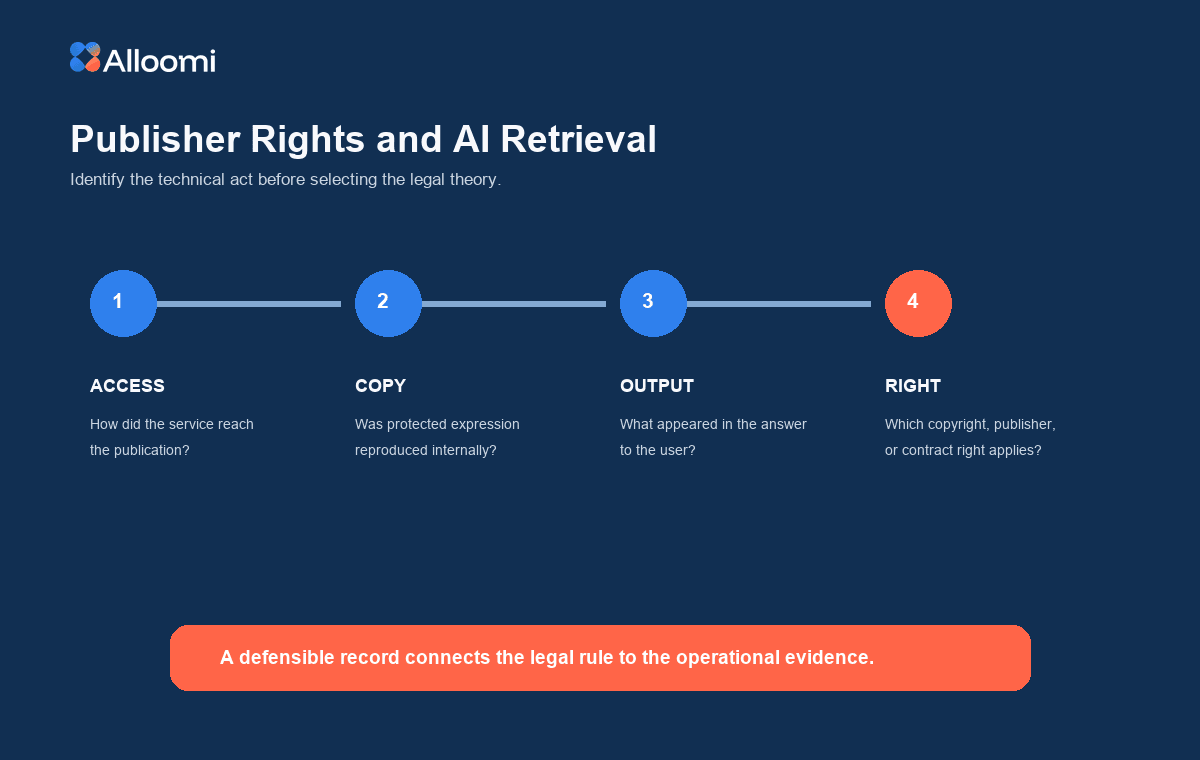
Publishers should identify the exact technical act before choosing a copyright or contract theory.
When Can an AI Summary Affect Publisher Rights?
The analysis turns partly on whether protected expression is reproduced or made available, not simply whether the output competes for attention. A summary of facts in new wording is different from an answer containing recognisable protected passages.
Press publishers also hold a related right under Article 15 of the EU Copyright in the Digital Single Market Directive. The scope, exceptions, and application depend on the precise use and output.
“Zero-click” traffic loss may explain commercial harm, but lost visits alone do not prove copyright infringement. The legal team still has to connect the technical act to a protected right and an applicable jurisdiction.
Does robots.txt Create a Legal Prohibition?
Not by itself in every jurisdiction or factual setting. A robots.txt file communicates crawler preferences and can support evidence that access was restricted or permission withheld, but it is not a universal substitute for copyright law, authentication, access controls, or an enforceable agreement.
Terms of Service are not magic either. Their effectiveness can depend on notice, assent, the identity of the crawler operator, governing law, and the particular claim. Publishers should align technical signals and legal terms rather than claiming that one file conclusively settles the issue.
What Publishers Should Update
• Identify which content is public, licensed, subscriber-only, or excluded from automated reuse.
• Preserve versions of Terms of Service, crawler rules, and licensing notices.
• State restrictions with enough precision to distinguish search indexing, training, retrieval, summarization, and commercial reuse.
• Monitor server logs and referral patterns while respecting privacy law.
• Create a licensing contact and a process for permission requests.
• Preserve examples that show recognisable output, dates, prompts, source pages, and traffic effects.
• Avoid making broader legal claims than the evidence supports.
What AI Providers Should Review
Providers should map each source-access pathway, respect applicable rights reservations, and retain records showing when a page was fetched, what was used, and what the output displayed. They should also test whether citations merely point users to a source or whether the answer substitutes for protected content.
These questions complement Alloomi's coverage of the AI copyright lawsuit tracker, training-data rights, and AI audit trails.
How Alloomi Can Help Organize the Evidence
Alloomi AI can help authorized teams compare Terms of Service, content licenses, crawler policies, output examples, and technical records while connecting legal conclusions to source documents. Human counsel must still determine the governing law and whether a specific use infringes a protected right.
The practical takeaway is narrower than “AI summaries are illegal.” The case shows why publishers and AI providers must identify the exact act: training, retrieval, copying, or output display.
Frequently Asked Questions
1. Has the CJEU ruled against Google?
No. The November 3 document is an Advocate General's opinion in a pending case, not the Court's final judgment.
2. Is Like Company about Google AI Overviews?
The official materials focus on the Gemini chatbot and real-time retrieval. The reasoning may inform broader debates, but the products should not be treated as identical.
3. Can Terms of Service stop every AI crawler?
No universal rule guarantees that result. Enforceability depends on notice, assent, law, facts, and the claim asserted.