Discovery responses are not ordinary drafts. They can bind a client to factual positions, disclose privileged material, shape later testimony, and expose the signing lawyer to procedural obligations. AI can help organize interrogatories, requests for production, and requests for admission, but it cannot know whether an answer is complete, whether an objection is justified, or whether a source document belongs to the correct matter.
The right question is not whether AI may assist with discovery. The question is how the legal team will connect every proposed answer to verified facts, preserve appropriate objections, protect sensitive material, and complete attorney review before service.
This article provides general educational information and is not legal advice. Applicable rules, court orders, discovery plans, and local practice must be checked for the matter at hand.
Why Discovery Responses Create a Different AI Risk
An AI-generated summary can be revised without leaving the building. A discovery response may be served on an opposing party and used later in depositions, motions, expert work, settlement discussions, or trial preparation. An inaccurate name, date, denial, or statement that no responsive documents exist can become much more consequential than a weak first draft.
Federal Rule of Civil Procedure 26(g) requires an attorney or party to sign discovery responses and objections. The signature certifies, after a reasonable inquiry, that the response is consistent with the rules and existing law, is not interposed for an improper purpose, and is neither unreasonable nor unduly burdensome in light of the case. The duty belongs to the signer, not to the software that prepared the language. See Federal Rule of Civil Procedure 26.
Recent federal court guidance makes the same point in direct terms. Lawyers remain responsible for AI-assisted work, including discovery responses that may never be filed with the court. The Western District of North Carolina guidance on AI use specifically extends validation duties to discovery responses and expert reports.
Where AI Can Help Without Making the Decision
AI can reduce mechanical work when the task is bounded and the source set is controlled. It may organize requests by topic, identify repeated definitions, build a response matrix, locate potentially responsive materials, compare a proposed answer with source records, or flag inconsistent names and dates.
Those tasks support the review process. They do not decide whether an objection is legally available, whether the client has completed a reasonable search, whether a response is evasive, whether a document is privileged, or whether a statement should be admitted. Those decisions require knowledge of the pleadings, discovery plan, jurisdiction, evidence, client operations, and case strategy.
A reliable workflow therefore separates assistance from authority. AI may propose, sort, compare, and flag. The legal team must investigate, decide, approve, and sign.
AI-assisted discovery should remain connected to the request, evidence, legal review, and final attorney sign-off.
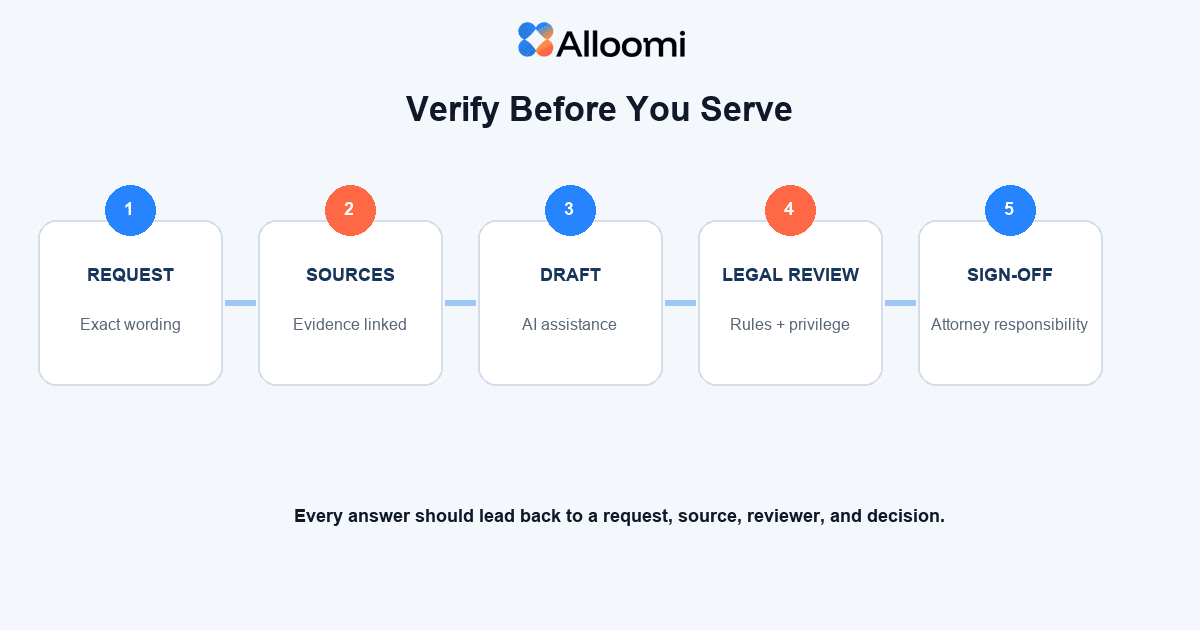
AI-assisted discovery should remain connected to the request, evidence, legal review, and final attorney sign-off.
Build a Source-Grounded Response Matrix First
Do not begin by asking AI to "answer the discovery." Begin with a controlled matrix that shows what was requested and what evidence supports the response.
Discovery Response Review Matrix
Use this matrix to connect every proposed discovery response to the exact request, supporting facts, privilege review, and final attorney sign-off.
| Field | Purpose | Review question |
|---|---|---|
| Request | Preserve the exact interrogatory, production request, or admission | Did the draft respond to the actual language and incorporated definitions? |
| Objection | Record each proposed objection and its basis | Is the objection supported by the governing rules, order, and facts? |
| Factual source | Link people, records, systems, and interviews supporting the answer | Can a reviewer trace every material statement to a verified source? |
| Search status | Show custodians, repositories, dates, and remaining collection work | Is the response premature because the reasonable inquiry is incomplete? |
| Privilege status | Identify material requiring withholding, redaction, or logging | Has counsel reviewed privilege rather than relying on an automated label? |
| Owner and sign-off | Assign the person responsible for verification | Who confirmed the final answer, and when? |
This matrix also prevents a subtle AI failure: producing polished language that sounds complete while the underlying investigation remains unfinished. If a source is missing, the system should show a gap, not manufacture a bridge.
Review the Draft by Response Type
Interrogatory Answers
Interrogatories often require narrative facts, identification of people, calculations, timelines, or the basis for a contention. Review every proper noun, date, amount, and causal statement. Confirm that the answer does not combine information from different entities, matters, products, or time periods. If the response depends on records maintained by the client, verify the referenced system and the scope of the search.
Requests for Production
A production response should match what the client can actually search, collect, review, and produce. AI should not state that all responsive documents will be produced merely because the sentence is conventional. Confirm custodians, data sources, date ranges, possession or control, collection status, production format, and any limitations. Connect withheld material to the privilege review and log process.
Requests for Admission
An admission may narrow the case, but a careless admission can also surrender a disputed fact. A denial may require a fair statement of the portion that is true. Compare every proposed admission or denial with pleadings, testimony, contracts, correspondence, and verified records. Escalate any response that appears inconsistent with an earlier position.
Objections
Generic objections are easy for AI to imitate and easy for an opponent to challenge. Each objection should be assessed under the applicable procedural rules, scheduling order, discovery agreement, local practice, and facts. Remove objections that do not fit the request. Explain whether responsive information is being withheld when the governing rule requires that clarification.
A Pre-Service Verification Workflow
• Lock the request set and confirm that definitions and instructions are included.
• Separate client-provided facts from lawyer analysis and AI-generated language.
• Link each material answer to a source document, interview, system record, or confirmed client statement.
• Compare names, dates, amounts, and defined terms across every response.
• Review privilege, confidentiality designations, protective-order requirements, and redactions.
• Confirm the search process and identify work that remains open.
• Check the response against pleadings, prior productions, deposition testimony, and earlier representations.
• Obtain client verification or signature when required.
• Complete attorney review under the applicable rules before service.
• Preserve the approved version, sources, reviewer, and service record.
Red Flags That Require a Human Pause
Stop the workflow when the draft contains a fact with no traceable source, a categorical denial based on incomplete collection, an unfamiliar objection, a reference to a document that cannot be located, inconsistent entity names, or language that appears copied from another matter.
Other warning signs include unexplained changes from the client's account, privilege labels applied without review, a statement that no responsive documents exist before custodians are confirmed, or an AI-generated citation to a rule or case that has not been checked in an authoritative source.
The safest response to uncertainty is not more fluent drafting. It is a visible unresolved issue assigned to a responsible person.
How Alloomi Can Support Discovery Review
Alloomi AI can help authorized legal teams organize requests, source materials, draft responses, open questions, and reviewer comments in one working context. That makes it easier to compare proposed answers with the evidence and identify issues that still require investigation.
Alloomi does not replace the reasonable inquiry, privilege decision, client verification, or attorney signature. Its role is to reduce reconstruction work and keep the draft connected to the materials a lawyer needs to review.
For related controls, see How Should Lawyers Verify AI-Generated Evidence Before Using It?, What Is Privilege Review?, and Who Reviews the Reviewer? Supervising AI-Assisted Legal Work.
Conclusion
AI can help lawyers structure and compare discovery responses, but service is a legal act, not a drafting milestone. The final response must reflect a reasonable inquiry, verified evidence, defensible objections, privilege review, and attorney judgment.
The practical safeguard is traceability. Every important answer should lead back to the request, the source, the reviewer, and the final decision. If the team cannot reconstruct that path, the response is not ready to serve.
Frequently Asked Questions
1. Can lawyers use AI to draft discovery responses?
AI may assist with organization, comparison, and first-draft language when firm policy, client obligations, confidentiality rules, court requirements, and professional duties permit it. A lawyer must still conduct the required inquiry and independently review the final response.
2. Does Rule 26(g) apply when AI prepared the first draft?
Yes. The attorney or party signing the discovery response remains responsible for the certification required by Rule 26(g). Software does not assume that duty.
3. Should AI decide whether a document is privileged?
No. AI may help identify potentially privileged material, but privilege determinations require legal analysis, context, and authorized human review.