Legal AI can produce a draft in seconds. That does not mean the legal workflow became faster.
The draft may require extensive correction. A lawyer may spend less time writing but more time reconstructing sources. The team may complete more work while creating new confidentiality, supervision, or billing concerns. A tool can look productive in a demonstration and still produce weak returns in daily practice.
Measuring legal AI ROI therefore requires more than estimated hours saved. Law firms should measure the complete workflow, including preparation, review, correction, escalation, delivery, and any later rework.
Why "Time Saved" Is an Incomplete Metric
Time matters, but it is only one input. If AI reduces first-draft time by forty minutes and adds thirty minutes of verification, the net gain is ten minutes, not forty. If the resulting work later creates a client correction, billing write-off, missed issue, or reputational problem, the apparent gain may disappear entirely.
Time estimates are also vulnerable to optimism. Users tend to compare AI with an imagined manual process rather than a measured baseline. They may record generation time but ignore document preparation, prompt refinement, source checking, formatting, and partner review.
A useful ROI model asks what changed in the delivered legal service. Did the team respond faster? Did quality remain stable? Was less work written off? Were risks identified earlier? Did clients receive clearer advice? Those outcomes are more meaningful than the number of prompts sent.
Start With a Baseline Before Measuring AI
Choose a repeatable legal task and measure it before changing the workflow. Good candidates include a standard contract review, research memo, due diligence summary, outside counsel invoice review, matter intake, or recurring client update.
The baseline should include:
• Total elapsed time from assignment to delivery
• Active working time by role
• Number and type of review corrections
• Escalations to senior lawyers or specialists
• Write-offs, discounts, or rework
• Missed issues found after delivery
• Client or business response time
• Work product quality under a defined rubric
Measure several examples rather than one unusually easy or difficult matter. The goal is a realistic range, not a perfect universal average.
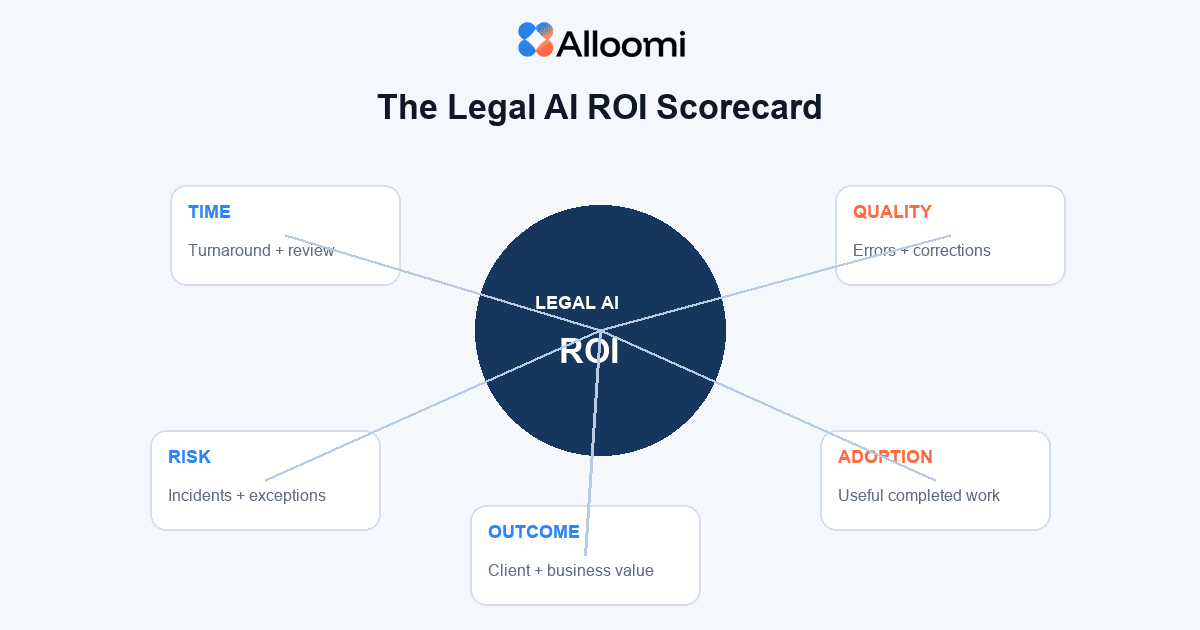
Legal AI ROI should measure the delivered workflow, not only generation speed.
Five Dimensions of Legal AI ROI
Legal AI ROI Measurement Framework
Measure legal AI across time, quality, risk, adoption, and outcomes to determine whether it improves the complete legal workflow.
| Dimension | What to measure | Warning sign |
|---|---|---|
| Time | Active time, elapsed time, review time, correction time, and turnaround | Generation is faster, but review or rework increases |
| Quality | Material errors, omissions, source accuracy, consistency, clarity, and reviewer corrections | Output is fluent but requires substantive rebuilding |
| Risk | Confidentiality incidents, unsupported claims, missed deadlines, privilege concerns, and policy exceptions | Efficiency depends on controls being bypassed |
| Adoption | Eligible users, active users, repeat use, abandonment, and workflow completion | High login counts but low completion of useful legal tasks |
| Outcome | Faster business decisions, earlier risk detection, reduced outside spend, better client service, and increased capacity | Time savings cannot be connected to a legal or business result |
These dimensions prevent a firm from declaring success because a small group of enthusiastic users generated many documents. Usage is evidence of activity. It is not proof of value.
Calculate the Cost of a Completed Legal Task
A practical unit of measurement is the cost of a completed, approved task. Include software cost, implementation, training, user time, reviewer time, correction time, and operational support. Then divide that cost by the number of work products that reached the required quality standard.
For example, a research tool may produce many drafts, but only approved memoranda should count as completed units. A contract-review workflow should count reviews delivered with required issue identification and lawyer approval, not documents merely uploaded to the platform.
This method also makes different tools easier to compare. A lower-priced tool can be expensive if it produces more abandoned drafts. A higher-priced system can deliver stronger value if it reduces review friction and supports more completed work.
Measure Quality With a Defined Review Rubric
"Good output" is too vague for ROI analysis. Create a short rubric for the task. A contract review might score issue coverage, clause accuracy, playbook alignment, source traceability, practical recommendations, and drafting quality. A research memo might score authority selection, citation accuracy, jurisdiction, treatment, factual fit, counterarguments, and clarity.
Use the same rubric for the baseline and AI-assisted work. Record both the final score and the effort required to reach it. If AI improves the first draft but not the approved result, the benefit may be speed. If it improves issue coverage while reducing corrections, the benefit includes quality.
Run a 30-Day Controlled Pilot
A short pilot should answer a narrow question, such as whether AI can reduce the approved turnaround time for routine NDA review without increasing material corrections.
Week one establishes the baseline and confirms eligible task types. Week two introduces the controlled workflow and trains users on sources, permissions, and review. Week three measures repeated use across comparable matters. Week four examines outcomes, user friction, exceptions, and whether the observed gains survive partner or client review.
Keep a comparison group when feasible. Do not change the tool, template, reviewers, and task definition at the same time. Otherwise, the team may attribute an improvement to AI when it came from a better template or clearer instructions.
When Fast AI Produces Negative ROI
Legal AI has negative ROI when the organization pays for speed that creates more expensive downstream work. Common examples include junior lawyers accepting weak research, senior lawyers rechecking every source because provenance is missing, confidential material entering an unapproved system, and teams producing more drafts than reviewers can supervise.
Negative ROI can also appear when a tool fragments the workflow. If users export drafts, copy information between systems, rebuild formatting, and manually document decisions, the measured generation time may hide substantial operational cost.
Watch for these signals:
• Review time rises as usage increases
• Users cannot explain where an answer came from
• Partners stop trusting drafts from the workflow
• Work product is generated but rarely delivered
• Policy exceptions become routine
• Clients question billing or quality
• Saved time is not reallocated to useful work
Do Not Turn Efficiency Into a Headcount-Only Story
Cost reduction is a legitimate result, but it should not be the only result reported. The Thomson Reuters Institute's 2026 analysis of legal AI measurement notes that relatively few legal departments measure ROI and that many of those measuring it focus primarily on internal cost savings.
A stronger report explains what the recovered capacity accomplished. The team may have shortened contract turnaround, reviewed more regulatory changes, answered the business earlier, reduced outside counsel dependence, or investigated risks that previously waited in a queue.
Efficiency is the means. The result is better legal service at an appropriate cost and level of risk.
How Alloomi Supports Measurable Legal Work
Alloomi AI helps legal teams keep assignments, source materials, drafts, review comments, decisions, and follow-up work connected. That continuity makes measurement more credible because the team can examine what entered the workflow, what AI produced, what the lawyer changed, and what was ultimately delivered.
Alloomi does not decide whether the ROI is acceptable. Legal and operational leaders must define the task, quality standard, risk tolerance, and outcome that matter. The system can help preserve the evidence needed for that judgment.
Related reading includes How to Evaluate a Legal AI Tool Before Firmwide Rollout, Can Law Firms Bill for AI-Assisted Work?, and If AI Made the Decision, Can Your Legal Team Reconstruct It?.
Conclusion
Legal AI ROI is not the difference between human drafting time and machine generation time. It is the change in the cost, speed, quality, risk, and outcome of an approved legal workflow.
Begin with a measured baseline. Track the full task. Apply a consistent quality rubric. Include review and correction. Then connect saved capacity to a result the firm, client, or business actually values.
Frequently Asked Questions
1. What is the best metric for legal AI ROI?
No single metric is sufficient. Cost per completed and approved legal task is a useful anchor when combined with turnaround, quality, risk, adoption, and business outcomes.
2. How long should a legal AI pilot run?
A 30-day pilot can reveal workflow friction and repeated-use patterns for a bounded task. Higher-risk or less frequent work may require a longer period and a larger sample.
3. Should estimated hours saved be reported?
Estimated savings may be reported if the method is transparent, but measured active time, review time, correction time, and completed outcomes provide stronger evidence.