A subcontracting clause determines whether a party may delegate performance, who remains responsible, and what conditions apply before another provider enters the work. A flow-down clause addresses a related but different problem: which duties from an upstream agreement must appear in a lower-tier contract.
These provisions are easy to underestimate. A prime contractor may promise security controls, insurance, audit access, confidentiality, delivery standards, or regulatory compliance, then hire a subcontractor without creating a workable path for that subcontractor to perform the same duty. The result is a gap between what the customer can enforce upstream and what the contractor can enforce downstream.
A sound review does not begin by copying every upstream clause. It begins by identifying the obligations that depend on lower-tier performance, deciding which tiers they must reach, and adapting each obligation to the parties and work involved.
Subcontracting and Flow-Down Clauses Are Not the Same
A subcontracting clause usually controls the right to use another person or company to perform part of the services. It may require consent, notice, due diligence, specified qualifications, or continued responsibility by the original contracting party.
A flow-down clause passes selected obligations into the subcontract. It may require the subcontractor to protect information, comply with law, maintain insurance, support audits, meet service levels, preserve records, or accept particular remedies.
The distinction matters because permission to subcontract does not automatically create an enforceable flow-down. Conversely, a general promise to bind subcontractors may be too vague if the lower-tier agreement never identifies the applicable duties.
Start With the Source Obligation
Before reviewing the subcontract, identify the exact upstream language that creates the duty. Record the agreement, section, version, affected service, responsible party, and any incorporated policy or exhibit.
Ask whether performance of the duty depends on a subcontractor. A confidentiality obligation may apply whenever a subcontractor receives protected information. A service level may apply only to a provider operating a particular system. An audit clause may require records held by every lower-tier vendor. A notice deadline may require the subcontractor to report an incident early enough for the prime contractor to meet its own deadline.
This source-first method prevents two common errors: flowing down obligations that do not apply and omitting obligations that cannot be performed without lower-tier cooperation.
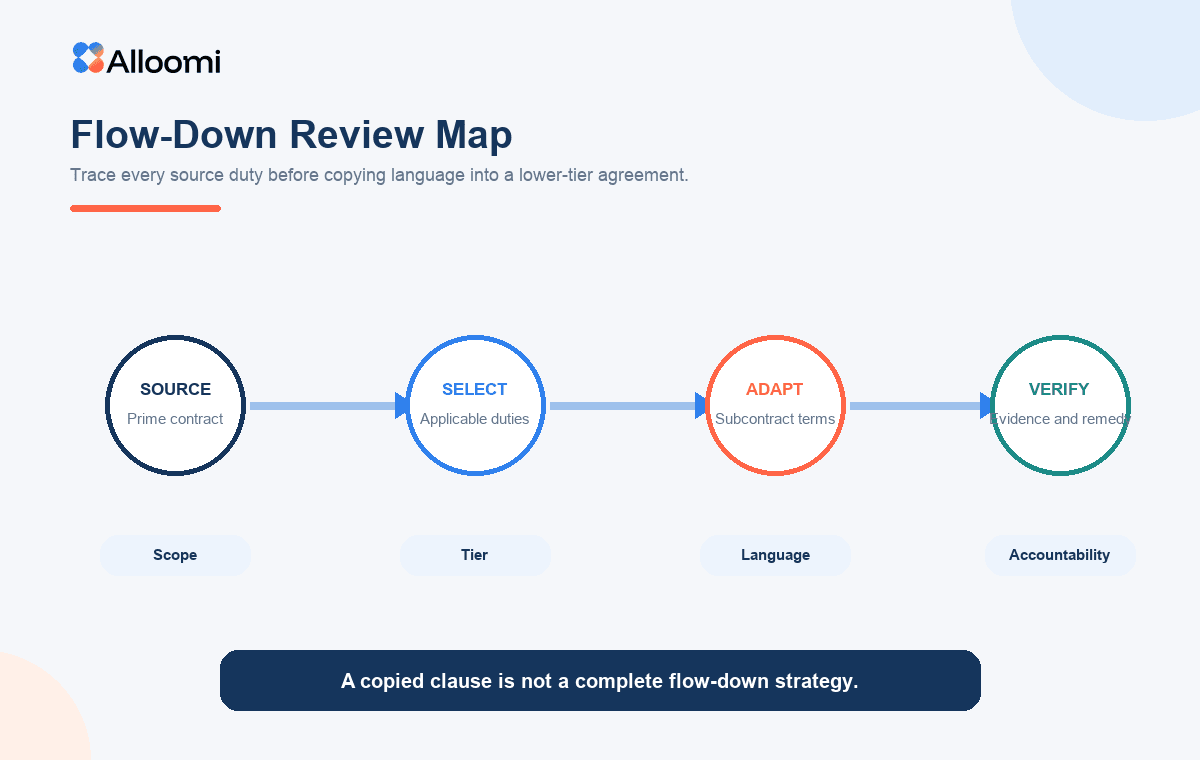
Trace the source, scope, adapted language, and proof before approving a flow-down.
Define Which Subcontractors and Tiers Are Covered
Terms such as subcontractor, supplier, agent, affiliate, and service provider may overlap but are not interchangeable. The agreement should make clear whether the restriction covers only direct subcontractors or also lower-tier providers.
Coverage may need to depend on function rather than label. A hosting provider, payment processor, consultant, temporary worker, or affiliated company may create the same risk even if the business does not call it a subcontractor.
Review the following questions:
• Which activities count as subcontracted performance?
• Does the clause cover access to confidential information or systems even without delegated deliverables?
• Must obligations reach every tier, or only providers performing specified functions?
• Are affiliates automatically permitted, or subject to the same controls?
• Does replacing a subcontractor require new notice or consent?
Separate Consent From Notice
Prior written consent gives the customer control but can create operational delay. Notice is easier to administer but may provide little protection if the recipient cannot object before work begins.
A workable clause should state whether consent is required, the information needed for a decision, the response period, and whether consent may be withheld or conditioned. It should also address emergency replacements and routine providers already identified in a schedule.
If the contract allows objection, define the consequence. The parties may require a replacement provider, additional controls, a transition plan, or termination of the affected service. A right to object without a remedy may not solve the underlying risk.
Adapt the Language Instead of Copying It Blindly
Upstream language often refers to the customer, prime contractor, contracting officer, regulator, or a particular reporting channel. Copying it unchanged into a subcontract may create impossible duties or direct notices to the wrong person.
For each flow-down, confirm:
• The parties are renamed correctly.
• Deadlines allow the prime contractor to meet the upstream deadline.
• Reports and notices go to the correct recipient.
• Audit and access rights can operate through the contractual chain.
• Confidentiality and data rules match the subcontractor's actual access.
• Remedies correspond with the harm the prime contractor may face.
• The term survives for as long as the upstream obligation survives.
For federal contracting, flow-down analysis is especially clause-specific. FAR Subpart 44.4 limits clauses that contractors may be required to apply to subcontractors furnishing commercial products or services, while FAR 52.244-6 identifies required clauses and recognizes a minimal set of additional clauses necessary to satisfy contractual obligations. Those rules should not be treated as a universal template for private commercial contracts.
Align Liability and Remedies Across the Contract Chain
A subcontractor may accept an operational duty while excluding the losses most likely to arise from breach. Review the duty together with indemnity, liability caps, insurance, warranties, termination rights, and cure periods.
If the prime contractor faces uncapped exposure for a security incident but the responsible subcontractor has a low general cap, the contract chain contains a risk mismatch. The solution is not always identical liability. It may involve a dedicated cap, required insurance, direct remediation duties, or a right to terminate the affected service.
Related Alloomi guides explain how to review an indemnification clause, contract insurance requirements, and data processing agreement as connected parts of the risk allocation.
Preserve Evidence of Compliance
A promise to comply is difficult to enforce if the prime contractor cannot obtain records. The subcontract should identify the evidence required, such as certifications, test reports, training records, incident notices, invoices, time records, security assessments, or insurance endorsements.
Define who may review the evidence, how often it must be updated, and what happens if a record is missing. Audit rights should be proportionate and should address confidentiality, access limits, cost, and remediation. See How to Review an Audit Rights Clause for a fuller framework.
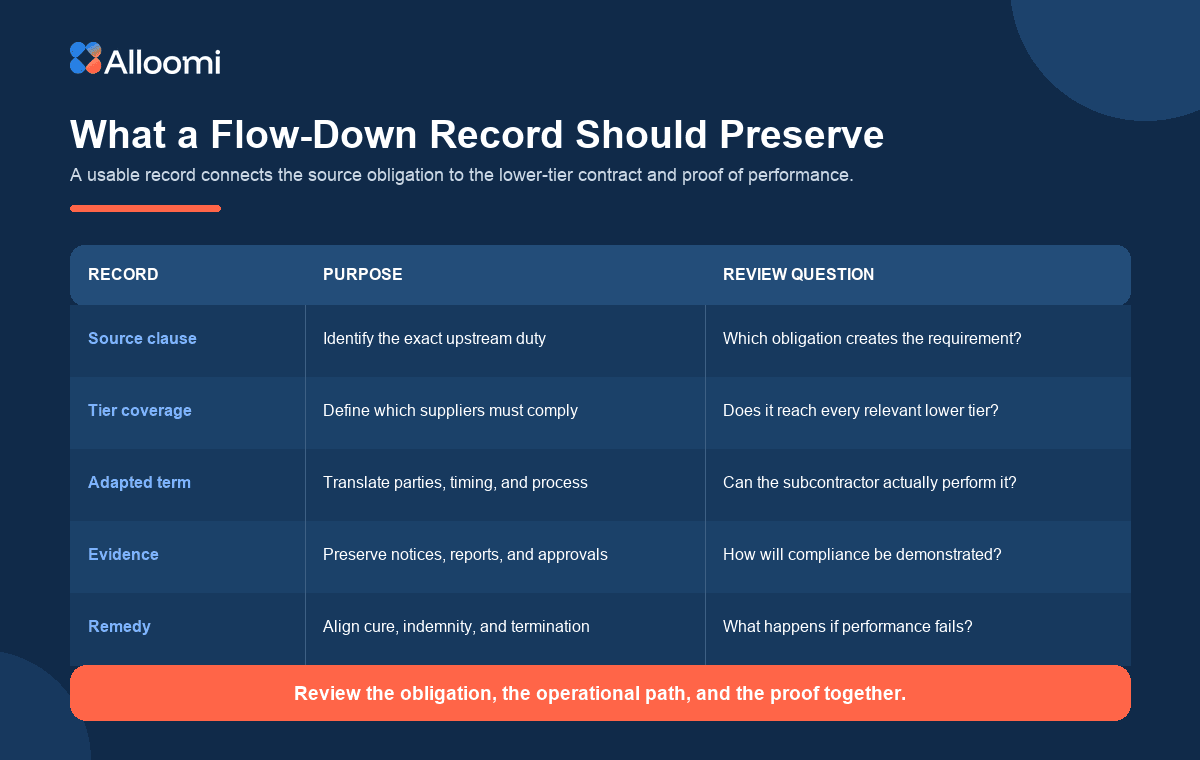
A defensible record connects the upstream duty with lower-tier performance and proof.
A defensible record connects the upstream duty with lower-tier performance and proof.
Review Changes and Termination
Upstream duties can change through amendments, updated policies, new regulations, or customer instructions. A subcontract should not automatically incorporate every future change without a process for notice, feasibility review, pricing, and timing.
At termination, confirm whether the subcontractor must return data, assist transition, continue critical services, preserve records, or support an audit. If the upstream agreement requires transition assistance, the subcontract must give the prime contractor enough time and control to deliver it.
How Alloomi Can Support Flow-Down Review
Alloomi AI can help legal teams compare an upstream agreement with a proposed subcontract, identify duties that depend on lower-tier performance, and keep findings linked to the source language for human review.
It can also help compare contract versions, surface changes to incorporated documents, and organize open questions before approval. The final decision still requires legal and operational judgment about scope, feasibility, and risk.
Conclusion
Effective flow-down review is not a copying exercise. It is a controlled translation from an upstream obligation into a lower-tier duty that the subcontractor can perform and the prime contractor can verify.
Start with the source clause, define the relevant tiers, adapt parties and deadlines, align remedies, and preserve evidence. That approach reduces the chance that the prime contractor promises more than its contract chain can deliver.
Frequently Asked Questions
1. Must every term in a prime contract flow down?
No. The required terms depend on the contract, law, incorporated requirements, work delegated, and risk involved. Overbroad flow-downs can create conflicts and obligations that do not fit the subcontract.
2. Does consent to subcontract protect the customer?
Consent provides control over provider selection, but it does not replace clear lower-tier duties, evidence requirements, and remedies.
3. Who remains responsible after subcontracting?
Commercial agreements commonly keep the original contractor responsible for subcontracted performance, but the exact allocation depends on the contract language and applicable law.