Payment clauses determine more than the number of days shown beside Net 30 or Net 60. They define what creates a valid invoice, when the payment clock begins, which approvals can delay payment, what amounts may be withheld, whether one claim can be set off against another, and what remedies follow a late payment.
A clause can appear commercially familiar while still leaving the parties with different assumptions. The supplier may count from invoice issuance while the customer counts from receipt of a correct invoice. One party may treat a disputed line item as a reason to hold the entire invoice. The other may expect undisputed amounts to be paid on time.
Effective review turns those assumptions into a sequence of verifiable events.
Start With the Payment Trigger
Identify the event that makes an amount invoiceable. It may be delivery, acceptance, completion of a milestone, passage of time, achievement of usage thresholds, or receipt of supporting records.
Then distinguish invoice eligibility from the payment due date. A supplier may be permitted to invoice after delivery, but payment may not become due until the customer receives a correct invoice at the designated address.
For sales of goods, applicable law may supply default rules when the contract is silent. For example, UCC Section 2-310 addresses open timing for payment unless the parties agree otherwise. The relevance of Article 2 depends on the transaction and governing law, so the provision should not be treated as a universal rule for services.
Define a Correct Invoice
A payment period should not depend on an undefined correct invoice. List the information and attachments required, such as purchase order number, contract reference, service period, itemization, tax information, milestone evidence, time records, and payment instructions.
Require the customer to identify defects promptly and with enough detail for correction. Otherwise, an invoice might remain pending without a clear reason or deadline.
Consider whether a corrected invoice restarts the entire payment period or only the period reasonably needed to review the correction. The answer may depend on whether the error affected the full invoice or one line item.
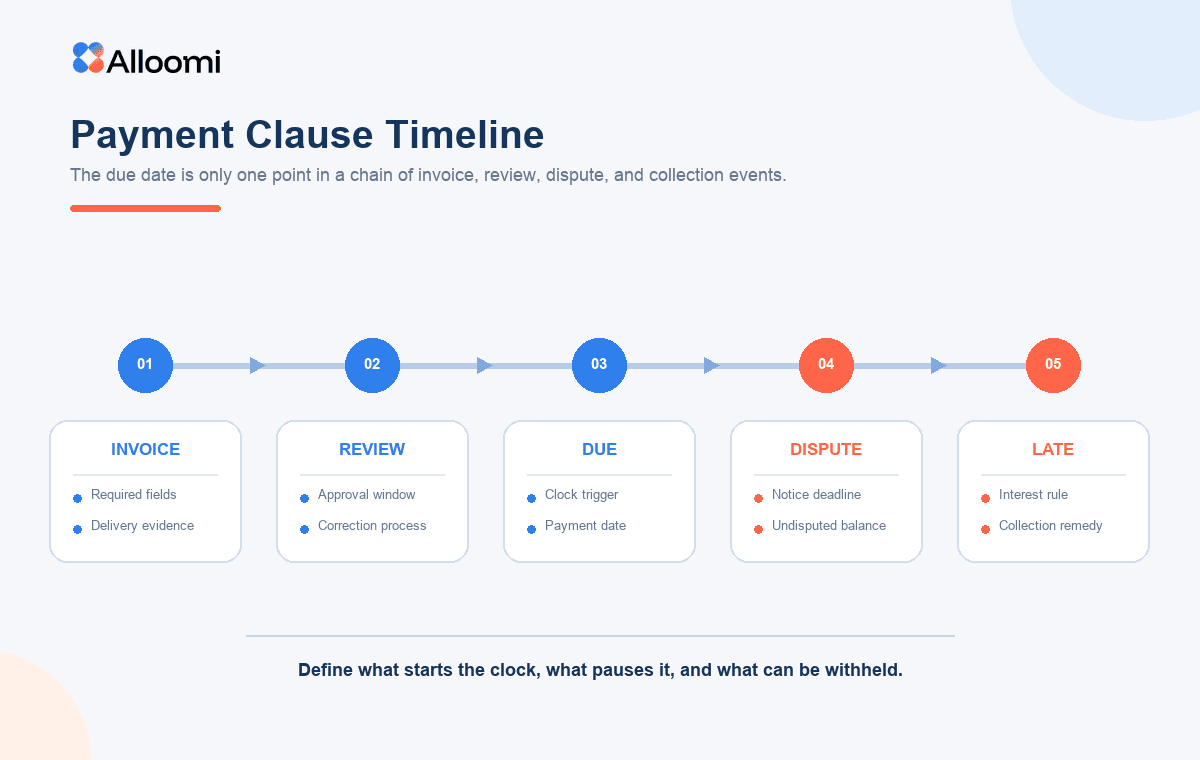
Payment timing depends on the full event chain, not only the stated number of days.
Payment timing depends on the full event chain, not only the stated number of days.
Separate Approval From Acceptance
Internal invoice approval should not silently change contractual acceptance rights. Confirm whether payment approval tests administrative accuracy, satisfactory performance, formal acceptance, or all three.
If the customer has an acceptance period, define the test, deadline, rejection notice, and consequence of silence. An indefinite approval process can turn a fixed payment term into an open-ended one.
For project work, connect payment milestones with the scope, deliverables, and acceptance criteria. Alloomi's guide to reviewing a statement of work explains how those elements should operate together.
Require Payment of Undisputed Amounts
A dispute over one item should not necessarily suspend the entire invoice. The clause can require timely payment of undisputed amounts while the parties investigate the remainder.
Define the dispute notice. It should identify the invoice, amount, basis, supporting records, and responsible contact. The notice period should give the customer enough time to review without allowing disputes to be raised indefinitely.
Consider an escalation process for unresolved disputes. Operational contacts may address documentation errors, while material legal disputes may move to designated executives or the contract's dispute-resolution process.
Review Setoff and Deduction Rights Carefully
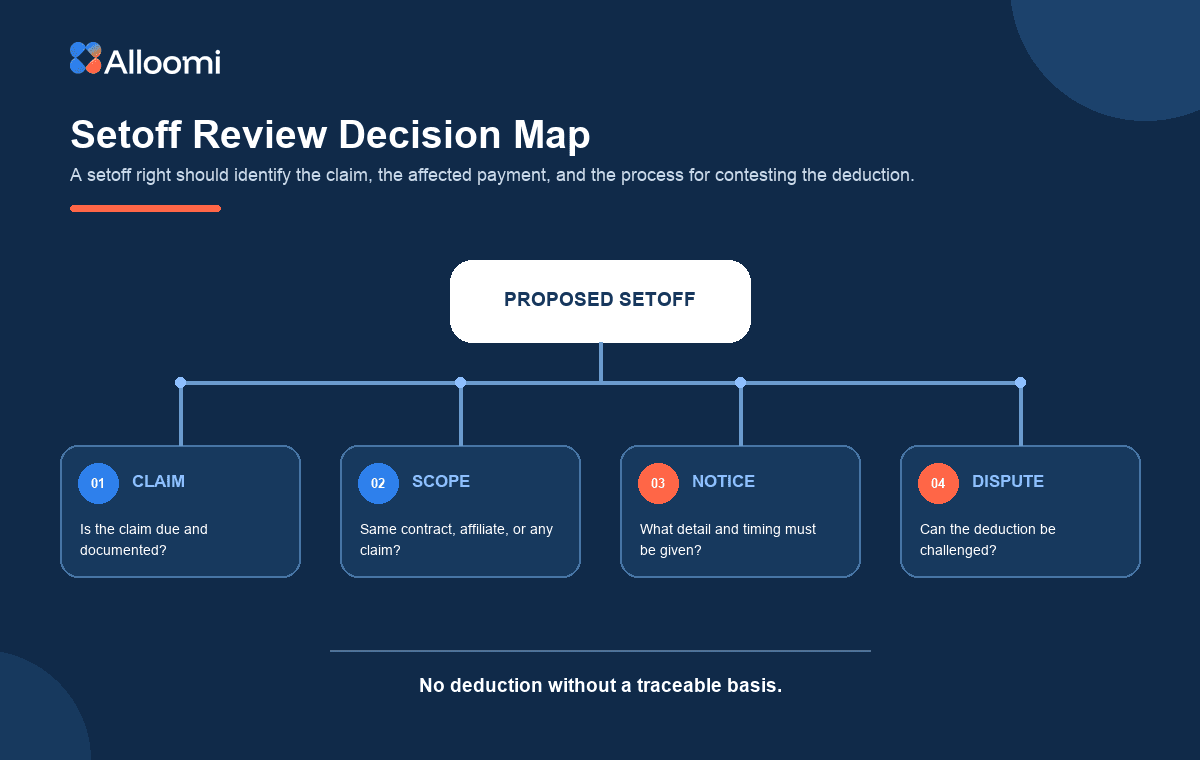
Setoff allows one party to reduce an amount it owes by another claim against the payee. The clause should state whether setoff is prohibited, permitted only for amounts finally determined, or allowed for asserted claims.
Review the scope:
• Must the claim arise under the same agreement?
• Can claims involving affiliates be used?
• Must the amount be undisputed, due, or established by judgment?
• Is prior notice required?
• Can the payee contest the deduction?
• Are taxes, credits, service levels, and refunds treated separately?
For goods transactions, UCC Section 2-717 addresses deduction of damages from the price after notice in defined circumstances. Its application depends on the transaction and governing law. A commercial agreement should still state the parties' intended process instead of relying on an uncertain default.
Check Taxes, Expenses, and Currency
State whether prices include sales, use, value-added, withholding, or similar taxes. Allocate responsibility for taxes based on income, payroll, personnel, and property separately from transaction taxes.
If withholding is required by law, address documentation, cooperation, tax receipts, and whether gross-up applies. For reimbursable expenses, define approval, categories, limits, supporting records, and markup.
Cross-border contracts should identify currency, exchange-rate source, conversion date, bank charges, and the account that bears transfer costs.
Test Late Fees and Interest
A late-fee clause should identify the rate, calculation base, accrual date, compounding method, and whether the charge applies to disputed amounts. It should also be subject to applicable law.
Review whether the contract uses a fixed charge, interest rate, collection costs, suspension right, or a combination. The remedy should be proportionate and should not allow a minor administrative delay to trigger disproportionate consequences.
If services may be suspended, require notice, an opportunity to cure, and protection for critical data or transition obligations. Check how suspension interacts with service levels, security, and termination rights.
Align Payment With Credits, Renewals, and Change Orders
Service credits may reduce future invoices, require a separate claim, or operate as the customer's exclusive remedy. Review the payment clause with the SLA and service-credit provisions.
Renewal pricing can create surprise increases if notice and objection periods do not align. See How to Review Contract Renewal and Price Increase Terms.
Change orders should state when additional work becomes billable and who can approve it. See How to Review Change Orders and Prevent Scope Creep.
Audit rights may be necessary for usage charges, pass-through costs, royalties, rebates, and variable fees. See How to Review an Audit Rights Clause.
Preserve a Reconstructable Payment Record
The parties should be able to reconstruct the invoice, receipt date, approval history, dispute notice, supporting evidence, adjustment, and final payment. Define the system of record and retention period.
Where several agreements interact, confirm which document controls pricing and payment. An MSA may establish general invoicing rules while an SOW sets milestones, rates, and acceptance. Review the order-of-precedence clause and see MSA vs SOW: Key Differences and Which Agreement Controls.
How Alloomi Can Support Payment-Term Review
Alloomi AI can help legal teams locate payment triggers, compare pricing schedules, identify conflicting invoice and acceptance terms, and connect review findings to the source documents for human verification.
It can also help compare contract versions and surface changes to due dates, credits, setoff rights, or renewal pricing. Finance, tax, and legal reviewers should confirm the operational and jurisdiction-specific consequences before approval.
Conclusion
A useful payment clause answers five questions: what may be invoiced, what starts the clock, what may be disputed, what may be deducted, and what happens when payment is late.
Review the full timeline rather than a single Net term. Clear triggers, limited setoff rights, prompt dispute notices, payment of undisputed amounts, and reconstructable records reduce both collection risk and unnecessary conflict.
Frequently Asked Questions
1. Should disputed amounts accrue late fees?
The contract should answer this directly. A common approach is to exclude genuinely disputed amounts while requiring prompt notice and payment of the undisputed balance.
2. Can a customer deduct any claim from an invoice?
Not automatically. Setoff rights depend on the contract, governing law, relationship between the claims, and applicable procedural requirements.
3. Is Net 30 measured from the invoice date?
It depends on the language. The period may run from issuance, receipt, receipt of a correct invoice, delivery, acceptance, or another defined event.