Tax clauses determine whether a stated price is tax-inclusive, which party must collect or pay transaction taxes, whether legally required withholding may be deducted, and whether the payer must increase the payment so the recipient receives an agreed net amount.
These provisions matter most when payments cross borders, involve royalties or services, include uncertain tax classifications, or depend on documentation and treaty relief. A careful review should separate transaction taxes from income taxes, preserve mandatory withholding duties, define any gross-up formula, and assign responsibility for forms, refunds, audits, and cooperation.
Separate the Types of Tax
Do not treat “taxes” as one category. The clause may address sales tax, value-added tax, goods and services tax, use tax, excise tax, customs duties, payroll tax, income tax, or withholding tax.
Identify which taxes arise from the transaction and which arise from a party's net income, personnel, property, or corporate status. A common structure requires the customer to pay applicable transaction taxes while each party remains responsible for its own income and employment taxes.
The wording should match the actual products, services, locations, invoicing model, and legal entities. Tax treatment may change when services are performed in another country, software is delivered electronically, intellectual property is licensed, or an affiliate issues the invoice.
Confirm Whether the Price Is Tax-Inclusive
The contract should state whether quoted fees include or exclude transaction taxes. If taxes are additional, determine what documentation the supplier must provide and whether the customer may challenge an incorrect charge.
Review pricing schedules, order forms, statements of work, and invoices together. An MSA may say taxes are additional while an order form describes a price as all-inclusive. The MSA vs SOW guide explains how an order-of-precedence clause can resolve conflicting commercial terms.
Identify the Withholding Obligation
A payer may be legally required to withhold tax from a payment and remit it to a tax authority. The contract should permit mandatory withholding even if the payment clause otherwise requires full payment.
Determine:
• Which party is the payer and potential withholding agent.
• Which payment types may be subject to withholding.
• Which country or source rules may apply.
• Whether a treaty or statutory exemption may reduce the rate.
• Which forms must be delivered before payment.
• What evidence of remittance must be provided.
The IRS explains that withholding agents should obtain appropriate documentation, including applicable Forms W-8 or W-9, and that payment characterization and source must be reviewed. See the IRS U.S. withholding agent FAQ.
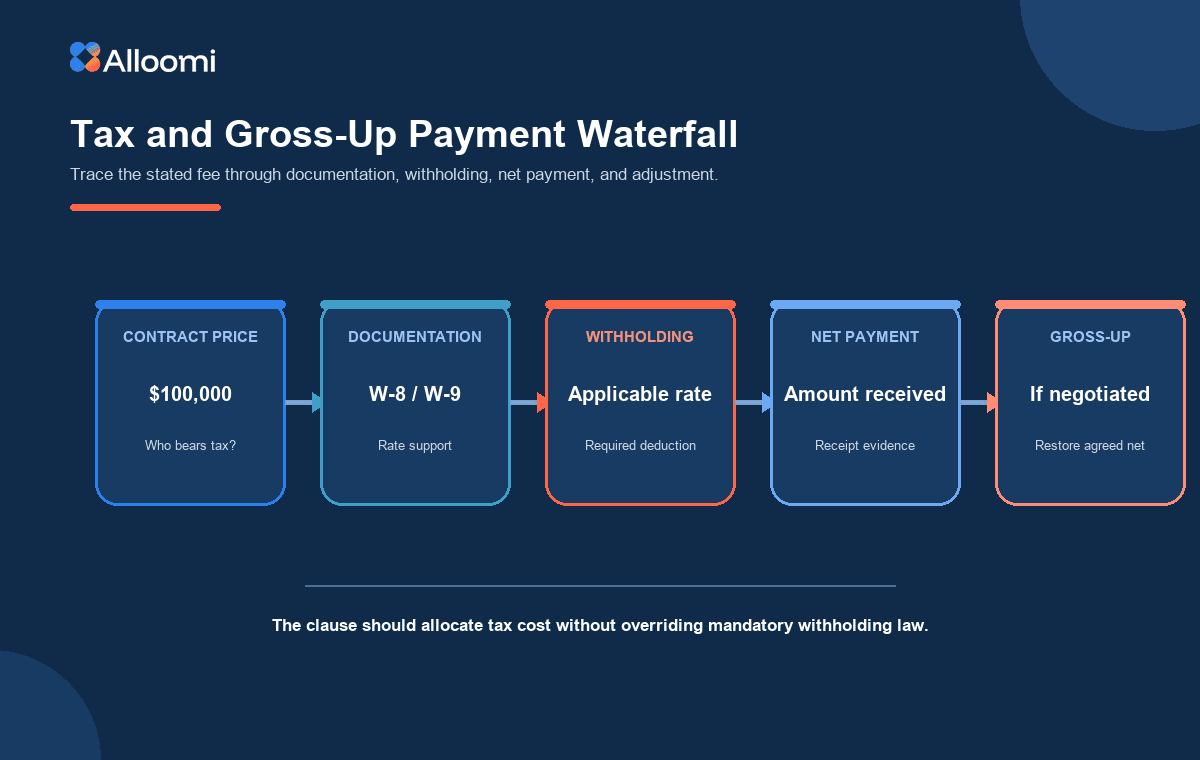
Review the payment from stated price through documentation, withholding, net receipt, and any negotiated gross-up.
Review the Gross-Up Promise
A gross-up clause requires the payer to increase a payment so the recipient receives a specified net amount after withholding. It can shift tax cost from the recipient to the payer and may materially increase the contract price.
Confirm whether gross-up applies to all withholding or only specified taxes. Common exclusions include withholding caused by the recipient's residence, failure to provide documentation, change in tax status, assignment, noncompliance, or connection with the taxing jurisdiction beyond the contract.
The formula should avoid circular ambiguity. If the payer must gross up the gross-up itself, the clause should use a mathematically workable calculation and identify the applicable rate.
Require Timely Tax Documentation
Assign responsibility for delivering forms, certificates of residence, taxpayer identification numbers, exemption claims, invoices, and renewal documents.
The IRS instructions for Form W-8BEN-E explain that a foreign entity may use the form to document status and, where applicable, claim a reduced rate or exemption. A contract should not assume that one form or treaty position fits every payment.
Set a deadline before the first payment and require updated documentation when information changes or a form expires. State what happens when valid documentation is missing. The payer may need to apply a default or presumption rule rather than postpone withholding indefinitely.
Address Treaty Relief and Cooperation
A treaty may reduce withholding for certain payments, but eligibility can depend on residence, beneficial ownership, payment type, limitation-on-benefits rules, and valid documentation.
The IRS notes that U.S. tax treaties may provide reduced rates or exemptions for qualifying residents. See Publication 515. The contract can require reasonable cooperation without guaranteeing that a tax authority will accept a treaty claim.
Avoid requiring a party to adopt an unsupported position. Cooperation should be limited by law, reasonable cost, confidentiality, and the information available to each party.
Allocate Refunds, Credits, and Recoveries
If withholding is later refunded or credited, determine who receives the economic benefit. A payer that funded a gross-up may expect repayment of the recovered amount, while the recipient may control the refund application.
Define:
• Who may apply for a refund or credit.
• Which party controls communications with the authority.
• How costs and professional fees are handled.
• When recovered amounts must be transferred.
• Whether interest or currency gains are included.
Do not require a party to disclose privileged advice or unrelated tax information merely to support a refund request.
Check Indemnities, Interest, and Audit Risk
Tax clauses may include indemnities for incorrect collection, failure to withhold, late remittance, penalties, or inaccurate documentation. Review causation, control, notice, mitigation, and whether the obligation sits inside the liability cap.
Distinguish contractual late-payment interest from statutory tax interest. A payer may owe contract interest to the supplier while separately owing interest or penalties to a tax authority.
Read tax indemnities with the agreement's broader indemnification clause, limitation of liability, cooperation duties, and record-retention terms.
Review Currency and Exchange-Rate Effects
Withholding may be calculated and remitted in a currency different from the contract currency. Define the conversion source, date, and responsibility for exchange-rate differences.
If a gross-up is designed to protect a net receipt, the formula should address currency conversion and bank charges. Otherwise, the recipient may receive less than the stated amount even when the tax calculation is correct.
Connect Tax Terms With Invoicing and Setoff
Tax review should not occur in isolation. Determine whether tax adjustments can be set off against future invoices, whether disputed tax must be paid first, and how corrected invoices affect the payment clock.
Use the dedicated guide to payment, setoff, and late-fee terms to test invoice mechanics and disputed amounts. For project transactions, align tax triggers with the statement of work.
Common Tax Clause Red Flags
• “All taxes” language that does not distinguish tax categories.
• A gross-up applying even when the recipient caused the withholding.
• No documentation deadline or consequence for missing forms.
• A treaty guarantee rather than a reasonable cooperation obligation.
• No method for calculating a circular gross-up.
• No allocation of refunds, credits, penalties, or audit costs.
• Conflict between the MSA, order form, SOW, and invoice.
• A clause that appears to prohibit withholding required by law.
How Alloomi Can Support Tax Clause Review
Alloomi AI can help teams locate tax and withholding language across the contract set, compare versions, identify conflicting payment terms, and connect review findings with source clauses and commercial instructions for human verification.
Tax treatment depends on jurisdiction, entity status, payment type, facts, and current law. Qualified tax and legal professionals should confirm the final position and required documentation.
Conclusion
A useful tax clause separates transaction taxes from income taxes, preserves mandatory withholding, defines documentation and cooperation, limits any gross-up to the negotiated risk, and allocates refunds, penalties, and evidence. The parties should be able to calculate the payment and explain the result before the first invoice is issued.
Frequently Asked Questions
1. What is a tax gross-up clause?
It is a provision requiring the payer to increase a payment so the recipient receives an agreed amount after specified withholding taxes are deducted.
2. Can a contract prohibit legally required withholding?
A contract should not override mandatory law. It can allocate the economic cost and cooperation duties while preserving required withholding and remittance.
3. Does a W-8 form eliminate withholding?
Not automatically. The form documents status and may support an exemption or reduced rate where the applicable rules allow it. The payer must review the payment, documentation, and governing requirements.