A clause library is useful only when users can tell which language is approved, when it applies, who owns it, and what has changed. AI makes retrieval and drafting faster, but it can also spread outdated language faster if the library lacks governance.
The solution is not a larger collection. It is a controlled lifecycle for proposing, reviewing, approving, using, monitoring, and retiring clauses.
What a Governed Clause Library Contains
A governed entry includes the approved text, clause type, jurisdiction, contract type, business context, risk position, fallback options, prohibited uses, owner, approval date, review date, source, and version history.
It should also explain why the clause exists. Without context, AI may select technically approved wording that does not fit the transaction.
Why AI Changes the Risk
Traditional libraries rely on users selecting a clause. AI may retrieve and insert language automatically based on similarity. That improves speed but increases the importance of metadata, access, and clear status labels.
A model may favor frequently used language even after policy changes. It may combine two approved alternatives, remove a qualification, or apply a clause from the wrong jurisdiction.
A Clause Governance Lifecycle
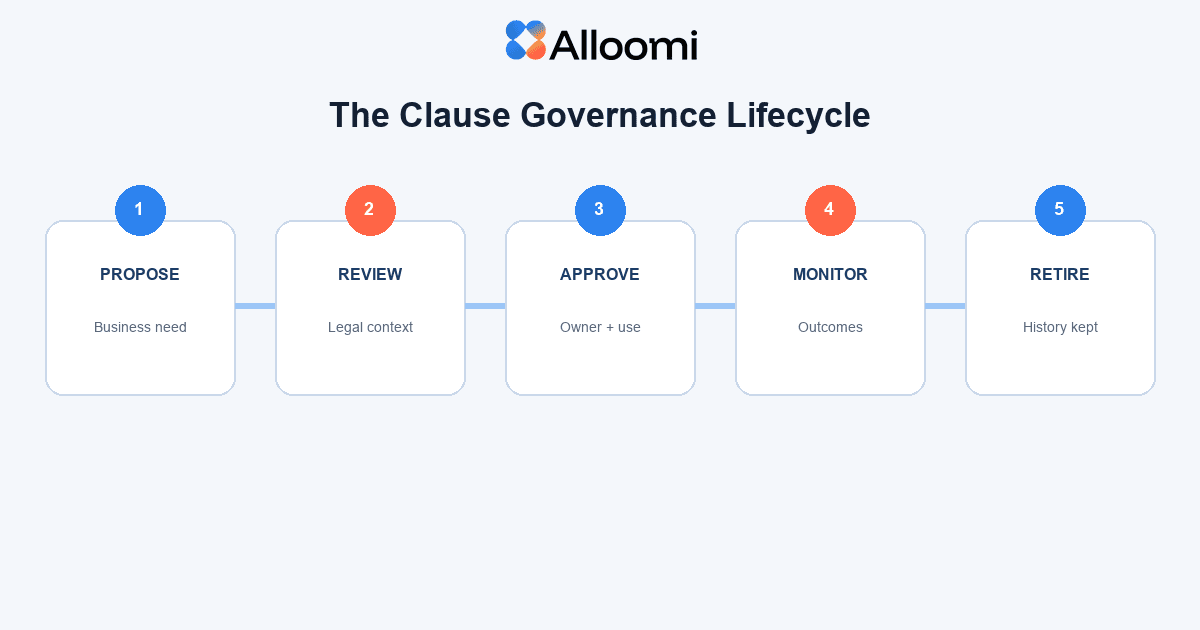
Propose
Record the business problem, source, requested use, jurisdiction, and reason for adding or changing language.
Review
Legal, business, tax, privacy, security, or finance owners assess the clause based on its subject. Compare the change with existing templates and playbooks.
Approve
Name an accountable owner, approval date, permitted uses, fallback position, and next review date.
Use
AI should retrieve only clauses valid for the matter context and show the source, status, and reason for selection. The drafting process described in Contract Authoring and Drafting provides the broader workflow.
Monitor
Track edits, negotiation outcomes, exceptions, legal changes, and recurring reviewer corrections. Do not treat frequency of use as proof of quality.
Retire
Remove a clause from active retrieval while preserving its history and affected documents. Record the replacement language and effective date.
Minimum Metadata for Each Clause
Use these fields to identify which clause version is approved, where it may be used, who owns it, and why the language remains current.
| Field | Purpose | Warning sign |
|---|---|---|
| Status and version | Identify approved, draft, restricted, or retired language | Multiple entries appear current |
| Use conditions | Define contract type, jurisdiction, and business context | AI selects by wording alone |
| Risk position | Separate preferred, acceptable, and fallback language | Fallback wording becomes the default |
| Owner and review date | Create accountability for updates | No one knows whether the clause remains current |
| Source and rationale | Explain why the language was approved | The clause cannot be defended or updated |
AI should retrieve clauses only from approved sources and display the applicable version, use conditions, owner, and review status. Lawyer review is still required before language is used in a contract.
Human Review Still Applies
ABA Formal Opinion 512 emphasizes competence, confidentiality, supervision, and lawyer responsibility when generative AI is used. Approved clause retrieval does not eliminate the need to confirm transaction facts, client objectives, and legal effect.
The NIST AI Risk Management Framework offers a broader governance model built around governing, mapping, measuring, and managing risk. Legal teams can adapt those ideas to clause provenance, testing, review, and change control.
Connect the Library to the Contract Workflow
Evaluate tools using the criteria in How to Choose a Contract Authoring Tool. Align clauses with an AI Contract Review Playbook, and compare negotiated language with the approved starting point using contract version comparison.
How Alloomi Can Support Approved Legal Knowledge
Alloomi can help teams carry approved templates, decisions, review standards, and matter context into future work. Lawyers remain responsible for determining whether a clause fits the transaction and current law.
Test Retrieval Before Expanding Access
Create realistic test matters and verify which clause the system retrieves, which metadata it displays, and how it handles missing context. Test common agreements, unusual jurisdictions, conflicting business instructions, and retired language. A useful test does not ask whether the AI found a clause. It asks whether the system showed the correct approved option and explained the conditions for using it.
Use Negotiation Outcomes as Evidence, Not Automatic Approval
Accepted counterparty language can reveal recurring market pressure, but acceptance does not make the wording safe or reusable. Capture the deal context, concessions, approval path, and result. Route proposed library updates through the same review process as any other legal standard.
Track how often users reject AI-selected clauses, which fallbacks are used, and where reviewers repeatedly add the same qualification. Those signals can identify a library problem without allowing the system to rewrite policy on its own.
Frequently Asked Questions
1. Should every negotiated clause enter the library?
No. Add language only after review, approval, and documentation of its proper use.
2. How often should clauses be reviewed?
Use risk-based dates and event triggers such as legal changes, recurring negotiation problems, or policy updates.
3. Can AI combine approved clauses?
Only with review. Combining approved text can create an unapproved legal result.
Conclusion
AI makes a clause library more powerful and less forgiving. Give every clause an owner, status, context, rationale, review date, and history. Fast retrieval is valuable only when the language retrieved is current and appropriate.