An AI-generated damages figure can look precise while resting on the wrong legal category, incomplete evidence, duplicated amounts, or an unsupported assumption. The calculation is not reliable because the spreadsheet balances. Lawyers need a review process that connects every material input and formula to the claim, governing law, evidence, and appropriate expert judgment.
Begin With the Legal Theory, Not the Number
Identify the categories of recovery, required elements, causation standard, time period, mitigation, offsets, caps, interest, taxes, and evidentiary burden. A model cannot choose the correct legal measure merely by finding financial records.
Under Federal Rule of Civil Procedure 26(a)(1)(A)(iii), a party must provide a computation of each category of damages it claims and make supporting evidentiary material available unless privileged or protected.
What AI Can Help Do
AI can classify transactions, extract amounts, normalize dates, identify missing periods, compare scenarios, connect entries to source documents, and draft an explanation of assumptions. It can also test arithmetic across a large model.
It should not silently decide causation, choose a discount rate, infer mitigation, treat all projected revenue as lost profit, or replace expert analysis.
A Six-Layer Review Framework
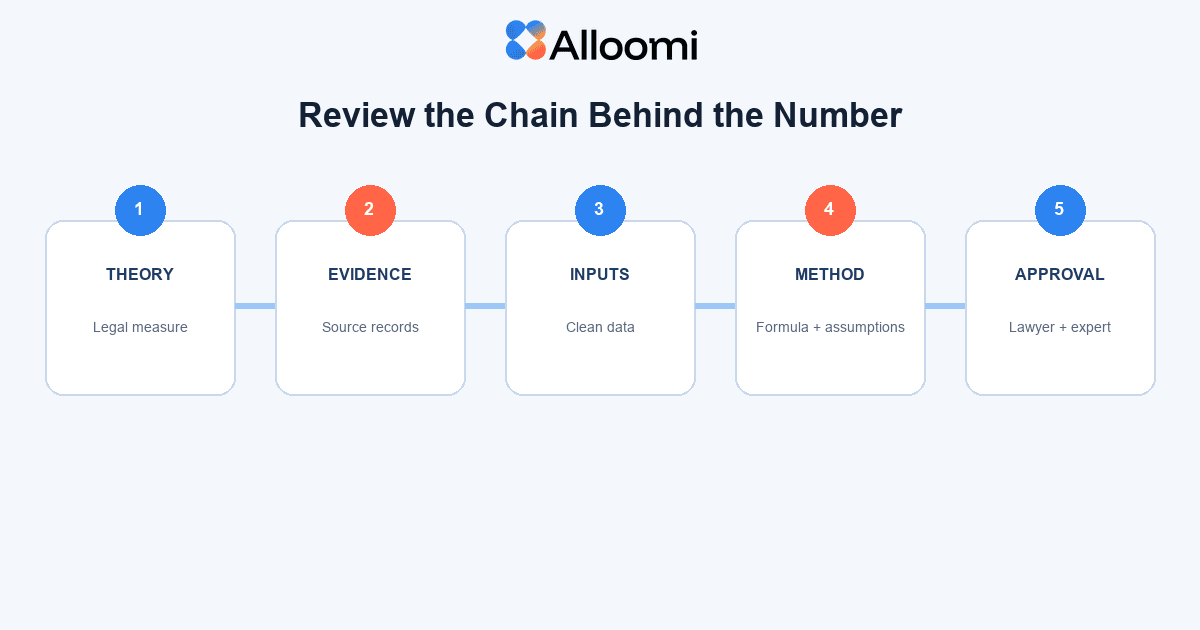
Legal category
Confirm what the calculation is intended to measure and whether the law permits that category.
Source evidence
Trace each material figure to invoices, contracts, payroll, tax records, market data, medical records, or other evidence. Use a source-connected litigation chronology where timing matters.
Data preparation
Check duplicates, missing data, currency conversion, inflation, time zones, unit changes, and inclusion or exclusion rules.
Formulas
Inspect formulas, references, rounding, compounding, discounting, and scenario logic. Recalculate independently.
Assumptions
List every assumption visibly. Explain its source, sensitivity, and effect on the result.
Legal and expert approval
Record who reviewed the legal theory, financial method, evidence, and final presentation.
A Damages Review Table
| Layer | What to verify | Warning sign |
|---|---|---|
| Claim | Recoverable category, causation, period, and limits | The model begins with available data rather than the law |
| Inputs | Source, completeness, date, unit, and owner | Values cannot be traced to evidence |
| Method | Formula, benchmark, forecast, and sensitivity | The method changes without explanation |
| Adjustments | Mitigation, offsets, taxes, discounting, and interest | Adjustments are hidden inside formulas |
| Approval | Lawyer and expert review, version, and date | No accountable reviewer owns the conclusion |
Every material figure and assumption should remain connected to supporting evidence and the applicable legal theory. AI may support extraction and modeling, but lawyers and qualified experts remain responsible for the method and conclusion.
LayerWhat to verifyWarning sign
Claim
Recoverable category, causation, period, and limits
The model begins with available data rather than the law
Inputs
Source, completeness, date, unit, and owner
Values cannot be traced to evidence
Method
Formula, benchmark, forecast, and sensitivity
The method changes without explanation
Adjustments
Mitigation, offsets, taxes, discounting, and interest
Adjustments are hidden inside formulas
Approval
Lawyer and expert review, version, and date
No accountable reviewer owns the conclusion
Expert Evidence Requires More Than an AI Explanation
Federal Rule of Evidence 702 addresses qualification, sufficient facts or data, reliable principles and methods, and reliable application. AI cannot serve as the unexplained basis for an expert conclusion. The expert must understand and defend the method used.
Where a summary of voluminous records is offered, Federal Rule of Evidence 1006 may also be relevant. Underlying records and accuracy remain central.
Verify Sources and Outputs
Apply the evidence controls in How Lawyers Should Verify AI-Generated Evidence. Research any legal premise using the process in AI for Legal Research. Keep assumptions, source decisions, and changes within a controlled matter management record.
Measure the Cost of Review
AI may reduce data extraction time while increasing verification work. Measure the complete workflow using the approach in How Law Firms Should Measure Legal AI ROI.
How Alloomi Can Support the Review
Alloomi can help authorized teams keep calculations connected to documents, matter facts, prior decisions, and review history. It does not determine recoverability or replace a qualified damages expert. Lawyers and experts remain responsible for the method and conclusion.
Run Sensitivity and Reconciliation Checks
A single damages figure hides how strongly the result depends on its assumptions. Test reasonable changes to volume, duration, growth, discount rate, mitigation, and other disputed variables. Show a range when the evidence supports a range. Sensitivity analysis should illuminate uncertainty, not be used to select the largest outcome.
Reconcile the model to source totals and independent records. Compare revenue to invoices, payroll to tax records, quantities to operational data, and projections to historical performance. Investigate unexplained differences rather than adjusting the model until it matches the preferred conclusion.
Preserve Version and Formula History
Record the dataset, formula version, assumptions, reviewer, and date for each material output. If the number changes, the team should be able to explain whether the cause was new evidence, corrected data, revised law, or a changed assumption. Screenshots and exported summaries are not substitutes for a reproducible model.
Frequently Asked Questions
1. Can AI calculate legal damages?
AI can support extraction and modeling, but recoverable damages depend on law, evidence, causation, and expert judgment.
2. What is the most important review step?
Trace every material input and assumption to a verified source and the legal theory it supports.
3. Should AI-generated models be disclosed?
Disclosure depends on procedural rules, expert discovery, court orders, and how the model is used. Counsel should address this before relying on the output.
Conclusion
A credible damages calculation is a chain of reasoning, not a single number. Review the legal category, evidence, preparation, formulas, assumptions, and accountable human approval. Precision without traceability is not reliability.