AI can help a legal team prepare a chronology, summarize claims, compare damages positions, and organize a mediation brief. It should not receive unrestricted access to settlement authority, confidential caucus communications, or negotiation strategy simply because those materials are relevant.
The practical goal is controlled preparation: use AI for source-grounded organization, restrict the most sensitive strategic inputs, and require lawyers and clients to make every material negotiation decision.
What AI Can Help Prepare
AI can assemble verified facts, identify disputed issues, compare pleadings with evidence, summarize prior offers, organize damages support, and create draft sections for a mediation statement. It may also generate questions for the client or highlight missing documentation.
These tasks work best when the source set is defined and the output links back to evidence. Open-ended prompts such as "tell us the settlement value" can hide assumptions and create false confidence.
Keep Four Information Zones Separate
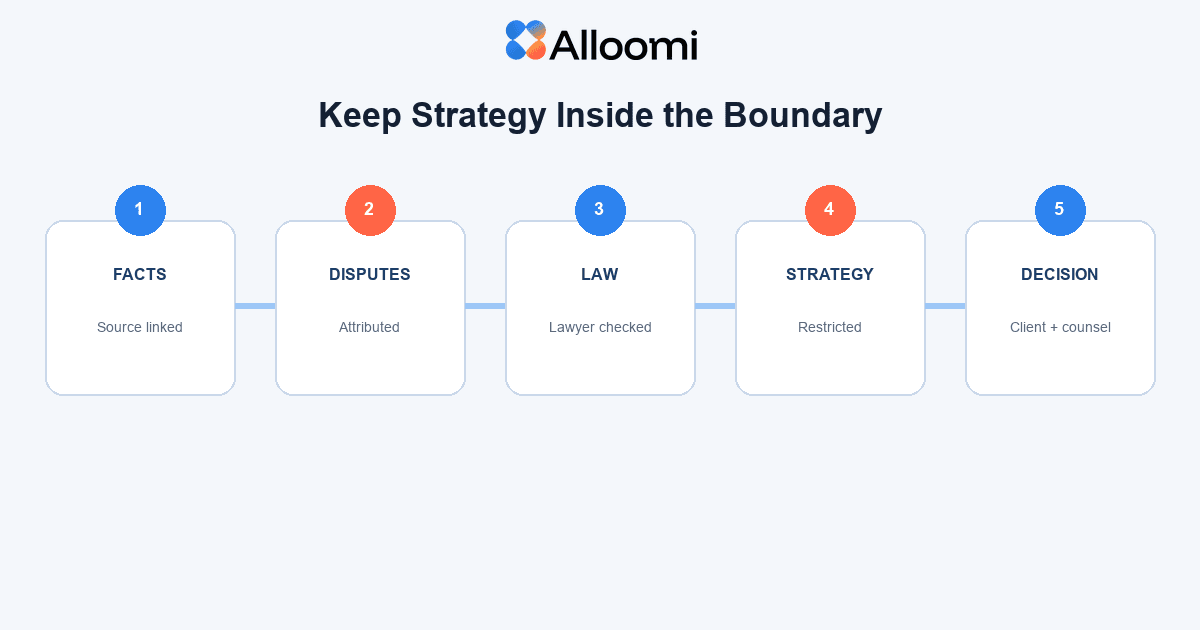
Verified case facts
Documents, testimony, procedural history, and agreed facts can be organized with source links.
Disputed positions
Each side's contentions should remain attributed. Do not let AI merge allegations and established facts.
Legal analysis
Research, burdens, remedies, evidentiary issues, and likely procedural outcomes require lawyer review. Source checking principles from AI for Legal Research still apply.
Confidential strategy
Settlement authority, walk-away points, negotiation sequencing, personality assessments, and caucus communications should have the narrowest access. Decide whether they should enter the AI system at all.
Rule 408 Is Not a General Confidentiality Rule
Federal Rule of Evidence 408 limits specified uses of compromise offers and statements made during negotiations. It does not create a universal privilege for everything connected with settlement. Court rules, mediation statutes, agreements, protective orders, and state law may add different protections.
Teams should label sources accurately and avoid assuming that placing information in a mediation file makes it protected for every purpose.
A Practical Preparation Process
• Define the issues the mediation must resolve.
• Build a source-linked chronology and identify disputed events.
• Create damages ranges with visible assumptions.
• Separate facts, advocacy, and confidential negotiation strategy.
• Limit access by role and matter.
• Review every draft for inaccurate concessions or unsupported statements.
• Obtain client approval for authority and material positions.
Protect Client Information
ABA Formal Opinion 512 requires lawyers to consider confidentiality, competence, communication, and supervision when using generative AI. Before uploading mediation material, review the provider's retention, training, access, subprocessors, and security terms.
Use verified redaction when sharing a reduced dataset. See AI Legal Document Redaction. Keep the matter's permissions, decisions, and external counsel work organized through a reliable matter management process.
How Alloomi Can Support Mediation Preparation
Alloomi can help authorized teams connect current documents, matter history, client instructions, and open issues. It does not determine settlement value, provide authority, or replace negotiation judgment. Those decisions belong to the client and responsible lawyers.
Review the Mediation Statement as Advocacy
A mediation statement is not a neutral case summary. It is advocacy directed to a particular mediator and sometimes a particular audience. AI may flatten the theory of the case, overstate weak facts, or include damaging information that was useful for internal analysis but inappropriate for the submission.
Review every factual statement for support, every legal proposition for authority, and every damages figure for its assumptions. Confirm which sections are confidential, which may be shared, and whether the mediator has specific requirements. Remove drafting notes, alternative strategies, and hidden metadata before transmission.
Prepare for the Live Session
Use AI to produce a concise issue map, source list, decision checklist, and questions that require client instructions. Do not let the briefing replace preparation with the client. Settlement decisions often turn on business constraints, relationships, timing, and risk tolerance that are not visible in the litigation record.
Frequently Asked Questions
1. Can AI recommend a settlement amount?
It can model scenarios, but the recommendation depends on assumptions, evidence, law, risk tolerance, and client objectives that require human judgment.
2. Are mediation communications always privileged?
No. Protection depends on applicable law, rules, orders, and agreements. Rule 408 is not a universal confidentiality privilege.
3. Should confidential settlement authority be entered into AI?
Only after a deliberate security and necessity assessment. Many teams should keep final authority outside general AI workflows.
Conclusion
AI can improve mediation preparation when it organizes evidence and exposes assumptions. It becomes risky when the boundary between analysis and confidential strategy disappears. Separate information zones, restrict access, verify every material statement, and keep settlement decisions under client and lawyer control.