A contract knowledge qualifier limits a statement by tying its accuracy to what specified people know, should know, or would know after an agreed inquiry. The qualifier is not minor drafting. It decides who bears the risk of facts that exist but are unknown when the representation is made.
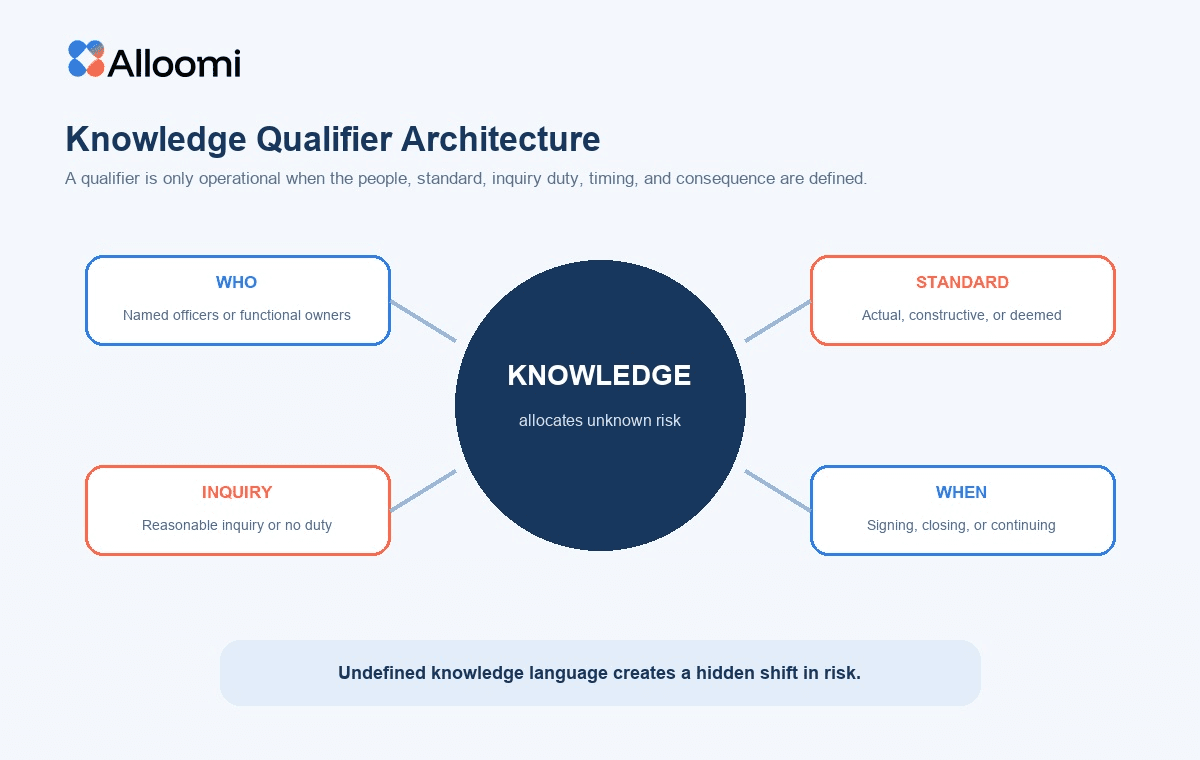
A useful clause answers five questions: whose knowledge counts, what level of knowledge applies, whether inquiry is required, when knowledge is measured, and what happens if the statement is wrong.
What Is a Contract Knowledge Qualifier?
A knowledge qualifier modifies language that would otherwise be absolute. "There is no pending claim" allocates the risk differently from "to the Seller's Knowledge, there is no pending claim." The second formulation may protect the speaker when a claim exists but falls outside the agreed knowledge standard.
Knowledge qualifiers often appear in representations about litigation, compliance, intellectual property, employees, customers, taxes, environmental matters, investigations, and notices. Their effect depends on the complete definition, not merely the words "to the knowledge of."
Whose Knowledge Should Count?
The contract may refer to the company generally, named officers, people holding specified roles, or individuals responsible for a subject area. A general reference to "management" can create uncertainty when reporting lines change or the relevant information sits with an operational employee.
Named individuals provide precision but can become outdated before closing. Functional descriptions travel better with organizational changes but may sweep too broadly. The drafting should match the information involved. An intellectual-property representation may require different knowledge holders than an employment or tax representation.
Actual Knowledge Versus Constructive Knowledge
Actual knowledge generally asks what the identified people consciously know. Constructive or deemed knowledge may include facts they should know, facts in company records, or facts discoverable through reasonable inquiry. Those standards can move the clause from a narrow mental-state test toward an operational diligence obligation.
Court-hosted briefing in a Delaware Supreme Court matter describes knowledge qualifiers as tools for allocating the risk of unknown occurrences. Public transaction agreements filed through SEC EDGAR also show how definitions may identify people, standards, and inquiry duties differently.
What Does Reasonable Inquiry Require?
"After reasonable inquiry" is incomplete unless the parties understand the expected inquiry. It may mean speaking with direct reports, reviewing a litigation list, checking an IP register, contacting facility managers, or asking the people responsible for a customer account. The appropriate process depends on the representation and the transaction.
A seller may seek "actual knowledge without duty of inquiry." A buyer may request knowledge after reasonable inquiry because the seller controls the relevant records. A compromise can identify a limited inquiry group or specific records rather than leave the obligation open-ended.
When Is Knowledge Measured?
Knowledge may be measured at signing, at closing, when a certificate is delivered, or continuously during the contract term. A transaction signed and closed on different dates should address whether representations are brought down and whether newly acquired knowledge must be disclosed.
The contract should also coordinate the qualifier with disclosure schedules, notice duties, amendment rights, and closing conditions. A fact learned after signing may require a schedule update, give rise to a termination right, or have no contractual consequence depending on the surrounding provisions.
Does the Qualifier Apply to Every Representation?
No. Applying one global knowledge qualifier can accidentally weaken representations the parties intended to be absolute. Legal teams should identify each qualified statement and ask why unknown risk belongs with the recipient rather than the speaker.
Fundamental representations, title, authority, capitalization, or taxes may receive different treatment from operational matters that genuinely depend on awareness. The answer is transaction-specific and should be visible in the risk record.
Knowledge Qualifier Review Checklist
- Identify every person or role included in the knowledge group.
- Define actual, constructive, imputed, and deemed knowledge expressly.
- State whether inquiry is required and what inquiry is expected.
- Confirm the measurement date and any bring-down mechanism.
- Test how employee turnover affects the definition.
- Coordinate the qualifier with schedules, notices, indemnity, survival, and remedies.
- Preserve the negotiation rationale and approved fallback language.
How Alloomi Supports the Review
Alloomi Contract Review helps legal teams locate qualified representations, compare them with review standards, and decide which suggested edits to apply. Related guidance includes warranty and disclaimer review, contract version comparison, amendments and side letters, and the broader contract review workflow.
The lawyer still decides which unknown risks each party should bear. The value of a structured review is making every qualifier, definition, and consequence visible before signature.
How the Qualifier Changes Remedies and Claims
The same knowledge language can have different effects depending on where it appears. A qualifier inside a representation may limit whether a breach occurred. A knowledge standard in an indemnity exclusion may instead affect whether a claim can be recovered. A notice clause may use knowledge to start a reporting deadline, while a termination provision may use it to determine whether a party may exit.
Review the qualifier together with survival periods, materiality thresholds, baskets, caps, exclusive-remedy language, fraud carve-outs, and sandbagging provisions. A narrow representation may still create significant exposure if the remedy section measures loss broadly. Conversely, a broad representation may have limited practical effect if the contract supplies no meaningful remedy.
Knowledge Scrapes and Materiality Scrapes
Some transaction agreements remove knowledge or materiality qualifiers when calculating whether an indemnifiable breach or loss exists. This is often called a knowledge scrape or materiality scrape. The mechanism can preserve qualified drafting for disclosure while changing the remedy analysis after closing.
The clause should identify whether the scrape applies when determining breach, calculating loss, or both. It should also coordinate with disclosure schedules and negotiated risk limits. A reviewer should not assume that the qualifier's effect ends with the representation itself.
How to Test the Definition With Real Facts
Apply the definition to realistic scenarios before approving it. What happens if the named officer never received an email held by a direct report? Does a searchable compliance system create constructive knowledge? Is a former executive still part of the knowledge group at closing? Does an ongoing investigation trigger a duty to inquire?
These examples reveal whether the text matches the intended risk allocation. They also help the business identify who must participate in disclosure preparation and closing certificates. If the answer changes depending on unstated assumptions, the qualifier needs further drafting.
Build a Defensible Knowledge Process
For material transactions, create a record of the knowledge group, subject areas assigned to each person, questions asked, sources reviewed, answers received, and unresolved items. The process need not become unlimited diligence, but it should match the contractual inquiry standard.
Preserve the final questionnaire or certification with the transaction record. If a later dispute concerns what the company knew, contemporaneous evidence of the agreed process is more useful than a generic statement that management was consulted.
Buyer and Seller Negotiation Positions
A buyer generally wants the people closest to the relevant information included, an inquiry obligation tailored to the representation, and protection against information being isolated in records or lower levels of the organization. The buyer may also seek a broader standard for matters the seller controls and a narrower qualifier only where genuine uncertainty exists.
A seller generally wants a limited group of senior individuals, actual knowledge, no imputation, and no duty to investigate beyond the agreed process. The seller may argue that a broad constructive standard turns a knowledge-qualified representation back into an absolute representation while adding uncertainty about what inquiry was enough.
A balanced clause can vary by subject. It may use actual knowledge for threatened litigation, reasonable inquiry for compliance systems, and an absolute representation for authority or title. The important point is to make the variation deliberate. Repeating one definition across every representation can create false consistency while allocating very different risks.
Document the Final Risk Decision
The review record should state which representations remain absolute, which are qualified, who sits in each knowledge group, what inquiry was completed, and why the final allocation was accepted. This prevents future reviewers from treating negotiated wording as generic boilerplate and gives the closing team a clear basis for certificates, disclosures, and follow-up questions.
Frequently Asked Questions
1. Is "to the best of knowledge" the same as actual knowledge?
Not necessarily. The contract should define the phrase rather than rely on assumed meaning.
2. Should a knowledge definition name individuals?
Named people improve precision, while roles may handle personnel changes better. Some agreements use both.
3. Can knowledge be imputed from company records?
Only if the contract or governing law supports that result. State the intended rule and inquiry duty explicitly.