A most-favored-customer clause can look like a simple promise to provide the customer with the supplier’s best price. In practice, it may create an ongoing pricing obligation across products, regions, channels, bundles, rebates, promotions, affiliates, and future deals.
The clause becomes risky when “better terms” are undefined, the comparison group is too broad, operational data cannot reproduce the calculation, or the remedy applies retroactively across a large contract value.
What Is a Most-Favored-Customer Clause?
A most-favored-customer clause, sometimes called a most-favored-nation or MFN clause, generally requires a seller to provide pricing or commercial terms at least as favorable as those offered to specified other customers. The U.S. Department of Justice has described MFN clauses in similar terms while examining their competitive effects.
The clause can protect a buyer from overpaying, but it can also restrict discounting, complicate segmentation, discourage experimentation, and create disputes over whether two transactions are genuinely comparable.
Which Comparison Terms Must Be Defined?
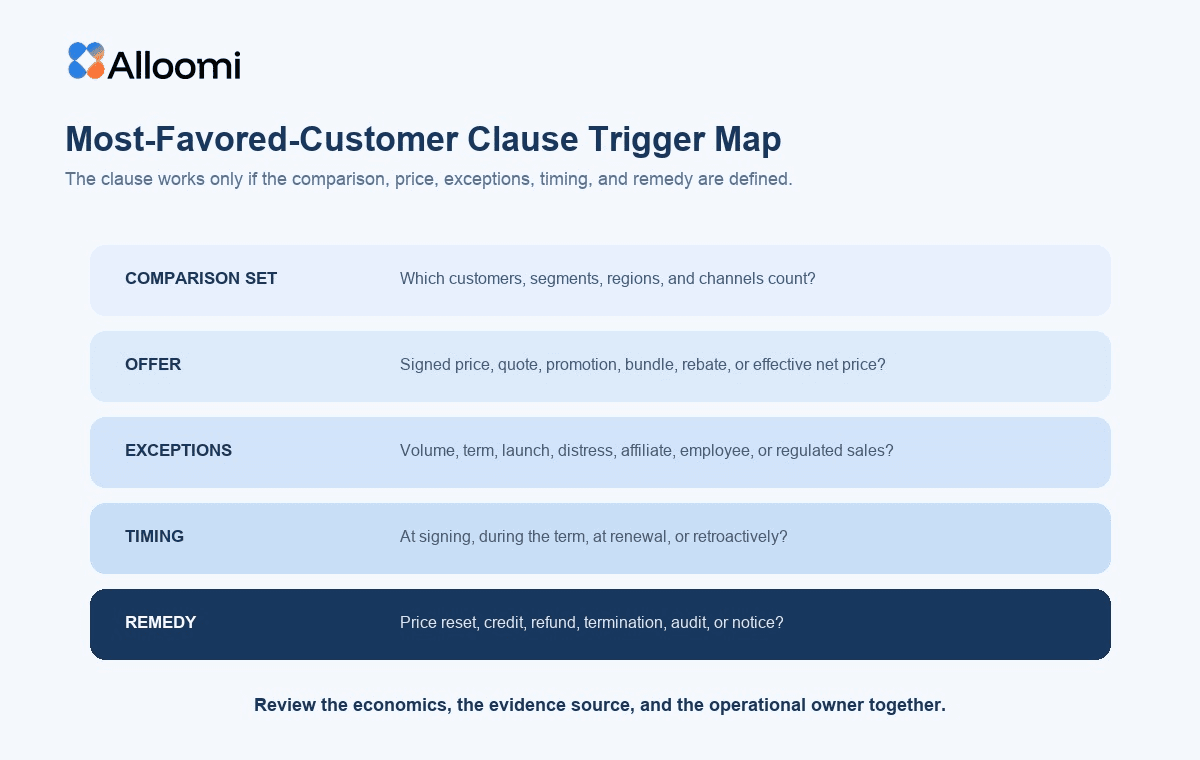
• The customers, industries, territories, channels, and affiliates included in the comparison set.
• The relevant product, edition, service level, volume, term, currency, and delivery obligations.
• Whether “price” means list price, invoiced price, effective net price, total economic value, or another measure.
• Treatment of rebates, credits, free services, implementation, bundles, financing, and non-cash benefits.
• Exclusions for pilots, launches, distressed sales, employee programs, regulated prices, and strategic partnerships.
When Does the Obligation Apply?
The clause should specify whether comparison occurs at signing, throughout the term, at renewal, or whenever a new offer is made. It should also state whether an improved price changes future invoices only or creates retroactive credits and refunds.
Notice mechanics matter. Decide who identifies a triggering deal, what data supports the comparison, how confidential customer information is protected, and how quickly the supplier must respond.
What Are the Competition-Law Concerns?
MFN clauses are not automatically unlawful. Their competitive effect depends on market structure, market power, scope, enforcement, and commercial context. The DOJ and FTC have examined how these provisions may raise rivals’ costs or discourage discounting in some markets. DOJ litigation involving health-insurer MFN clauses illustrates why market context matters.
Legal teams should involve competition counsel when a broad clause covers a concentrated market, a powerful buyer, multiple sellers, or pricing information that could influence market behavior. See the DOJ’s MFN workshop materials and its health-insurer enforcement discussion.
How Should Legal Teams Review the Clause?
Test the clause against real deals. Compare a high-volume customer, short-term promotion, reseller bundle, affiliate transaction, and renewal discount. If the business cannot determine whether each example triggers the clause, the drafting is not operationally complete.
Alloomi Contract Review helps teams review clauses against their standards and matter context, locate flagged language, and decide which suggested edits to apply. Supporting guides include audit-right review, payment and setoff terms, renewal and price increases, and boilerplate clauses that alter the deal.
Translate the Clause Into an Operational Calculation
A workable clause needs a calculation that finance and sales operations can reproduce. Define the comparison period, data source, currency conversion, tax treatment, allocation of bundled consideration, and treatment of rebates that are earned later. If the clause compares effective net prices, specify which discounts and benefits reduce the price and how non-cash benefits are valued.
Assign an owner for monitoring. Legal may interpret the language, but finance, sales operations, deal desk, or revenue operations usually holds the data needed to detect a trigger. The contract should not promise a comparison that the company’s systems cannot perform reliably.
Buyer and Supplier Negotiation Positions
A buyer may seek a broad comparison group, automatic price adjustment, retroactive credits, audit access, and continued protection through renewals. A supplier may narrow the comparison to similarly situated customers, equivalent commitments, the same channel and territory, and objectively measurable net price. Suppliers also commonly seek exclusions for promotions, pilots, distressed transactions, strategic launches, and transactions required by law.
Compromise structures include a certification by an authorized officer, periodic rather than continuous testing, an independent auditor, prospective adjustment instead of retroactive refunds, or a cap on credits. The right structure depends on bargaining power, product economics, data sensitivity, and the cost of administration.
Evidence and Confidentiality Controls
An audit right should identify the records necessary to test compliance without granting unrestricted access to other customers’ contracts. Consider anonymized transaction data, aggregated reports, counsel-only review, independent verification, confidentiality obligations, retention limits, and a prohibition on using the information for competitive purposes.
The dispute process should also address who bears audit costs, the threshold for reimbursement, the lookback period, materiality, privilege, and the treatment of genuine disagreements about comparability. Without these controls, a pricing protection can become a recurring discovery dispute.
Red Flags in a Most-Favored-Customer Clause
• “Best terms” is used without defining the economic comparison.
• The clause covers every customer worldwide regardless of volume, term, channel, or obligations.
• Bundles, credits, rebates, and free services are ignored.
• The adjustment is retroactive but has no lookback limit or exposure cap.
• The supplier must disclose third-party confidential information.
• No business function owns monitoring or certification.
• The remedy stacks with termination, indemnity, audit costs, and other damages without coordination.
What Should Be Preserved After Negotiation?
Keep the approved comparison definition, financial examples, exception rationale, data owner, monitoring cadence, notice procedure, and negotiated remedy with the final agreement. These records help future reviewers understand why the clause was accepted and prevent a later team from applying it as a generic promise to match every lower price.
Frequently Asked Questions
1. Are MFN and most-favored-customer clauses the same?
The labels are often used interchangeably in commercial contracts, but the actual scope depends on the written definition and remedy.
2. Should the supplier accept retroactive credits?
Only after understanding the calculation, lookback period, data source, dispute process, financial exposure, and exclusions.
3. Can an audit right reveal other customers’ confidential prices?
It can create confidentiality issues. Consider independent verification, aggregation, certifications, or narrowly controlled access.