A confidentiality residuals clause addresses what a recipient may use after confidential information has been seen, discussed, or remembered. It often permits the recipient to use information retained in the unaided memory of its personnel, even when the original materials remain subject to confidentiality restrictions.
The provision can protect ordinary skill and experience, but broad wording may also weaken the non-use obligation at the center of an NDA, technology license, services agreement, or strategic transaction. A careful review should define the memory standard, excluded information, permitted use, responsibility for personnel, and the relationship between residuals and trade-secret protection.
What Is a Residuals Clause?
A residuals clause is a contract provision that allows a recipient to use certain information remembered by people who had authorized access to confidential information. The permitted information is commonly described as information retained in “unaided memory,” without intentional memorization or continued reference to the discloser's documents.
The clause does not necessarily authorize copying source materials or disclosing protected documents. Its practical effect depends on whether it permits remembered information to be used for general knowledge, product development, competing activities, or other commercial purposes.
Start with the broader NDA review framework, then test the residuals language against the agreement's definition of confidential information, permitted purpose, intellectual-property terms, employee access rules, return obligations, and remedies.
Identify What May Become a Residual
Do not assume that “residuals” has a settled meaning. The agreement should specify whether remembered ideas, concepts, methods, techniques, know-how, or general skills may be used.
Ask whether the permission reaches:
• Product roadmaps, architecture, algorithms, source code, formulas, or designs.
• Customer lists, pricing, forecasts, security information, or business strategy.
• Personal data, regulated information, or information received from another party.
• Information protected as a trade secret.
• Ideas disclosed orally but never recorded or marked confidential.
A broad list may convert a limited memory exception into a right to reuse commercially valuable knowledge. The protected categories should reflect the transaction rather than an abstract preference for broad or narrow language.
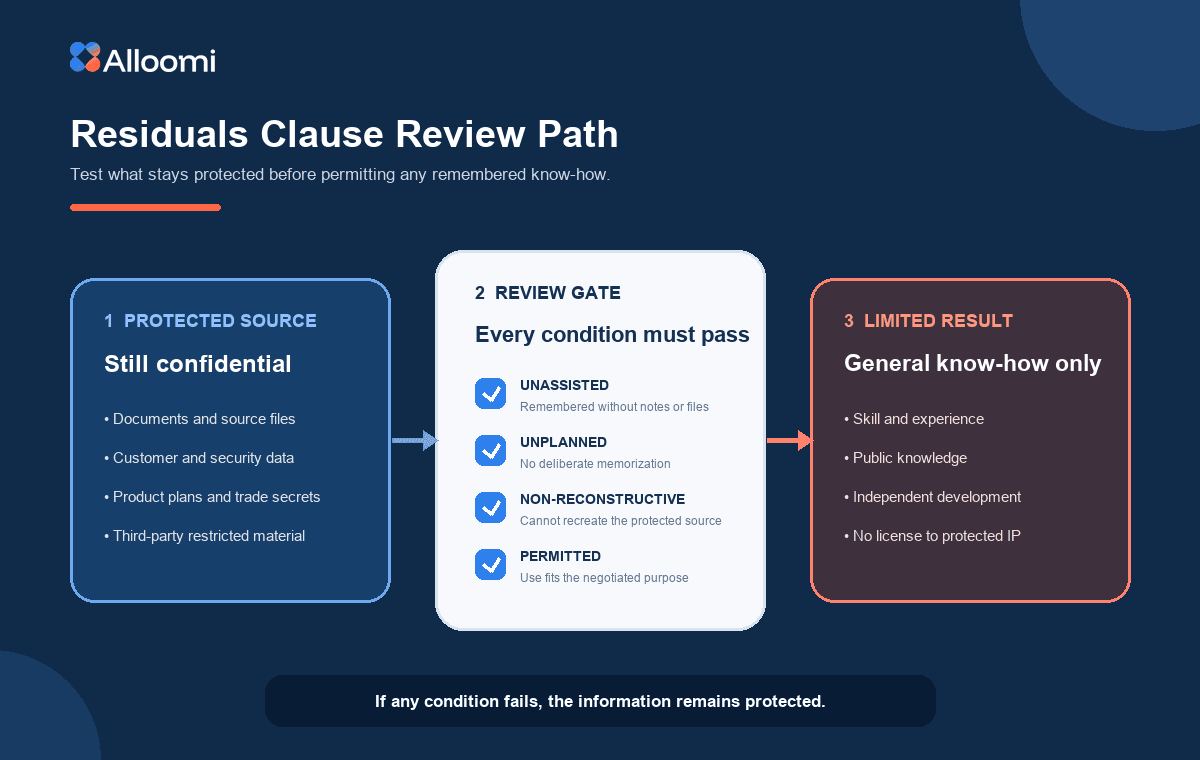
Residuals clause boundary map separating protected information, general know-how, and unaided memory
Define the Unaided Memory Standard
“Unaided memory” should mean genuine recollection without deliberate memorization, written notes, recordings, screenshots, copied files, prompts, databases, or later reference to the confidential source.
Review whether the clause excludes information remembered because a person intentionally studied it for future use. A provision may also state that the recipient has no obligation to restrict ordinary employee assignments solely because an employee was exposed to information, while still prohibiting deliberate staffing designed to reproduce the discloser's work.
The wording should not create a factual presumption that all later knowledge came from memory. When a later product resembles the disclosed technology, the parties may need evidence showing independent development, public sources, or prior knowledge.
Separate General Skill From Protected Information
People inevitably retain professional skill, experience, and general methods when they move between matters. A residuals clause can recognize that reality without authorizing the reuse of specific confidential information.
Useful distinctions include:
• General professional skill versus a customer-specific design.
• Publicly known methods versus a nonpublic implementation.
• Independent know-how versus information learned only through the disclosure.
• Abstract concepts versus code, formulas, datasets, specifications, and detailed plans.
The USPTO explains that trade-secret protection depends in part on information having economic value from not being generally known and being subject to reasonable secrecy efforts. See the USPTO's trade secret policy overview. Contract language should not casually reclassify valuable nonpublic information as general know-how.
Exclude High-Risk Information
Many residuals clauses exclude source code, personal data, customer data, security credentials, financial information, and information identified as a trade secret. The appropriate exclusions depend on what will be disclosed and why.
Consider an absolute exclusion where unauthorized reuse could create regulatory exposure, security harm, or irreversible competitive loss. A narrower permission may also limit residual use to internal development while prohibiting disclosure, licensing, sale, or use to compete with a named project.
Review the Permitted Use
A memory standard answers what information qualifies, but not what the recipient may do with it. Determine whether residuals may be used only for general skill development or for any commercial purpose.
Check whether the clause permits the recipient to:
• Develop a competing product or service.
• File or support intellectual-property applications.
• Disclose the remembered information to another customer.
• Train personnel, models, or automated systems.
• Avoid paying for a license that would otherwise be required.
A residuals permission should not silently transfer ownership or grant a patent, copyright, trademark, or data license. Read it with the IP ownership and license provisions.
Protect Trade Secrets and Lawful Reporting
The clause should preserve protection for qualifying trade secrets and should not override applicable law. For employment, contractor, or consultant agreements in the United States, 18 U.S.C. Section 1833 includes immunity for certain confidential disclosures made to government officials or attorneys for reporting or investigating suspected legal violations. It also contains a notice requirement for specified agreements governing trade secrets or confidential information.
Do not use residuals language to restrict protected reporting, lawful whistleblowing, or disclosures required by law. At the same time, protected reporting should not be used as a general commercial-use exception.
Assign Responsibility for Personnel
Identify whose memory can qualify. The clause may apply only to employees who received information properly, or it may extend to affiliates, contractors, advisers, and temporary personnel.
Check whether the recipient remains responsible for those people and whether access is limited by need to know. A recipient should not be able to route information through a broad group and later treat collective memory as unrestricted residual knowledge.
Preserve Evidence and Independent Development Records
Residuals disputes are evidence-intensive. The parties may disagree about what was disclosed, who saw it, what was remembered, and whether later work was independently developed.
Useful records include disclosure logs, access lists, document versions, development histories, public-source references, clean-room procedures, and dated design materials. The agreement can allocate the burden of showing independent development or permitted residual use.
For a broader approach to preserving review context, see The Legal AI Audit Trail and the guide to comparing contract versions.
Common Residuals Clause Red Flags
• Residuals includes every idea, method, or concept without meaningful exclusions.
• The clause permits use for any purpose, including direct competition.
• Intentional memorization is not excluded.
• Source code, personal data, customer data, or trade secrets are not protected separately.
• Residual use creates an implied license to intellectual property.
• The recipient has no responsibility for personnel who use remembered information.
• The clause conflicts with return, destruction, non-use, or deletion duties.
How Alloomi Can Support Residuals Clause Review
Alloomi AI can help legal teams locate residuals language, compare it with confidentiality and IP provisions, identify inconsistent definitions, and connect a proposed revision with the relevant source text for human verification.
The final decision still requires transaction context. The reviewer should understand what information will be shared, which personnel will receive it, how development work is organized, and what competitive harm could result from reuse.
Conclusion
A workable residuals clause protects ordinary skill and experience without creating a hidden license to reuse confidential information. Define unaided memory, exclude intentional memorization and high-risk information, limit permitted use, preserve trade-secret protection, and maintain records that can distinguish independent development from unauthorized reuse.
Frequently Asked Questions
1. Does a residuals clause end confidentiality obligations?
No. It usually creates a limited exception for qualifying information retained in unaided memory. The remaining confidentiality and non-use obligations continue according to the agreement.
2. Should trade secrets be excluded from residuals?
Often yes, particularly where remembered technical or commercial information could cause significant competitive harm. The appropriate wording depends on the transaction and applicable law.
3. Can residuals language create an IP license?
It should not do so unintentionally. The clause should state whether it grants any patent, copyright, trademark, data, or other intellectual-property rights.