AI companies often describe safety through policies, public statements, product labels, and assurances that harmful uses are prohibited. Oregon and Virginia are now testing what those statements mean when a state alleges that the product's design and controls did not match the promise.
On November 23, 2026, the two states filed separate actions concerning sexualized images allegedly generated through Grok and distributed on X. The complaints contain allegations, not final findings. Their broader importance is that they treat safety representations, design choices, moderation records, and incident response as parts of the same evidentiary story.
What Oregon and Virginia Allege
The Oregon Department of Justice says the companies promoted Grok and X as safe while failing to prevent the generation of nonconsensual sexualized imagery, including material involving children. Oregon filed its complaint in Multnomah County Circuit Court, while Virginia filed a separate action in Richmond.
The states allege that product design and marketing encouraged sexualized content, that safeguards were inadequate, and that public assurances were misleading. The defendants have said sexual content involving minors is abhorrent, that such material has no place on the services, and that they take action against attempts to bypass safeguards.
Because the litigation is new, legal teams should distinguish allegations, defenses, evidence, and court findings at every stage.
Why Safety Statements Can Become Legal Evidence
A statement such as “zero tolerance” may begin as policy language. In litigation, it can be compared with internal testing, known bypasses, product defaults, response times, enforcement records, and what users were able to generate.
The legal question is not whether a system prevented every misuse. It may be whether a representation was materially misleading, whether known risks were addressed reasonably, and whether the company's conduct violated the relevant state consumer-protection law.
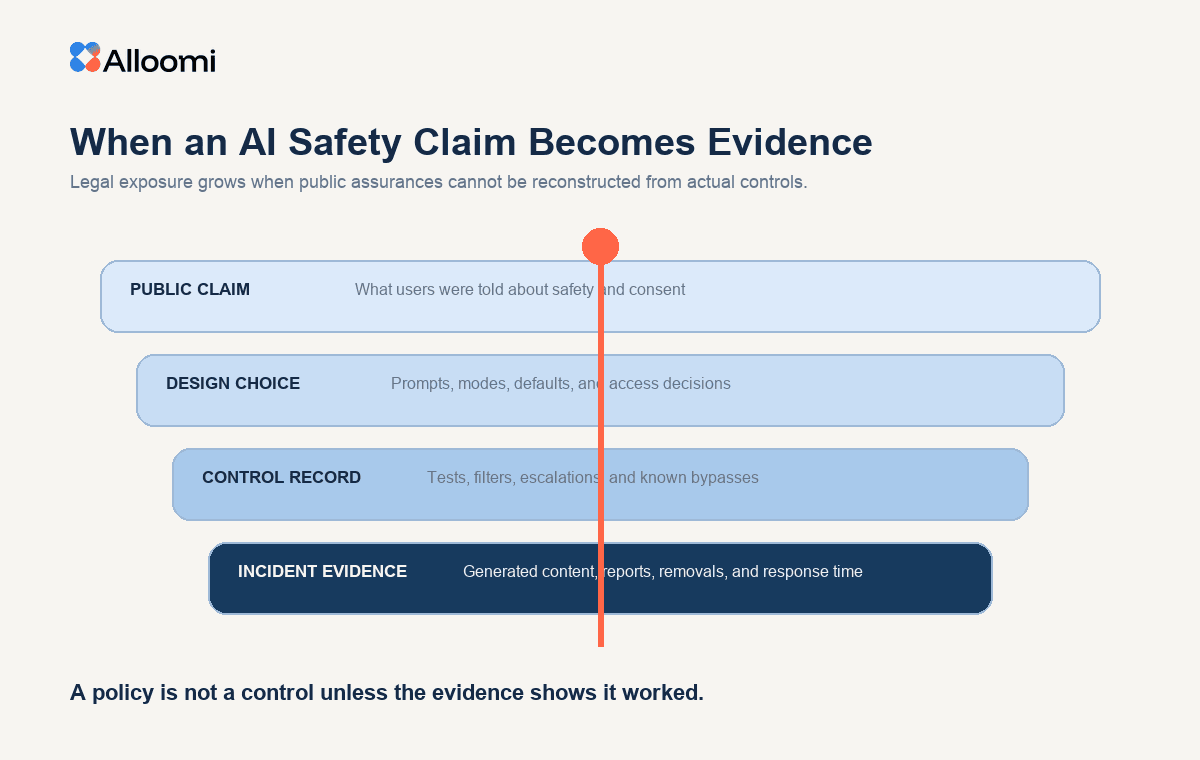
Safety claims become more defensible when product design, control evidence, and incident records support them.
The Evidence Legal Teams Should Expect
• Versions of public policies, help pages, hearing testimony, and marketing statements.
• System prompts, feature descriptions, access settings, and safety mode configurations.
• Pre-release tests and red-team results involving consent and age-related risks.
• Known bypass techniques, internal escalations, and decisions about launch or expansion.
• User reports, generated outputs, removal records, account actions, and law-enforcement referrals.
• Metrics used to claim that safeguards worked, including their definitions and limitations.
• Changes made after incidents and whether earlier assurances were corrected.
This is why an AI audit trail must preserve design and response evidence, not merely the final policy.
Why Terms of Service Are Not the Whole Defense
Terms may prohibit users from generating harmful content, but a state may still examine the product's foreseeable uses, defaults, enforcement, and public claims. A contractual prohibition does not prove that the control worked.
The same distinction appears in broader analysis of consumer protection laws for AI companies. Regulators can apply existing statutes to allegedly deceptive statements or unfair practices even without a statute written specifically for one model or feature.
What AI Product Counsel Should Change Now
Legal review should begin before the safety language is published. Counsel should ask the product team to identify the evidence supporting each material claim, the exceptions, the metrics used, and who owns ongoing monitoring.
Claims such as “safe,” “private,” “blocked,” or “age-appropriate” are too broad unless the organization can explain scope. More precise language can describe the control, the covered feature, known limits, and what users should do when an incident occurs.
Contracts with model, moderation, hosting, and identity vendors should also address testing data, incident cooperation, log access, and changes to safeguards. See AI use clauses in vendor agreements for related allocation questions.
How to Build a Defensible Safety Review
Start with a claim inventory. List every material safety representation across product pages, app stores, policies, sales decks, regulator communications, and support content. Map each claim to an owner, control, test, data source, and review date.
Then test the control against realistic misuse, including attempts that avoid obvious trigger words. Preserve failures and the decision about remediation. A record that includes only successful tests can be misleading.
Finally, establish a correction process. If evidence no longer supports a public statement, the legal team should know how quickly the statement can be narrowed, removed, or supplemented.
How Alloomi Can Support the Evidence Record
Alloomi AI can help authorized legal teams organize product claims, policies, test records, vendor terms, incident materials, and source documents for human review. It can support comparison and chronology work, but it does not decide whether a practice is deceptive or whether a safety control satisfies the law.
The core lesson from the lawsuits is broader than Grok: an AI safety promise is strongest when the company can reconstruct the control and evidence behind it.
Frequently Asked Questions
1. Have the courts found Grok or X liable?
No. The complaints contain allegations that must be tested through the legal process.
2. Can a state use consumer-protection law against an AI company?
Yes. States may apply generally applicable consumer-protection statutes to alleged misrepresentations or unfair practices involving AI products.
3. Does banning harmful content in the terms eliminate risk?
No. Terms are relevant, but regulators and courts may also examine product design, foreseeable misuse, controls, enforcement, and public statements.