A case is “good law” only when its relevant holding remains authoritative for the proposition, court, jurisdiction, and date in question. A green status symbol is useful triage, but it does not prove that every sentence in an opinion can still be cited safely.
Lawyers should validate both the case and the proposition. That means checking direct appellate history, later judicial treatment, the hierarchy of authority, changes in statutes or rules, and whether the quoted passage actually supports the draft statement.
What Does “Still Good Law” Mean?
A decision may remain published while part of its reasoning has been reversed, limited, questioned, distinguished, superseded, or undermined by later authority. Conversely, a case with negative discussion may still be valid on an unrelated issue. The research task is therefore proposition-specific.
The Northern District of California’s legal research guide explains that researchers must learn what happened after a case was published and check whether it was invalidated, criticized, limited, or reaffirmed. The Ninth Circuit similarly encourages researchers to verify that cited decisions remain good law.
Start With the Exact Proposition
Before running citation history, write the proposition the draft needs to support. Identify the governing jurisdiction, court level, procedural posture, relevant date, and whether the point is a holding, standard, test, exception, remedy, or background statement.
A case may be valid but irrelevant. Another may state the right rule in dicta, under an older statute, or in a posture that changes the standard. Starting with the proposition prevents a researcher from treating a favorable quotation as the end of the inquiry.
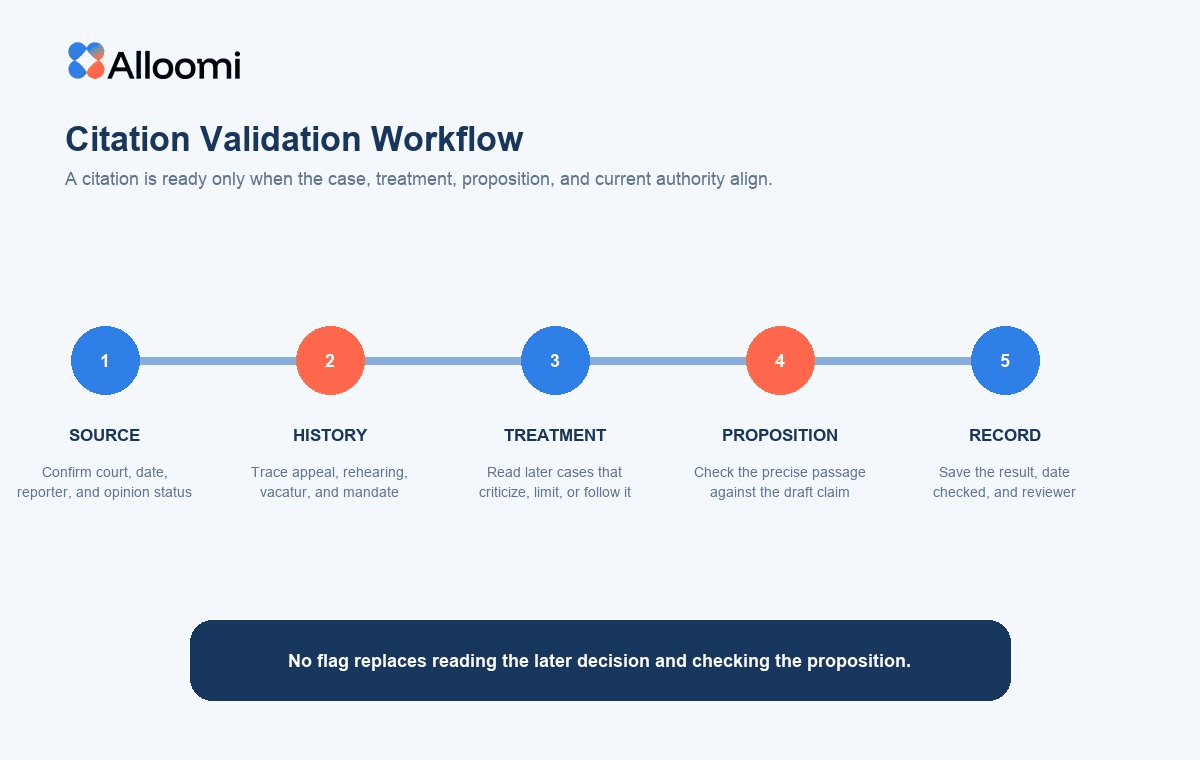
Run a Five-Stage Citation Validation
• Confirm the full citation, court, date, opinion status, and authoritative text.
• Trace the case’s direct history, including appeal, rehearing, vacatur, mandate, and later orders.
• Read later decisions that criticize, limit, distinguish, follow, or explain the case.
• Compare the exact passage with the proposition in the draft and the current governing rule.
• Record the database, search date, material treatment, conclusion, and reviewer.
Why Treatment Flags Need Human Reading
Citator signals summarize relationships between decisions. They do not decide whether later treatment affects the precise issue in your matter. A negative flag may concern a different count, statute, procedural question, or portion of the opinion. A neutral-looking history may still conceal a statutory amendment that displaced the rule.
The Federal Circuit’s Law Clerk Handbook advises checking that cited cases stand for the proposition asserted and that another reviewer check citations in the final draft.
How Should the Research Record Be Written?
The record should identify the proposition researched, controlling sources, material negative treatment, contrary authority, unresolved issues, assumptions, date checked, and final conclusion. Avoid a bare note such as “KeyCited, no problem.” A later reviewer should be able to reproduce the reasoning.
Alloomi Legal Research helps teams frame a legal question with matter facts, check authorities, and carry source-linked analysis into an editable Word memo. Related workflows include AI for legal research, verification of AI-generated legal work, and case-law data continuity.
Check the Hierarchy and Weight of Authority
A valid case is not necessarily controlling. Identify whether the decision comes from the governing jurisdiction and whether it is binding on the court handling the matter. A trial-court opinion, unpublished decision, decision from another circuit, or agency interpretation may be persuasive without controlling the result. Local rules may also restrict citation to unpublished or nonprecedential opinions.
When several authorities state similar rules, prefer the source with the strongest combination of hierarchy, recency, factual fit, and clarity. Do not hide contrary controlling authority merely because a lower court provides better language. The research memo should distinguish binding authority from persuasive support and explain any unresolved conflict.
Look Beyond Judicial Treatment
A citator primarily tracks relationships among authorities. It may not fully resolve whether a statute was amended, a regulation was replaced, a rule was renumbered, or a later decision changed the governing test without expressly overruling the older case. Recheck the current text of every material statute, regulation, court rule, and administrative source on which the decision relies.
Also verify temporal fit. A decision may accurately interpret the law for conduct occurring before an amendment but not for a dispute arising afterward. Record the effective date, transition provisions, and any issue about retroactivity instead of treating the current text as automatically applicable.
Common Citation Validation Failures
• Checking only whether the case was reversed, without reading decisions that limited its reasoning.
• Treating a headnote or search-result snippet as the court’s holding.
• Citing a general standard while omitting a later-created exception.
• Relying on a quotation copied from a secondary source without opening the opinion.
• Failing to distinguish controlling authority from persuasive authority.
• Reusing an old research memo without recording a new validation date.
• Assuming that an AI-generated citation is accurate because the case name exists.
A Final Citation Validation Checklist
Before the work leaves the legal team, confirm that every material citation opens to the intended authority; pinpoint citations match the quoted or paraphrased proposition; quotations are complete and accurate; signals and parentheticals describe the authority honestly; negative treatment has been read; statutory and regulatory text is current; contrary authority is addressed; and the research record identifies who performed the final check and when.
For a filing, repeat the check close enough to submission that a later decision or rule change is unlikely to be missed. The appropriate timing depends on the matter, court, deadline, and pace of legal development.
Frequently Asked Questions
1. Does a negative citator flag mean the case cannot be cited?
No. Read the later authority and determine whether the treatment affects the proposition you need.
2. Can Google Scholar confirm a case is good law?
It can support research, but a high-stakes citation should be checked using authoritative texts, current law, reliable citators, and independent analysis.
3. When should citation validation be repeated?
Repeat it before filing or final delivery, after a major delay, and whenever the governing law or jurisdiction may have changed.