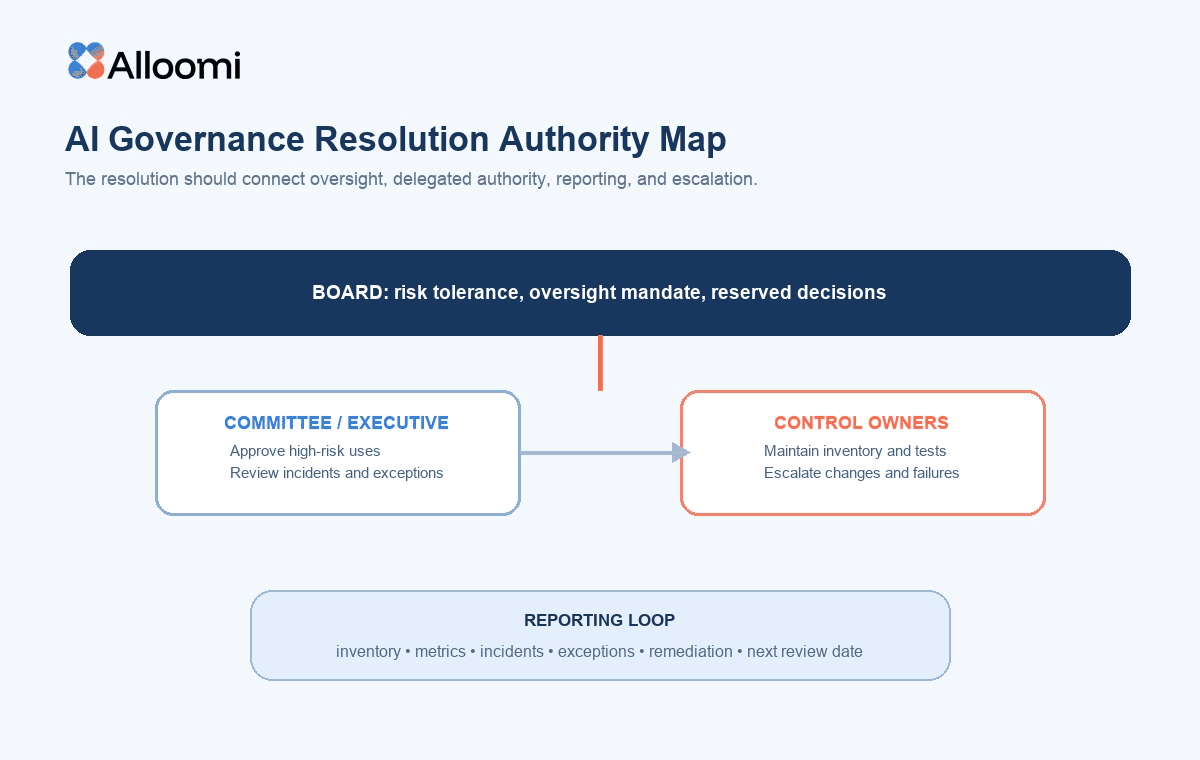
An AI governance board resolution should do more than announce that the company supports responsible AI. It should create a usable record of oversight: what the board reserves, what it delegates, which risks require escalation, what management must report, and when the mandate will be reviewed.
The resolution is one part of governance, not the entire program. Policies, inventories, testing, incident response, vendor controls, training, and reporting must implement the authority recorded in the board minutes.
When Is a Board Resolution Useful?
A formal resolution is useful when the company is creating an AI committee, approving an enterprise AI policy, delegating authority for high-risk systems, setting reporting requirements, or responding to a material incident or regulatory change. It can also clarify how AI oversight fits within existing audit, risk, privacy, security, and compliance structures.
Not every AI tool requires board action. The decision should reflect the company’s governing documents, risk profile, sector, applicable law, and the board’s existing delegation framework.
What Should the Resolution Establish?
• The purpose and scope of the AI governance mandate.
• The board, committee, or executive body responsible for oversight.
• Authority delegated to management and decisions reserved for the board.
• The organization’s method for categorizing AI systems by risk.
• Approval, conditional approval, suspension, and decommissioning authority.
• Required reporting on inventory, testing, incidents, complaints, exceptions, and remediation.
• Recordkeeping, privilege, confidentiality, training, and review requirements.
How Should Risk Tolerance Be Recorded?
Avoid vague language such as “acceptable AI risk.” The record should identify who defines risk categories, which impacts require enhanced review, what evidence supports approval, and which events exceed management’s delegated authority.
The resolution can reference a separate policy or framework so that detailed thresholds can be updated without rewriting the board mandate. It should still preserve the board’s reserved decisions and minimum reporting expectations.
What Should Management Report?
Reports should be decision-useful rather than a list of tools. Useful categories include high-risk use cases, material changes, validation results, unresolved limitations, regulatory developments, vendor concentration, security events, affected-person complaints, exceptions, and overdue remediation.
The NIST AI RMF Playbook emphasizes governance, documented responsibilities, oversight, risk tolerance, monitoring, and third-party risk. The NIST AI Risk Management Framework also explains that standardized documentation can improve transparency, accountability, and retrieval during incidents.
How Should the Draft Be Controlled?
Start from the company’s actual board-resolution format and authority structure. Confirm entity names, recitals, defined terms, voting mechanics, committee names, delegated officers, effective date, reporting cadence, review date, signatures, and attachments. Mark unresolved choices rather than silently filling them with assumptions.
Alloomi Document Drafting helps teams turn confirmed terms, templates, and matter context into editable Word drafts while clearly flagging open points. Related guidance includes AI use policies, legal AI tool evaluation, AI agent permissions, and legal AI audit trails.
What Belongs in the Resolution and What Belongs Elsewhere?
The resolution should establish durable authority and accountability. Detailed control procedures usually belong in policies, standards, playbooks, and committee charters that management can update. This separation keeps the board record stable while allowing operational controls to respond to new systems, incidents, and legal requirements.
The resolution may incorporate referenced documents by title and version. If it does, identify who may amend them, which changes require renewed board approval, and how the board will be informed. Avoid incorporating an unnamed “AI policy” that cannot be matched to an approved record.
How Should the Minutes Support the Resolution?
Minutes should show that directors received enough information to exercise oversight without attempting to transcribe every discussion. The record may identify materials presented, principal risks discussed, questions raised, management commitments, recusals, dissent, conditions, follow-up items, and the vote. Attachments should be retained under the company’s board-record practices.
Avoid statements that overpromise system safety or regulatory compliance. The record should accurately describe known limitations, open issues, assumptions, and the evidence available at the time. If directors approve a pilot or conditional use, document the conditions, owner, duration, success criteria, and stop authority.
Turn the Resolution Into an Implementation Record
After approval, map each directive to an accountable owner, deadline, evidence source, and reporting destination. Examples include maintaining an AI inventory, completing impact assessments, reviewing vendors, testing high-risk systems, training users, monitoring incidents, and reporting exceptions. Management should be able to show not only that a policy exists but that assigned controls operate.
Periodic reports should preserve changes since the prior report, overdue actions, accepted risks, decisions requested from the board, and the basis for management’s conclusions. A concise dashboard may help, but material limitations and incidents should not be reduced to a green status indicator without explanation.
Events That Should Trigger Reconsideration
• Deployment of an AI system with a new high-impact use or affected population.
• A material security, privacy, discrimination, safety, or reliability incident.
• A significant change in model, data source, vendor, autonomy, or human oversight.
• New legal obligations, enforcement guidance, litigation, or contractual commitments.
• Repeated exceptions or remediation that remains overdue.
• A merger, restructuring, leadership change, or transfer of control ownership.
Common Drafting Failures
Weak resolutions use aspirational language but assign no owner, reserve no decision, require no evidence, and set no review date. Others delegate authority so broadly that no one knows when management must return to the board. Another failure is to copy a public template without reconciling it to the company’s bylaws, committee charters, risk framework, regulated activities, or actual operating model.
Before execution, counsel should confirm the board’s authority, required approvals, conflicts and recusals, consistency with existing governance documents, and the record-retention plan. The final signed resolution, approved attachments, and minutes should be stored together with a reliable version history.
Frequently Asked Questions
1. Does every company need an AI board committee?
No. Oversight may sit with an existing committee or the full board, depending on governance structure and risk.
2. Should the resolution name specific AI vendors?
Usually the mandate should survive vendor changes. Material vendor approvals or incidents can be documented separately when needed.
3. Is the resolution privileged?
Board records are not automatically privileged. Counsel should separate legal advice appropriately and follow applicable privilege and recordkeeping rules.