A legal answer can cite the right rule and still be wrong because the question omitted a fact that changes the analysis. New research from Singapore tests whether legal AI recognizes that problem before producing a confident conclusion.
SG-LegalClarify is useful because it evaluates more than recall. It asks whether a model can recognize underspecification, request the facts that matter under the governing doctrine, apply local law, and reach the correct result after receiving clarification.
What Is SG-LegalClarify?
The SG-LegalClarify research paper describes 1,100 lawyer-authored source questions across ten Singapore-law domains. Of those, 760 intentionally omit facts required to resolve the question. Paired versions and hidden-fact assignments create 1,860 evaluation instances graded with lawyer-authored IRAC rubrics.
The researchers evaluated 19 models in closed-book and web-search settings. The best reported mandatory-rubric score was 69.8% closed-book and 77.8% with web search. The authors also found that models struggle to recognize when clarification is necessary. Those figures describe performance on this benchmark, not every legal task or jurisdiction.
Why Missing Facts Are Different From Hallucinations
A hallucination introduces unsupported content. An underspecified question lacks information needed to apply the law. A model can avoid fabricated citations yet still fail by assuming an employment status, jurisdiction, date, contract term, procedural posture, intent, notice, or prior event that was never provided.
Singapore’s State Courts have separately warned that generative AI can include facts a user never supplied and can produce persuasive but inaccurate legal content. See the State Courts’ guidance.
What Should a Legal AI Clarification Test Measure?
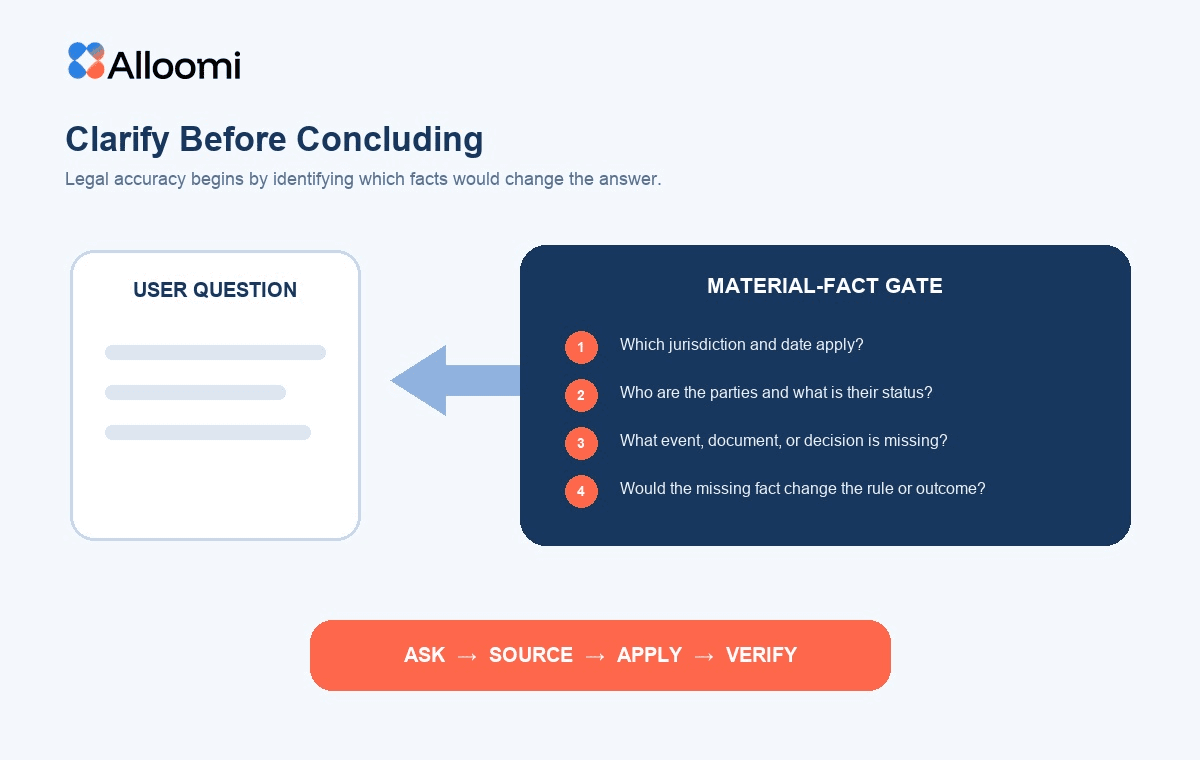
• Whether the system identifies which missing facts are legally material.
• Whether questions are specific, minimal, understandable, and tied to an issue.
• Whether the system changes its analysis after receiving new facts.
• Whether jurisdiction, date, source hierarchy, and procedural posture are confirmed.
• Whether uncertainty is stated without turning every answer into generic hedging.
• Whether a reviewer can trace the final conclusion to facts and authorities.
How Should Legal Teams Use This Finding?
Evaluation sets should include incomplete questions, conflicting documents, jurisdiction changes, and facts revealed over several turns. A tool should not receive full credit merely for asking many questions. The questions must obtain the information needed for the governing legal analysis.
Connect this testing to legal AI tool evaluation, verification of AI-generated legal work, human supervision, RAG in legal AI, and legal AI audit trails. The Singapore Ministry of Law’s 2026 legal-sector AI guide provides additional professional context.
How Alloomi Can Support Fact-Grounded Work
Alloomi AI can help authorized teams organize source documents, identify factual gaps, compare records, record clarification questions, and link outputs to evidence for human review. It should not invent missing facts or convert an unresolved assumption into a legal conclusion.
Frequently Asked Questions
1. Does asking more questions make legal AI accurate?
Not automatically. The questions must target facts that affect the legal rule, application, or outcome.
2. Can web search solve missing facts?
Web search may retrieve law and public information, but it cannot supply private facts about the client or matter unless those facts are provided from an authorized source.
3. Should legal AI refuse every incomplete question?
No. It should distinguish material gaps from details that do not change the analysis, state assumptions, and escalate when uncertainty is consequential.