A legal research question is a decision problem, not a string of keywords. It should identify what counsel must decide, the governing legal framework, the facts that may change the answer, the relevant jurisdiction, and the date as of which the answer must be correct.
Search terms come later. When the question is vague, researchers collect authorities without knowing whether they answer the assignment. A well-framed issue creates boundaries for research, verification, writing, and review.
Why Broad Assignments Produce Weak Research
Assignments often begin as "research enforceability," "find the rule on notice," or "see whether we can terminate." Each phrase hides multiple questions. Which contract? Which party? Which law? Which event? Which remedy? Which procedural posture? Which date?
If those variables remain unresolved, the researcher may find a correct rule for the wrong jurisdiction or analyze a remedy that is not commercially useful. The first task is therefore to convert the request into a question that can be answered and acted upon.
Start With the Decision, Not the Topic
Ask what the supervising lawyer or client must decide after receiving the research. The answer may be whether to file, remove, disclose, terminate, preserve, settle, revise a clause, or request more facts. This decision defines relevance better than a broad subject label.
For example, "research noncompetes" is a topic. "Can the company enforce a twelve-month customer restriction against a former salesperson in the selected state after the employee moved?" is a research direction. It exposes missing facts and points toward the governing rules.
Identify the Material Facts
Not every fact belongs in the issue statement. Include facts that trigger an element, exception, defense, remedy, procedural rule, or standard of review. Separate confirmed facts from assumptions and open questions so the research does not silently treat uncertainty as truth.
The Georgetown Law guide, The Art and Craft of Strategic Legal Research, recommends confirming key facts, jurisdiction, issue, scope, format, and deadline before beginning. That confirmation is also a practical control against researching the wrong assignment efficiently.
Define Jurisdiction and Authority
Identify governing law, forum, court level, agency, and any contractual choice-of-law or dispute provision. A question may require separate treatment of substantive law, procedure, conflict rules, and available remedies.
Also decide what authority is needed. A preliminary risk assessment may begin with secondary sources, while a filing or formal opinion requires controlling primary authority and current validation. Record the acceptable cutoff date and whether pending legislation or unsettled authority must be included.
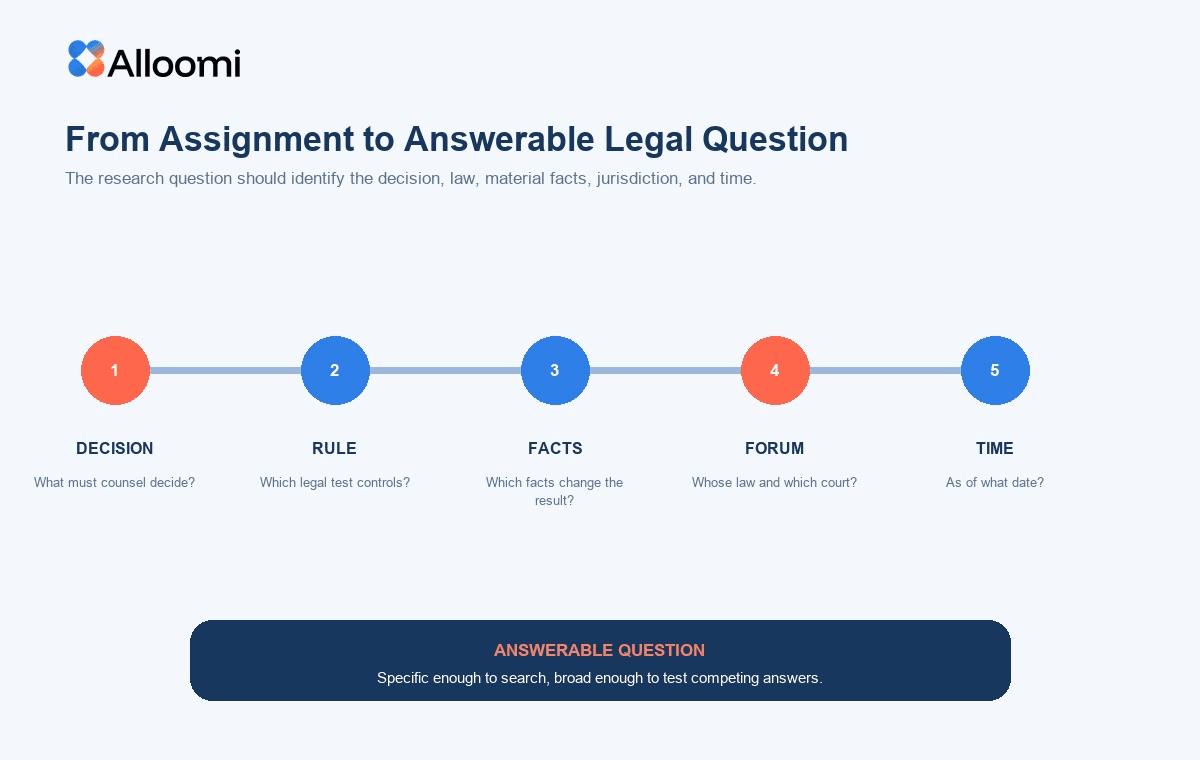
Use a Five-Part Research Question
- Decision: What must counsel recommend or decide?
- Rule: Which legal test, duty, prohibition, or remedy controls?
- Facts: Which confirmed facts and uncertainties could change the outcome?
- Forum: Which jurisdiction, court, agency, or contractual regime applies?
- Time: As of what date, and does retroactivity matter?
A good question is specific enough to exclude irrelevant law but broad enough to expose competing answers. Avoid drafting the question so persuasively that it assumes the desired conclusion.
Question Presented Versus Search Query
The question presented belongs in the work product. Search queries are temporary tools used to locate concepts, terminology, authorities, and contrary positions. One legal question may require dozens of searches using synonyms, elements, citations, party names, procedural terms, and source-specific filters.
Do not paste a long issue statement into a database and assume the best result will appear. Break it into concepts, learn the vocabulary used by courts, then expand and narrow searches iteratively. Maintain a search log when the matter is complex or likely to be reviewed later.
How to Test Whether the Question Is Ready
Read the proposed question to another lawyer without providing background. Can that person identify the decision, legal issue, important facts, jurisdiction, and time? If not, the framing still depends on hidden context.
Then test the opposite answer. If the question makes only one outcome appear possible, rewrite it neutrally and identify the missing counterarguments. Georgetown Law's guide to persuasive issue statements is useful for writing briefs, but an internal research question should initially remain open enough to test both sides.
Common Framing Failures
- Treating the client's business label as the legal issue.
- Omitting jurisdiction or assuming the forum supplies the substantive law.
- Including every background fact instead of legally material facts.
- Failing to identify the desired deliverable and deadline.
- Searching only for authority that supports the initial view.
- Ignoring procedural posture, burden, remedy, or standard of review.
- Letting an AI tool infer missing facts without marking assumptions.
How Alloomi Supports Issue Framing
Alloomi Legal Research helps teams frame legal questions with matter facts, check authorities, and carry source-linked analysis into an editable Word memo. Supporting resources include AI for legal research, verification of AI-generated legal work, and case-law data continuity.
The product can support organization and source tracing, but counsel remains responsible for defining the question, checking current authority, confronting contrary law, and connecting research to the actual decision.
Turn the Question Into a Research Plan
Once the issue is framed, divide it into research components. Identify the governing authority, required elements, exceptions, defenses, procedural rules, burden, remedies, and factual predicates. Assign a source strategy to each component: statutes and regulations, controlling cases, agency materials, court rules, secondary sources, and factual records.
Set stopping rules before searching. The researcher should know what would make the answer sufficiently reliable for the requested deliverable. A quick preliminary assessment may stop after identifying controlling law and major uncertainty. A filing, opinion, or board memorandum requires deeper validation, contrary authority, and a documented current-law check.
Build Query Fan-Out Without Losing Scope
One research question produces several related searches. A termination question may require searches about the substantive breach standard, notice, cure, waiver, anticipatory repudiation, materiality, available remedies, and the forum's procedural requirements. These are legitimate branches only when they remain connected to the decision.
Keep a short map of the branches investigated and why. This prevents the research from becoming a collection of interesting but unusable authorities. It also makes omissions visible to the reviewer and helps another lawyer reproduce the work.
Record Contrary Authority and Missing Facts
Research quality depends on what might defeat the proposed answer. Search for contrary holdings, limiting language, unfavorable factual analogies, jurisdictional splits, and authority applying a different standard. State clearly when controlling authority is absent or the law remains unsettled.
Maintain a separate list of missing facts. Each missing fact should explain why it matters and how different answers could change the legal analysis. This turns factual uncertainty into a targeted request rather than an invisible assumption inside the conclusion.
Use the Question to Control the Final Memo
The final memo should answer the same question the team approved at the outset. If research changes the issue, revise the question and document the change. The conclusion should identify the answer, confidence level, decisive authorities, material factual dependencies, contrary law, and the next decision required.
This alignment makes review faster. A supervising lawyer can compare the assignment, research record, and conclusion without reconstructing the researcher's path. It also reduces the risk that a polished memo solves a different problem from the one the client actually presented.
Example: From a Vague Assignment to a Researchable Issue
Suppose the assignment is "Can we end the vendor contract?" A researchable question might ask whether, under the selected state law and the agreement's termination provision, repeated failures to meet a defined service level constitute an uncured material breach permitting termination after the notices already sent.
That formulation exposes the work required. Counsel must interpret the contract, verify the service-level evidence, analyze material breach and waiver, check the notice and cure process, and identify available remedies. It also reveals missing facts, such as whether notices reached the required recipient and whether the vendor corrected performance within the cure period.
The example is not merely longer. It connects legal research to a concrete decision and makes the final answer reviewable against the actual record.
Confirm the Scope Before Delivering the Answer
Before finalizing the memo, compare the conclusion with the approved question and research scope. Confirm that the answer uses the correct law, date, factual assumptions, and requested level of confidence. If a missing fact or unresolved authority prevents a reliable conclusion, say so directly and identify the next research or factual step.
Frequently Asked Questions
1. How long should a legal research question be?
Long enough to state the decision, issue, material facts, jurisdiction, and time without turning into a case summary.
2. Should assumptions appear in the question?
Material assumptions should be stated or listed separately so the conclusion can be revisited when facts change.
3. Can the research question change during research?
Yes. New terminology, authority, and facts often refine the issue. Record material scope changes and confirm them with the assigning lawyer.