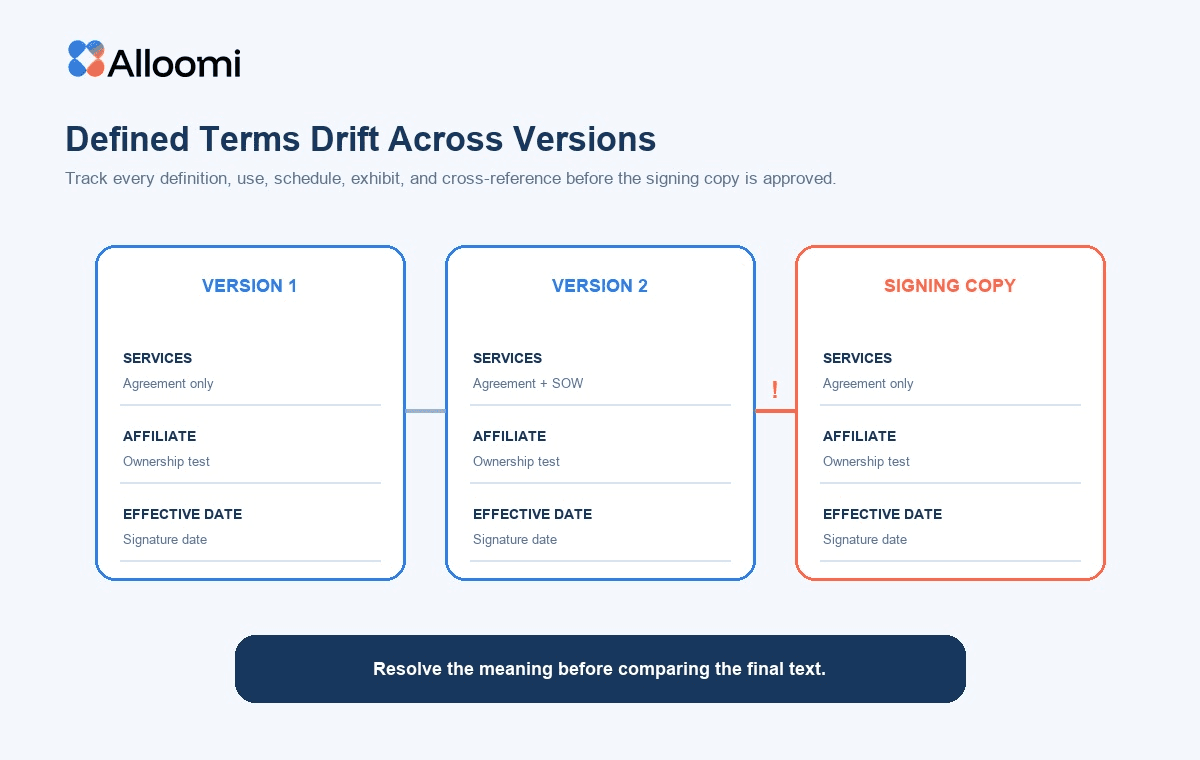
Defined terms drift occurs when a capitalized term changes meaning, scope, location, or usage as a contract moves through drafts, schedules, statements of work, and amendments. The words may still look consistent while the operative deal has changed underneath them.
Drift can expand obligations, narrow remedies, break cross-references, create unused definitions, or cause two documents to use the same label for different concepts. It is a version-control problem and a legal interpretation problem at the same time.
What Causes Defined Terms to Drift?
Contract drafts rarely evolve in one place. A negotiator revises the body, a business owner updates the SOW, security adds an exhibit, and another lawyer imports language from a prior deal. Each change may be reasonable alone but inconsistent with the document set.
Drift also appears when a definition contains substantive obligations, when a term is renamed without updating every use, or when a schedule uses an informal business label instead of the defined contract term.
Common Types of Defined-Term Drift
- Scope drift: "Services" expands from the agreement to include every SOW or support activity.
- Party drift: "Customer" alternates between the signing entity, affiliates, and authorized users.
- Time drift: "Effective Date" means signature date in one place and service start date elsewhere.
- Document drift: "Agreement" sometimes includes exhibits and sometimes excludes later orders.
- Remedy drift: a defined "Loss" adds categories not reflected in the indemnity clause.
- Capitalization drift: the same word appears capitalized and lowercase with potentially different meanings.
Why a Definitions Section Is Not Enough
A clean definitions table does not prove that the document uses each term consistently. Reviewers must trace where a term appears, what operative clauses it affects, which documents import it, and whether another term overlaps.
The SEC's Staff Legal Bulletin on plain-English disclosure cautions against frequent reliance on glossaries and defined terms when they make a document harder to understand. The SEC Plain English Handbook likewise emphasizes clarity, concise structure, and limited use of special vocabulary. Although those materials address disclosure, the drafting lesson travels well: definitions should clarify the deal, not force readers to decode it.
Trace Definitions Across the Document Set
Create a term inventory covering the main agreement, schedules, exhibits, policies incorporated by reference, SOWs, order forms, and negotiated side letters. For each term, record the definition location, every operative use, imported documents, version source, and reviewer decision.
Do not assume the main agreement always controls. The order-of-precedence clause may give a later SOW priority for a specific conflict. A definition that is stable in the MSA can therefore change meaning for one workstream.
Separate Definitions From Obligations
A definition should identify what a term means. When it also imposes duties, exclusions, payment rules, or remedies, reviewers may miss substantive language because it sits outside the operative clause.
If moving the substance is impractical, flag the embedded obligation and verify that the relevant business and legal owners approved it. A defined term should not silently become the broadest liability provision in the agreement.
Check Capitalization and Grammatical Variants
Capitalization can signal whether a word uses its special contractual meaning or its ordinary meaning. Review capitalized and lowercase forms, plurals, possessives, abbreviations, and renamed terms. Automated matching should assist this review but cannot decide whether a variation is intentional.
Pay particular attention to words that also have ordinary business meanings, such as "Data," "Deliverables," "Claim," "Loss," "Affiliate," "User," and "Documentation." Their everyday use can conceal a departure from the definition.
Run a Signing-Copy Definition Audit
- List every defined term and its authoritative location.
- Find terms used but never defined.
- Find terms defined but never used.
- Compare overlapping or synonymous terms.
- Trace each term through schedules, exhibits, SOWs, and incorporated policies.
- Validate capitalization, plurals, abbreviations, and cross-references.
- Review embedded obligations inside definitions.
- Confirm order of precedence and amendment effects.
- Compare the clean signing copy with the last approved redline.
What Should the Drafting Record Preserve?
Preserve the approved definition, source version, rationale for material changes, affected clauses, document hierarchy, unresolved questions, and final reviewer. When a term is intentionally different in an SOW or exhibit, state that exception clearly rather than relying on context.
This record becomes especially valuable during renewals and amendments. Without it, a later team may normalize an apparent inconsistency that was actually negotiated or preserve an error because no one knows why it exists.
How Alloomi Supports Definition Control
Alloomi Document Drafting helps legal teams turn confirmed terms, templates, and matter context into editable Word drafts while clearly flagging open points. Related workflows include contract version comparison, clause-library governance, contract authoring tool selection, and amendment and side-letter review.
Automation can locate inconsistencies and missing references. Counsel still determines which meaning reflects the negotiated deal and whether the signing copy preserves it.
Defined Terms in Schedules, Exhibits, and SOWs
Attachments often use operational language created by teams that did not draft the main agreement. A security exhibit may refer to "Customer Information," while the data-processing addendum defines "Personal Data" and the MSA defines "Customer Data." Those labels may overlap without being identical.
Review whether each attachment imports the main agreement's definitions, creates local definitions, or overrides them. Local definitions should state their limited scope. If an attachment controls in a conflict, determine whether its definition changes only that attachment or alters obligations throughout the contract set.
Amendments Can Create Historical Drift
An amendment may replace a definition without restating every affected clause. Later reviewers then read the original document and amendment together, increasing the chance that an old meaning survives in a schedule, renewal notice, order form, or internal playbook.
Maintain a consolidated or conformed version after material amendments when appropriate. At minimum, preserve a definition-change log showing the old text, new text, effective date, affected provisions, and document priority. Do not rely on memory to reconstruct which meaning governed a particular period.
Automated Checks That Help and Checks That Mislead
Automation can detect capitalized terms, unmatched definitions, unused terms, broken cross-references, and wording differences across versions. It can also trace the same phrase through related documents. These checks reduce mechanical review time and expose inconsistencies that are easy to miss in a long agreement.
However, matching text does not establish matching legal effect. Two definitions can use different words but create the same scope, while identical wording can operate differently because of precedence, context, or an amendment. Treat automated results as review leads, not final conclusions.
Create a Definition Control Record
For important terms, record the commercial owner, approved meaning, permitted variants, linked clauses, affected attachments, fallback position, and reason for any exception. This record is especially useful for recurring agreements, clause libraries, and automated drafting workflows.
The control record should follow the approved language into the template and signing copy. When a negotiator changes the definition, the system should surface the dependent provisions rather than allowing the change to remain isolated. That is how definition review becomes part of drafting governance instead of a final proofreading exercise.
Final Clean Copy Versus the Last Approved Redline
A definition audit should not end when negotiations stop. Compare the clean signing copy with the last approved redline and verify that accepted changes, rejected language, schedules, exhibit names, numbering, and cross-references survived document cleanup. Formatting changes can hide substantive deletions, duplicated definitions, or text restored from an older version.
Run the term inventory again on the clean copy rather than assuming the final redline already covered it. Confirm that every attachment delivered for signature is the approved version and that no placeholder, drafting note, unresolved bracket, or outdated schedule remains.
Ownership After Signature
Assign responsibility for maintaining defined terms when the agreement is amended, renewed, or used to generate new SOWs. The owner should know which template, clause-library entry, and operational system depend on the approved meaning.
Post-signature governance prevents the next document from reintroducing an older definition. It also lets legal teams distinguish a negotiated exception from a drafting error when the relationship changes months or years later.
Use Definitions to Improve Readability
A defined term earns its place when it reduces genuine repetition or gives a precise name to a recurring concept. If readers must continually return to a glossary to understand ordinary obligations, the drafting has become less usable. Remove unnecessary terms, define local concepts near their first important use, and reserve the central definitions section for language that operates throughout the document set.
Frequently Asked Questions
1. Are unused defined terms legally harmful?
They may not change the result, but they signal version residue and can obscure whether related language was removed correctly.
2. Should every capitalized word be defined?
No. Capitalization should be used consistently, but headings, proper names, and other terms may not require contractual definitions.
3. Can a statement of work redefine an MSA term?
It can if the documents permit it. The order-of-precedence clause and the scope of the override should be explicit.