A service level agreement should convert an operational promise into a measurable obligation and a usable response when performance fails. Many SLAs fall short because the metric is vague, the provider controls the only data source, exclusions swallow the commitment, or service credits are the customer's sole remedy even after repeated failure.
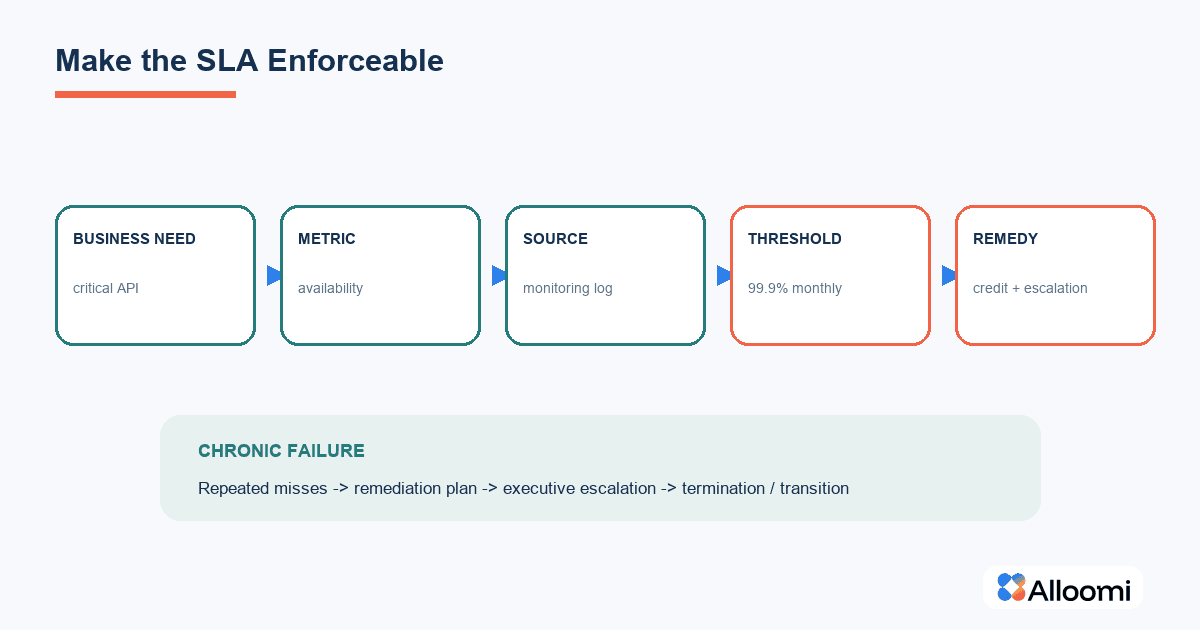
Review the SLA as an operating system, not an attachment. Every commitment should connect a business need to a metric, measurement source, reporting process, consequence, and escalation path.
Start With the Business-Critical Service
Define the service, feature, location, user population, and time period that matter. A 99.9% platform availability commitment may have little value if a critical API, region, support channel, or integration is excluded.
The NIST glossary describes an SLA as a commitment addressing responsibilities, service details, expected performance, reporting, resolution, and termination. That definition is useful because it goes beyond a headline availability percentage.
Make Every Metric Reproducible
For each service level, define:
• The numerator and denominator.
• The measurement period and time zone.
• The monitoring source and system of record.
• The event that starts and stops the clock.
• Whether partial degradation counts.
• The treatment of failed dependencies.
• The reporting format and delivery date.
• The customer's right to challenge the calculation.
Availability, response time, resolution time, recovery time objective, recovery point objective, throughput, defect rate, and support response are different measures. Do not combine them into a single undefined reliability promise.
Review Exclusions Before the Percentage
Scheduled maintenance, emergency maintenance, customer systems, third-party services, internet failures, beta features, force majeure, and misuse are common exclusions. Each exclusion should be defined and limited to the extent it actually caused the failure.
Require reasonable maintenance notice, a maintenance window, and a cap on excluded maintenance where appropriate. If the provider selects and manages a subcontractor, consider whether subcontractor failure should remain the provider's responsibility.
Control the Measurement Source
The provider may operate the monitoring system, but the customer should receive enough evidence to understand the result. Require incident timestamps, affected services, duration, root cause, calculation method, exclusions applied, and corrective action.
For critical services, preserve the right to compare provider reporting with independent monitoring, customer logs, and status-page records. NIST's Cloud Computing Synopsis and Recommendations distinguishes the service agreement from the technical performance promises and remedies typically captured in the SLA.
Design Service Credits as a Real Remedy
State whether credits apply automatically or require a claim. A short claim deadline can make the remedy illusory, especially if the provider's report arrives after the deadline. Credits should use a clear schedule tied to severity or duration.
Check the base used to calculate the credit. A percentage of one affected feature's monthly fee may be immaterial compared with the business loss. Also confirm whether credits expire, may be offset against future invoices, or are refundable when the agreement terminates.
Do Not Let Credits Become the Only Remedy for Everything
A service-credit remedy may be reasonable for ordinary availability misses. It should not automatically replace rights for confidentiality breaches, security incidents, data loss, infringement, gross negligence, willful misconduct, or repeated material failure.
Read the SLA together with the limitation of liability clause. Use the full-agreement method in How to Review a Contract to determine whether the credit structure, warranty language, and liability cap leave a meaningful remedy.
Add a Chronic Failure Escalation
A single month's credit does not solve recurring operational instability. Define chronic failure using repeated misses over consecutive or rolling periods. Remedies may include an executive escalation, remediation plan, enhanced reporting, fee adjustment, suspension of new work, termination right, or transition assistance.
Align chronic failure with termination, renewal, and price changes. See How to Review Contract Renewal and Price Increase Terms.
Include Security and Incident Support Levels
Cyber incidents require more than general support response. Define notification, containment cooperation, evidence preservation, status updates, root-cause analysis, patch timing, and restoration priorities. CISA guidance on incident response notes that contracts may need SLAs defining vendor assistance and turnaround time for patches or fixes.
Coordinate these terms with the data-processing and security schedule. The checklist in How to Review a Data Processing Agreement Before Signing can help align operational and privacy obligations.
Compare the SLA With the Main Agreement
Check order of precedence, defined terms, change procedures, invoice credits, limitation of liability, warranties, force majeure, suspension, termination, and dispute resolution. If the provider may change the SLA online, require notice and restrict changes that materially reduce service levels.
Use contract version comparison to detect metric, exclusion, and credit changes between drafts. Record deviations in a contract review memo so business owners understand the operational tradeoff.
An SLA Review Table
| Review area | What must be defined | Typical failure |
|---|---|---|
| Metric | Formula, period, scope, time zone, and event boundaries | A headline percentage without a reproducible calculation |
| Evidence | System of record, report fields, access, and challenge process | The provider controls the only data and gives no detail |
| Exclusions | Maintenance, customer acts, third parties, and force majeure | Broad exclusions remove most meaningful failures |
| Credit | Calculation base, schedule, claim deadline, and use | The customer misses the claim window before receiving the report |
| Escalation | Chronic failure, remediation, termination, and transition | Repeated failures trigger only another small credit |
Set Negotiation Priorities by Service Criticality
Not every metric deserves the same negotiating effort. Rank services by the operational, financial, regulatory, and customer impact of failure. For a low-risk internal tool, reporting and a modest credit may be enough. For a platform supporting regulated activity or customer-facing operations, the team may need stronger recovery objectives, incident cooperation, audit evidence, chronic-failure rights, and transition support.
Ask the business owner what happens after one hour, one day, and one week of unavailability. That answer should determine the metric, escalation path, and exit planning more than a provider's standard SLA package.
How Alloomi Can Support SLA Review
Alloomi can help contract teams locate performance commitments, compare SLA versions, connect service failures to contractual remedies, and preserve the source language for human review. It does not measure service performance or decide whether a breach occurred.
Frequently Asked Questions
1. Is 99.9% uptime always sufficient?
No. The appropriate target depends on business impact, architecture, recovery capability, and which services the metric actually covers.
2. Should service credits be automatic?
Automatic credits reduce administrative failure. If a claim is required, the process and deadline should be practical and tied to timely reporting.
3. What is chronic SLA failure?
It is a defined pattern of repeated or sustained service-level misses that triggers stronger remedies than a monthly credit.
Conclusion
An enforceable SLA connects business impact to measurable performance, reliable evidence, proportionate credits, and escalation. Review the metric, exclusions, data source, claim process, chronic failure, security support, and interaction with the main agreement.