How to Build an AI-Assisted Privilege Log Without Losing Control of the Claim
A privilege log must do two things at once: protect information that should not be disclosed and provide enough information for another party to assess the claim. AI can reduce the manual work of grouping documents, extracting metadata, and proposing descriptions, but it cannot decide whether a communication is privileged or whether protection has been waived.
The safest design is a lawyer-controlled workflow in which AI prepares candidate entries, every material claim remains connected to the underlying document, and the final log reflects the governing discovery protocol rather than a generic template.
What Is an AI-Assisted Privilege Log?
An AI-assisted privilege log uses document metadata and content to propose fields such as date, author, recipients, document type, subject matter, privilege basis, and related document family. It may also group repeated email threads or identify entries that need additional review.
The output is a working log. It is not a final privilege determination. Lawyers must assess the client relationship, purpose of the communication, participants, confidentiality, applicable doctrine, waiver, and any court-ordered logging method.
Start With the Discovery Protocol
Federal Rule of Civil Procedure 26(b)(5) requires a party withholding discoverable information on privilege or work-product grounds to expressly make the claim and describe the nature of the material without revealing protected information. The 2025 amendments also emphasize addressing the timing and method for privilege claims early in the discovery plan.
Before using AI, record whether the matter uses document-by-document logging, categorical logging, metadata fields, date cutoffs, email-thread rules, rolling logs, exclusions, or a court-approved protocol. The tool should implement those choices, not invent them.
A Lawyer-Controlled Workflow
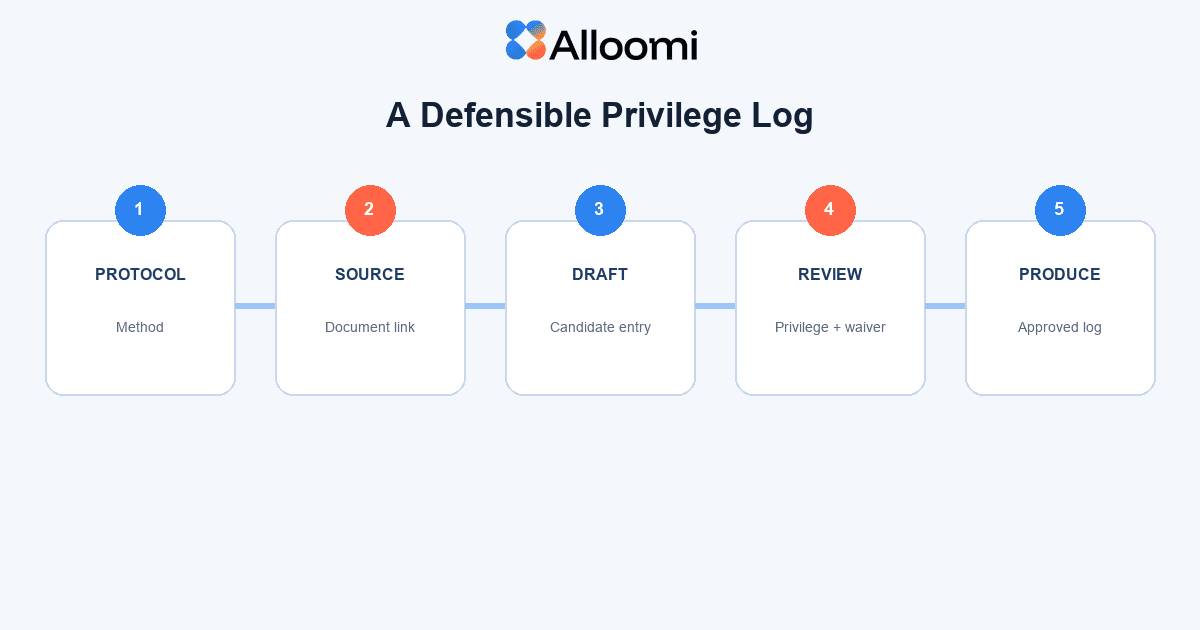
Collect the correct source set
Preserve document IDs, families, attachments, custodians, metadata, near-duplicate relationships, and production history. A detached message may appear privileged even though the complete thread changes the analysis.
Apply review categories
Use categories such as legal advice, work product, common interest, nonprivileged business communication, needs escalation, and potentially waived. The labels should reflect the jurisdiction and case protocol.
Generate candidate descriptions
AI may propose a neutral description that identifies the document's general subject without disclosing the legal advice. Require the draft to show which text and metadata support each field.
Review privilege and waiver
Counsel should confirm the participants, roles, purpose, confidentiality, forwarding history, attachments, and exceptions. See What Is Privilege Review? for the broader review process.
Run consistency checks
Compare similar entries, inconsistent privilege bases, missing recipients, unsupported descriptions, family gaps, and entries that expose too much. Review changes before exporting the final log.
What Each Log Entry Should Preserve
Use this table to connect every privilege log entry to the withheld document, relevant participants, asserted protection, and responsible reviewer.
| Field | Purpose | Review question |
|---|---|---|
| Document identity | Connect the entry to the withheld source | Can counsel retrieve the exact document and family? |
| People and roles | Explain the relationship relevant to privilege | Were nonlawyers and third parties assessed? |
| General subject | Permit assessment without revealing advice | Is the wording informative but not self-defeating? |
| Privilege basis | State the protection being asserted | Does the document satisfy every required element? |
| Reviewer decision | Record accountability and changes | Who approved the entry, and when? |
FieldPurposeReview question
Document identity
Connect the entry to the withheld source
Can counsel retrieve the exact document and family?
People and roles
Explain the relationship relevant to privilege
Were nonlawyers and third parties assessed?
General subject
Permit assessment without revealing advice
Is the wording informative but not self-defeating?
Privilege basis
State the protection being asserted
Does the document satisfy every required element?
Reviewer decision
Record accountability and changes
Who approved the entry, and when?
Clawback Agreements Do Not Replace Careful Review
Federal Rule of Evidence 502 addresses disclosure and waiver, including court orders and agreements concerning protected information. A clawback process can reduce risk, but it does not make an inaccurate log or uncontrolled AI workflow acceptable.
Teams should align the log with the ESI protocol, verify redactions using a controlled process described in AI Legal Document Redaction, and ensure any discovery response remains subject to lawyer review. See How Lawyers Should Review AI-Drafted Discovery Responses.
How Alloomi Can Support the Workflow
Alloomi can help authorized teams keep source documents, decisions, versions, and review history connected. It does not determine privilege. The responsible lawyer remains accountable for the claim, description, disclosure decision, and compliance with the applicable order.
Common Privilege Log Failure Patterns
Logs often fail because the same generic description is repeated across hundreds of documents, the participants' roles are missing, attachments are treated differently from parent messages, or the asserted basis does not match the content. AI can reproduce these problems at scale if the team optimizes only for speed.
Use exception reports to find one-person communications, messages involving external recipients, entries with no lawyer, inconsistent treatment of near duplicates, and descriptions that reveal legal advice. Sample both accepted and rejected documents. A quality check limited to the entries AI marked as uncertain will miss confident errors.
Measure Accuracy, Not Only Throughput
Track reviewer changes to privilege status, description, participants, and document family. Measure how often entries are challenged, how quickly disputes are resolved, and whether the same error repeats. If review time moves downstream into disputes and rework, the workflow has not created a real efficiency gain.
Frequently Asked Questions
1. Can AI decide whether a document is privileged?
No. AI can prioritize and propose entries, but a lawyer must apply the governing doctrine and assess waiver.
2. Can AI write privilege log descriptions?
It can draft them, but counsel should verify accuracy, consistency, and whether the wording reveals protected substance.
3. Should privilege logs be produced on a rolling basis?
That depends on the discovery plan, court order, volume, and agreement of the parties. The method should be resolved early.
Conclusion
AI can accelerate privilege logging when the process begins with the governing protocol and ends with accountable lawyer approval. Preserve the source, expose the basis for each proposed field, review waiver, test consistency, and retain a clear decision record.