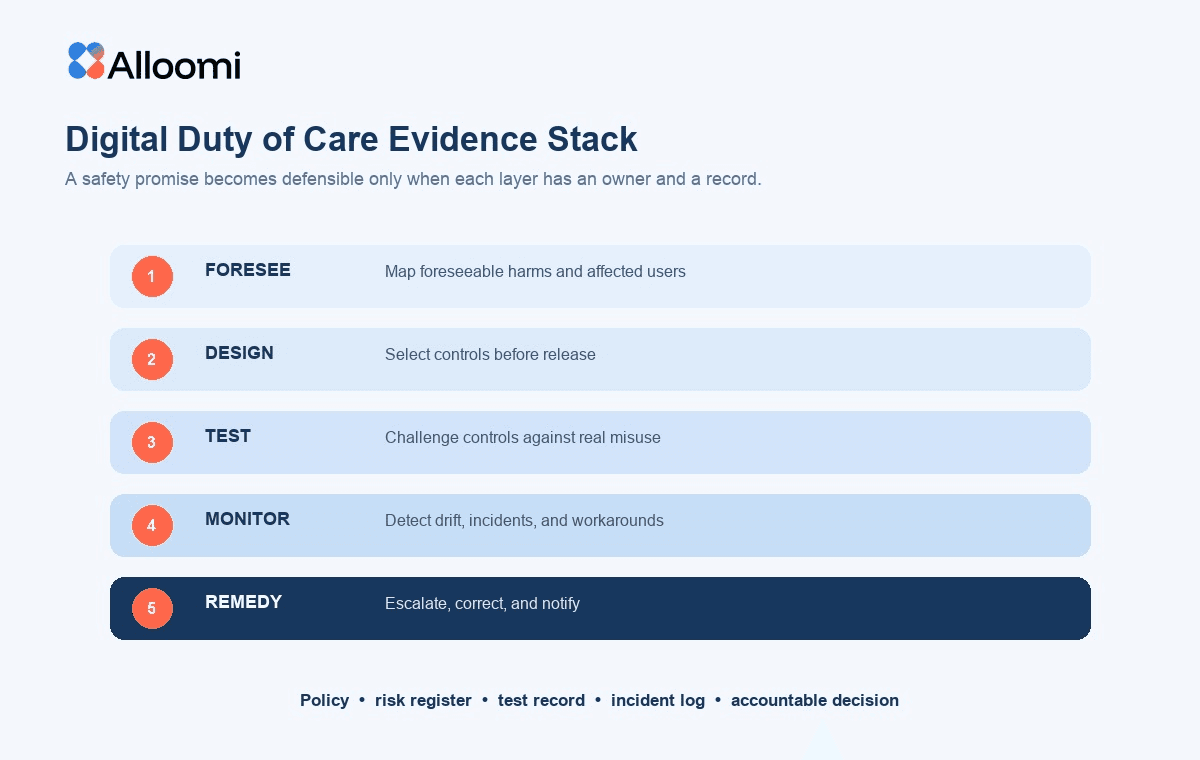
Australia’s new digital duty of care shifts the compliance question from whether a platform followed a narrow checklist to whether it took reasonable steps to prevent foreseeable harm. For AI-enabled services, that means legal teams need evidence connecting product risks, design choices, testing, monitoring, incidents, and remedies.
The law should not be reduced to a policy update. It creates a record-building problem: if a regulator, customer, or claimant asks what the company knew and what it did, the answer must be traceable across legal, product, trust and safety, security, and executive decisions.
What Changed in Australia?
Australia’s Parliament considered the Online Safety Amendment (Digital Duty of Care) Bill 2026 during the November sitting week. Parliamentary materials describe the central proposal as replacing the existing expectations, codes, and standards framework with a single enforceable duty of care. The bill also amends several Commonwealth laws and focuses on foreseeable online harms.
The Australian Parliament’s committee material is the best starting point for the text and legislative history. Companies should confirm commencement dates, final amendments, covered services, and regulator guidance before treating any checklist as complete.
What Evidence Should an AI Platform Preserve?
• A dated risk register identifying foreseeable harms, affected users, severity, likelihood, and assumptions.
• Product requirements showing where safety controls entered design and release decisions.
• Pre-release and post-release testing, including adversarial scenarios and known limitations.
• Incident reports, user complaints, escalation records, remediation, and notification decisions.
• Records of exceptions, accepted residual risk, owners, review dates, and executive approval.
• Vendor and model-provider evidence supporting claims about safeguards and performance.
Why Contracts Matter
AI platforms rarely control every component. Model providers, data vendors, moderators, hosting services, age-assurance tools, and analytics partners may each hold part of the safety evidence. Contracts should therefore address audit access, incident notice, testing cooperation, data retention, subcontractors, corrective action, and the evidence available after termination.
Use the controls in AI vendor contracts, audit-right clauses, subcontracting flow-downs, and legal AI audit trails to build a consistent record rather than separate spreadsheets.
What Should Legal Ask Before Release?
Legal should ask which harms are foreseeable, how the control changes that risk, what evidence proves the control works, what happens when it fails, and who can stop or modify the system. “We have a safety policy” is not the same as evidence of reasonable implementation.
How Alloomi Can Support the Work
Alloomi AI can help authorized teams organize risk assessments, policies, contracts, test reports, incidents, and approval records while connecting summaries to source documents for lawyer review. It does not determine legal compliance or replace product and safety testing.
Frequently Asked Questions
1. Does the duty apply only to social media?
Coverage depends on the final statutory definitions and guidance. AI services should map whether their product falls within a regulated service category rather than assume exclusion.
2. Is a risk assessment enough?
No. A defensible program should connect identified risks to controls, testing, monitoring, response, and accountable decisions.
3. Should non-Australian companies prepare?
Companies offering covered services to Australian users should assess territorial reach, local obligations, contracts, and evidence availability.